Celaenia excavata
Bird-Lime Spider Identification in Australia
Bird-dropping mimic with a broad triangular, rough-humped abdomen; the female hangs from short silk at night and grabs pheromone-attracted moths.
Usually low riskThis profile’s established “bird-lime spider” title refers to Celaenia excavata, the species more widely called the bird-dropping spider, death’s-head spider or orchard spider in Australian museum sources. The adult female is a large-bodied orb-weaver relative, about 12 mm long in Australian Museum’s account, with a broad triangular abdomen, paired rough humps and mottled cream, brown and black bird-dropping camouflage. She does not use a sticky bird-lime line or an orb to catch prey. At night she hangs from a short safety thread, releases a moth-attracting chemical signal and grabs approaching male moths with her front legs.
Quick identification
- Adult female with a broad triangular abdomen that is distinctly hollowed or concave along the middle
- Pair of roughened humps toward the rear of the abdomen
- Mottled cream, white, brown and black body with legs folded tightly against it by day
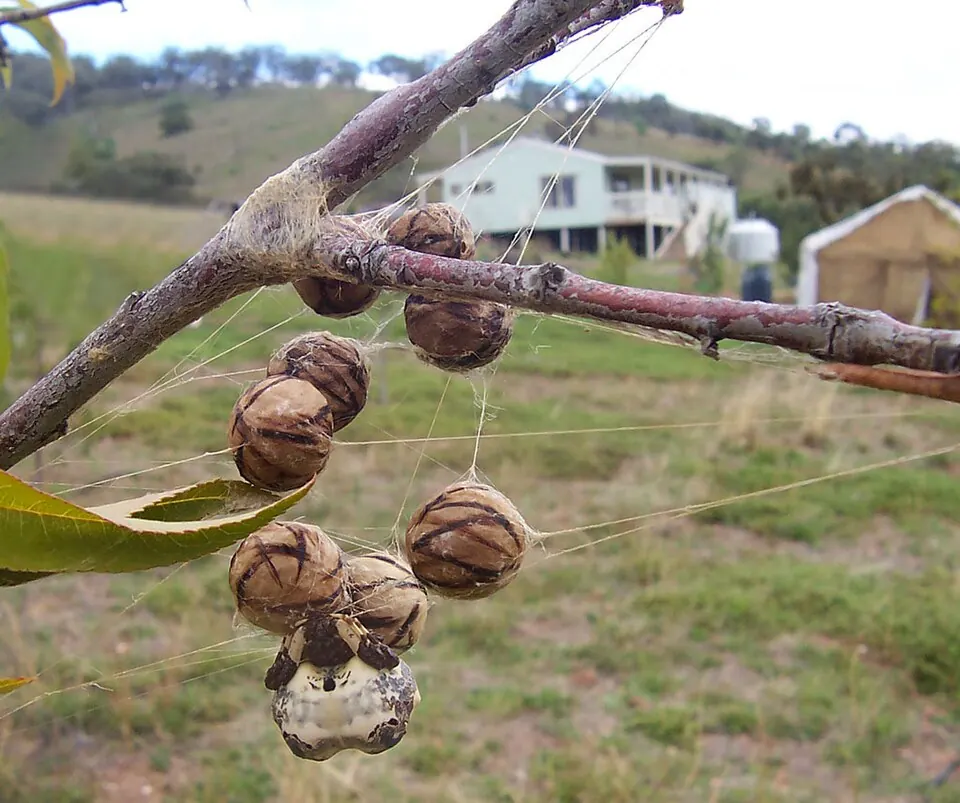
- Large marbled brown spherical egg sacs, often clustered above a resting female
- At night, hangs from short silk with front legs open and grabs moths rather than using a capture web
What to check next
Photograph the abdomen directly above and from the side, include folded-leg posture and any egg-sac cluster, and record body length without legs. Do not identify from a bird-dropping impression or round brown sacs alone.
When to seek medical help
Australian Museum and Museums Victoria do not consider the bite dangerous; a local reaction such as pain, redness, swelling, burning or itching remains possible. No useful species-specific Australian bite series was found, so “low risk” is not a guarantee and handling is unnecessary. For a witnessed minor bite, wash the area and use a cold pack for pain. Call the Poisons Information Centre on 13 11 26 if symptoms concern you, seek medical advice for severe or persistent pain, worsening swelling or illness, and call 000 for collapse, breathing difficulty or anaphylaxis. If the animal was actually a large dark funnel-web or mouse spider, follow emergency pressure-immobilisation advice and call 000 rather than applying this minor-bite guidance.
Where it is usually seen
Foliage in open woodland, dry sclerophyll forest, orchards, agricultural edges and suburban gardens. Museum sources place it across eastern and southern Australia, south-western mainland areas and Tasmania, with occasional central records including near Uluru.