Spider Identifier AustraliaBrowse spiders
Darling Downs funnel-web spider

Hadronyche infensa

Darling Downs Funnel-Web Identification: H. infensa

Medically important ground-dwelling Hadronyche from south-eastern Queensland and upper north-eastern NSW; dark funnel-web shape and region can support, but not prove, the exact species.

Medical emergency — call 000 for suspected bite

About the Darling Downs funnel-web spider

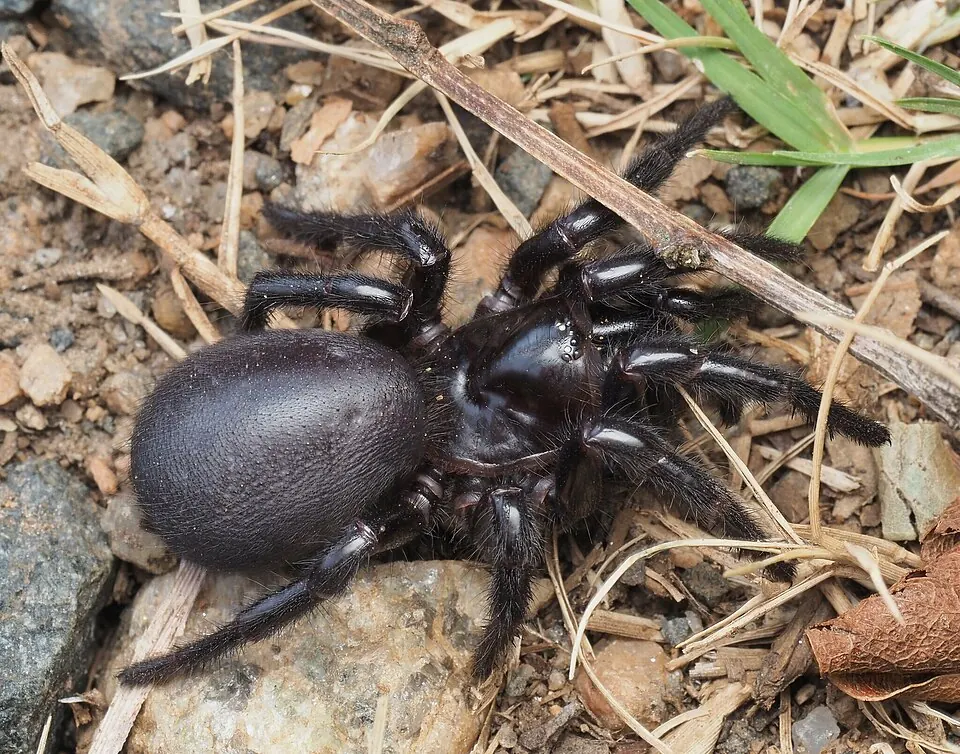
The Darling Downs or Toowoomba funnel-web, Hadronyche infensa, is a medically important Australian funnel-web spider documented from south-eastern Queensland into upper north-eastern New South Wales. The common name is therefore a regional label, not a rule that every specimen comes from the Darling Downs. Look first for the funnel-web group: a robust dark spider with a glossy, mostly unpatterned carapace, powerful parallel-moving jaws, closely grouped eyes and conspicuous rear spinnerets, associated with a silk-lined ground retreat or a wandering encounter. Exact H. infensa identification usually depends on locality and microscopic adult anatomy; a photograph of a “big black spider” cannot safely exclude another funnel-web, mouse spider or trapdoor relative. Any suspected bite is a medical emergency regardless of how well the photograph matches.

How to identify Hadronyche infensa safely

Start at family level. Australian funnel-web spiders have a compact mygalomorph build, a hard glossy carapace without an obvious dorsal pattern, a softer hairier abdomen, powerful jaws that strike downwards in parallel, and four rear spinnerets. The largest posterior pair has a terminal segment longer than it is wide. The eight eyes form a relatively tight cluster above the jaws rather than spreading broadly across the front of the carapace as in mouse spiders. Gray’s 2010 revision measured the described H. infensa male at about 20.6 mm and the described female at about 27.6 mm in body length, excluding legs; these individual type measurements are useful scale, not a complete population range. H. infensa itself cannot normally be confirmed from these field characters. The revision separates adult males from close Hadronyche species using details of the mating organ, leg spines and other measurements that require an expert and magnification. Use the exact species only when the overall funnel-web form, documented regional range and specialist evidence agree.

Clues that are not enough on their own

  • Black or glossy colour alone, because funnel-webs, mouse spiders and other mygalomorphs can share it
  • Being found in Toowoomba or the Darling Downs without seeing diagnostic anatomy
  • A silk-lined hole without a clear view of the resident spider; several unrelated burrow spiders use silk
  • A pool, bathroom or wet-weather encounter, which can involve many wandering ground spiders
  • A single online photograph matched by colour while the eyes, spinnerets, body proportions and locality are missing

Colour, sex and life-stage variation

Colour is less dependable than structure. A mature H. infensa may appear glossy black, dark chocolate or reddish brown depending on age, moisture, reflected light and camera exposure. The carapace is usually shinier than the abdomen; the abdomen can look charcoal, velvety or brown and may carry a small pale patch near its front in some specimens. Females are generally broader and remain closely associated with a retreat. Mature males are usually leggier, slimmer through the abdomen and have enlarged palpal bulbs; they are the sex more often noticed wandering. Juveniles can be distinctly browner and lack an adult’s heavy black appearance. Both licensed photographs retained here are source-labelled exact H. infensa: the hero was photographed in Australia and the second shows a young brown individual. They illustrate genuine variation, not a colour key. Two former gallery images were removed from this profile because one was only a generic museum funnel-web specimen and the other was H. versuta, the Blue Mountains funnel-web.

Behaviour, web and retreat

H. infensa is a ground-associated funnel-web rather than a tree-retreat specialist. Like other atracid funnel-webs, the resident spider uses a silk-lined tubular retreat in sheltered soil or beneath a protective object. Irregular silk trip lines extending from the entrance transmit the vibrations of insects; this is not a neat circular web and the spider may remain invisible deep inside. Females and juveniles are usually retreat-bound, while a mature male can leave shelter to search for a mate and appear on open ground, in a building or in a pool. Rain, humidity and darkness can coincide with funnel-web wandering, but an indoor or wet-weather encounter does not establish the species. Never probe the retreat, lift surrounding material, pour water into it or place fingers near the silk to make the spider emerge. A motionless spider removed from water should still be treated as alive.

Australian distribution

The taxonomic revision records H. infensa from south-eastern Queensland to upper north-eastern New South Wales. Its type male and female came from Toowoomba, while examined material included Queensland localities such as Bellthorpe, Buderim, Imbil, Maleny, Montville, Nambour, Toowoomba and the ranges west and north of Brisbane, plus Tenterfield and Tooloom in NSW. Confirmed clinical cases have also been reported from coastal south-east Queensland. This broader evidence is why the profile includes both Queensland and NSW. The label Darling Downs funnel-web, and the alternative clinical name Toowoomba funnel-web, should not be used to exclude a record elsewhere in the documented range. Conversely, a dark spider found anywhere in those states is not automatically H. infensa. Retain an approximate locality, date, habitat and several untouched photographs for a museum, arachnologist or wildlife authority; never sacrifice emergency response or personal safety to obtain an exact coordinate or specimen.

What to do if you find one

Keep people and pets clear and do not touch, corner or deliberately provoke the spider. If nobody has been bitten, take a zoomed photograph only when it can be done without moving closer, and close off the immediate area if the spider is indoors. A licensed pest professional or appropriate local wildlife service is safer than attempting bare-handed relocation. Do not dig out a burrow for identification. A container-and-card capture should be considered only by a confident adult when hands can remain well away and there is no risk; leaving the spider and isolating the area is preferable. If a bite may have occurred, stop all capture and photography attempts, call 000, keep the person still and begin pressure immobilisation. Do not wait for sweating, vomiting, breathing difficulty or other systemic signs. The 2005 systematic review recorded severe envenoming in 2 of 14 eligible confirmed H. infensa bites used for its species-rate calculation, with wide uncertainty; that research demonstrates real risk but cannot predict the outcome of an individual bite.

Compare with similar spiders

Use body shape, web or retreat, location and behaviour together before settling on a likely match.

  • Australian funnel-web spiders — Australian funnel-web spiders - use the broader atracid page when the glossy carapace, compact eye group, strong jaws and longer spinnerets fit but specialist evidence cannot establish H. infensa. This is the correct outcome for many photos.
  • Northern tree funnel-web spider — Northern tree funnel-web spider - Hadronyche formidabilis overlaps in south-eastern Queensland and north-eastern NSW, but is a larger tree-retreat specialist associated with trunks, stumps and elevated timber cavities. A ground encounter alone cannot safely separate wandering males.
  • Mouse spider — Mouse spider - Missulena is also dark, robust and medically significant, but usually has an especially broad bulbous head, eyes spread more widely across the front and shorter spinnerets. Do not approach a live spider to check these differences; the same emergency response applies to a suspected bite.
  • Trapdoor spider — Trapdoor spider - many trapdoor and wishbone spiders are browner, hairier or dustier and may have shorter spinnerets, but they can overlap strongly in body shape and burrow setting. A photo or empty burrow may justify only a large-mygalomorph result, never casual handling.

Sources for this profile

These accessible authoritative sources support the identification and bite-safety context on this page.

Profile review

Published by Spider Identifier Australia. Last factual review: 10 August 2026.

Quick identification

  • Robust dark mygalomorph body with a glossy, mostly unpatterned carapace
  • Small eyes grouped closely above the jaws and elongated rear spinnerets, visible only from a safe photograph
  • Silk-lined ground retreat with trip lines, or a wandering spider near sheltered soil
  • South-eastern Queensland to upper north-eastern NSW; the name Darling Downs does not define the whole range
  • Photo-level match cannot prove H. infensa; treat any suspected bite as an emergency

What to check next

From a safe distance, photograph the whole upper surface and rear of the abdomen, then record body length, exact locality, date and whether a silk-lined ground entrance or trip lines were present. Do not approach or handle the spider to inspect its eyes, jaws or spinnerets.

When to seek medical help

Treat a suspected bite as a medical emergency. Call Triple Zero (000) and ask for an ambulance, lie the person down and keep them still. Apply an elasticated pressure-immobilisation bandage over the bite and then over the whole bitten limb, and splint the limb, if you can do so safely; mark the bite site, note the time and wait for the ambulance. Do not delay first aid to photograph, catch or identify the spider. Healthdirect applies this advice to funnel-web bites and bites from any big black spider. Published confirmed H. infensa bites include severe envenoming, so the absence of early symptoms or uncertainty about the species must never be used as reassurance.

Where it is usually seen

Silk-lined ground retreats in sheltered soil, commonly around forest, woodland, gardens, rocks, logs, roots and other cool protected sites within south-eastern Queensland and upper north-eastern NSW. A wandering mature male may be found away from a burrow, including around buildings or pools.

Still not sure?

Compare this spider with more clues

Spider lookalikes can be close. Compare size, web, hiding place and state before handling anything.