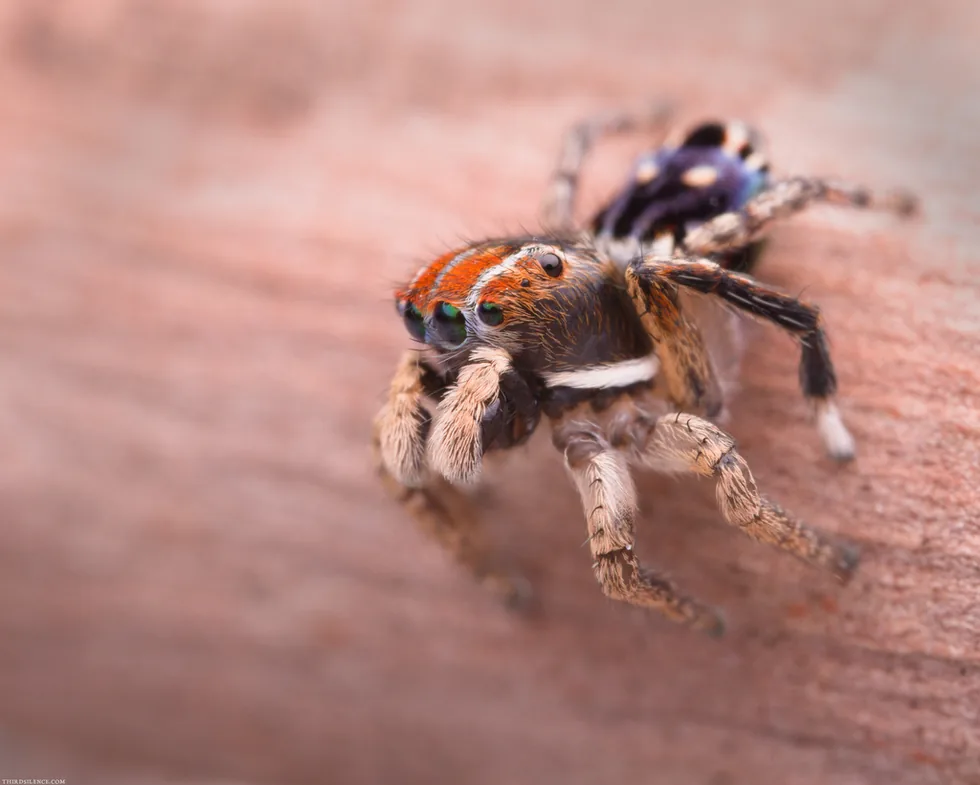
Maratus harrisi
Harris’s Peacock Spider Identification: Maratus harrisi
Tiny south-eastern Australian peacock spider whose adult male has two ivory abdominal patches, iridescent blue-purple scales and greenish folding display flaps.
Usually low riskThis page keeps the familiar “eastern peacock spider” route, but the accepted species is Harris’s peacock spider, Maratus harrisi—not a vague harrisi group. It is a minute Australian jumping spider first described from a single male collected at Booroomba Rocks in Namadgi National Park, south of Canberra. Start with jumping-spider structure: a compact body, very large forward-facing principal eyes, alert stop-start movement and short accurate jumps, with no prey-catching web. A mature male adds the strongest species clues: a broad folding abdominal fan with two raised ivory-white patches, an iridescent blue to purple central field, red-orange and black markings, olive-green side flaps and an elongated third pair of legs with white tips. Females and juveniles are much plainer and are not safely identified from colour alone. Current Australian Faunal Directory evidence places the species in the ACT, New South Wales, Tasmania and Victoria.
Quick identification
- Minute jumping spider; the described adult male is only 4.8 mm long
- Large forward-facing eyes, compact body and alert short hops rather than a capture web
- Adult male fan has two conspicuous ivory patches over an iridescent blue-purple field
- Olive-green folding side flaps, black and red-orange marks, and white-tipped elongated third legs
- Supported range is the ACT, New South Wales, Victoria and Tasmania; female or juvenile photos usually need expert review
What to check next
Use a safe macro photograph of the whole upper surface with a ruler or familiar object in the same plane, then record locality, date, microhabitat and whether the abdomen was folded or raised. For an adult male, compare the two ivory patches and complete fan pattern—not blue colour alone. Do not disturb a spider to force a display.
When to seek medical help
Harris’s peacock spider is not regarded as medically significant, but “low risk” does not mean a bite is impossible or that every tiny jumping spider has been identified correctly. Avoid handling. For an ordinary minor spider bite, healthdirect advises washing the area with soap and water and using a cold pack for pain or swelling. Seek medical advice if pain is severe, symptoms spread, the wound worsens, or the person is unwell; call Triple Zero (000) for breathing difficulty, collapse or another severe reaction. Do not use this page to assess a medically important dark spider.
Where it is usually seen
Ground-layer vegetation, leaf litter, twigs, boulders, low heath and open rocky sites in south-eastern Australia. Published Tasmanian records include alpine and subalpine boulder-heath around Barn Bluff and flowering shrubs near Mount Wellington, while current licensed photographs also document lower-elevation Victorian and NSW encounters.