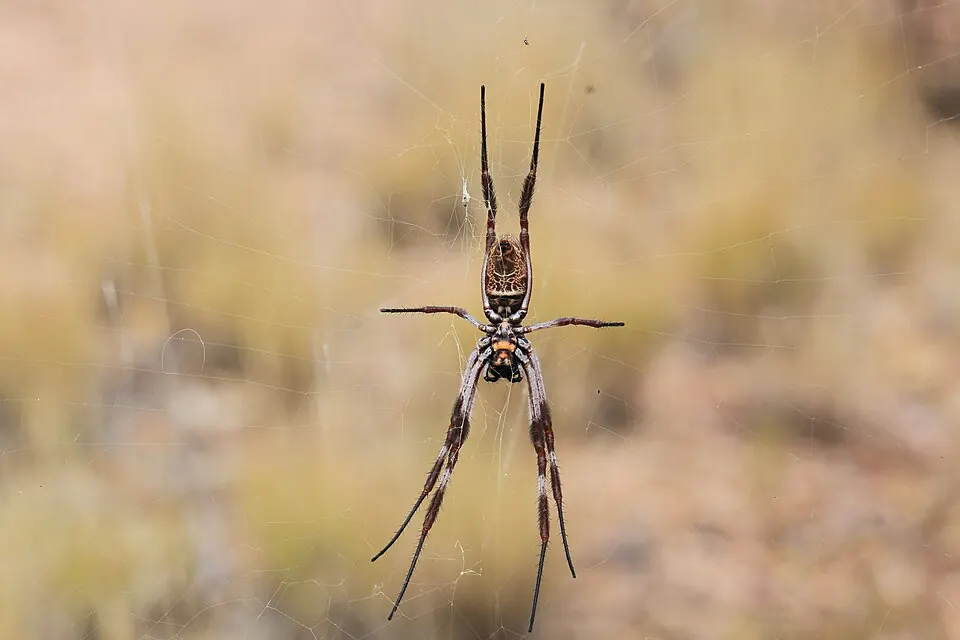
Trichonephila edulis
Edible Golden Orb-Weaver Identification Australia
Large golden-orb spider of inland and southern Australia, with a long silvery to plum abdomen, banded dark legs and a strong golden web.
Usually low riskAbout the Edible golden orb-weaver
The Edible golden orb-weaver is the Australian species Trichonephila edulis (Labillardiere, 1799), an araneid golden orb-weaver that older books and photographs often call Nephila edulis. The name is a reminder that common names and historical labels are not identification tests. A large female in a strong golden web is a useful starting point, but the closest Australian golden-orb species can overlap in colour, size and web setting.
This page is a cautious field guide rather than a formal determination. Start with the whole scene: the spider's body without the legs, the web supports, the light, the locality and whether a much smaller male is present. Keep the broader golden-orb group label when a photograph does not show enough detail.
How to identify the Edible golden orb-weaver cautiously
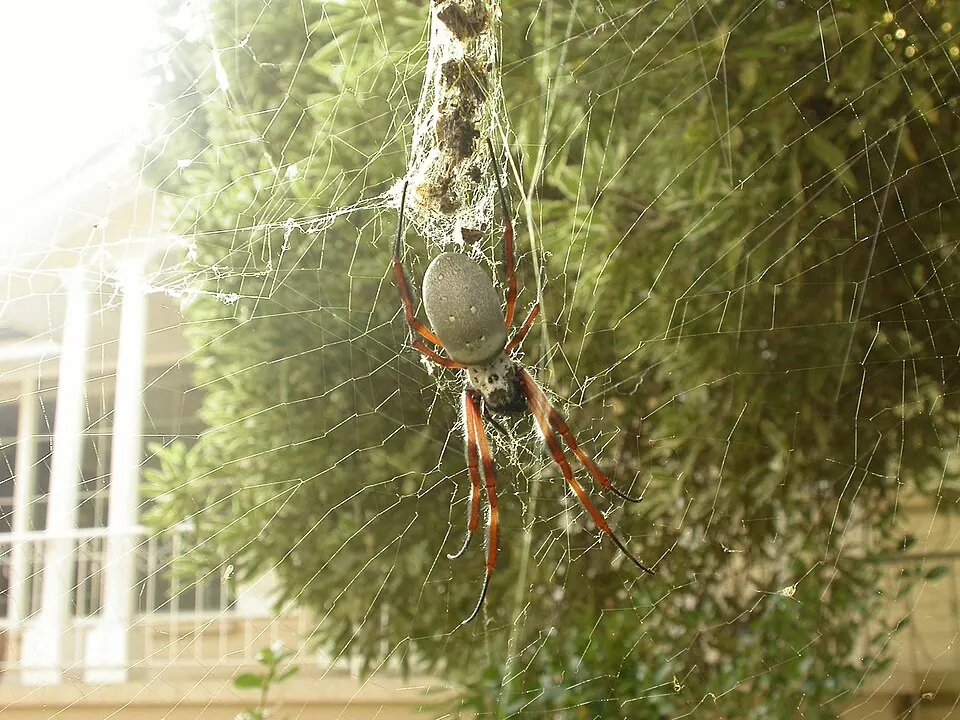
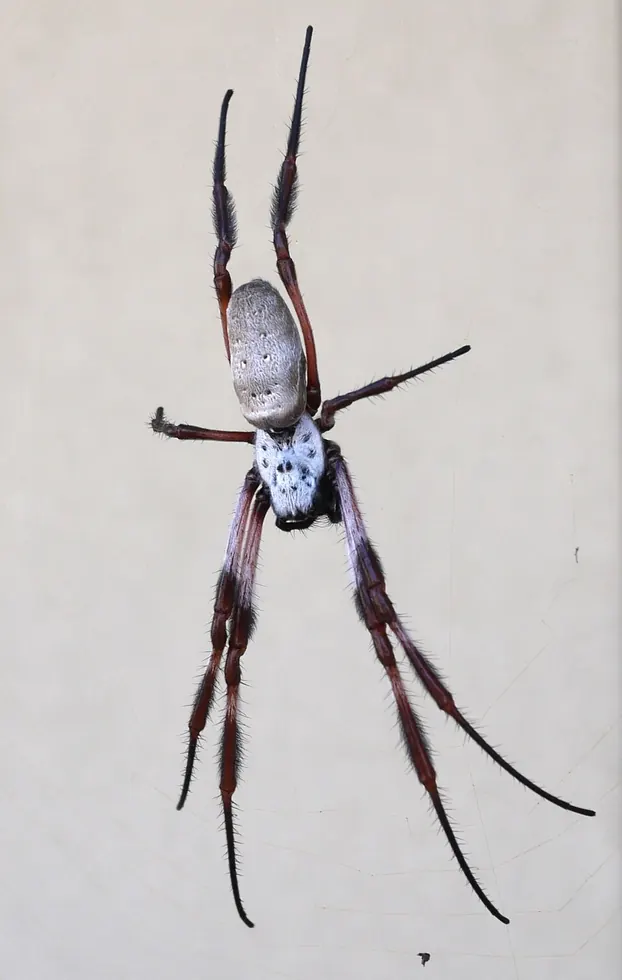
A typical adult female has an elongated silvery-grey, brown or plum abdomen, a dark cephalothorax with pale hairs and long legs that are dark around the joints with paler or yellowish bands. The body can be roughly 24–40 mm in different field and museum accounts, while the male is only about 6–7 mm and may sit around the frame or outer edge of the female's web. The combination of a large persistent golden orb, an inland or southern Australian setting and this long body shape is more useful than any one colour patch.
The underside matters when separating T. edulis from the Humped golden orb-weaver, T. plumipes. The latter is associated with a raised sternum knob and often stronger yellow-banded leg clues, but an underside view is rarely available in a safe field photograph. Do not turn a spider over, pull apart its web or call a species from a cropped dorsal image. A likely match is the honest result when the web, body and locality do not line up clearly.
Clues that are not enough on their own
- A golden-looking web: sunlight, camera white balance and silk age can change the colour.
- A large spider in a round web: several orb-weavers overlap in body scale and posture.
- A silver, brown or plum abdomen: maturity, wear and lighting create broad overlap.
- Dark legs with pale bands, a coin-size estimate or a tiny spider beside the female.
- An inland, coastal or garden location without an exact locality and whole-web view.
- The word “edible” or an older Nephila label copied from a guide.
Colour, sex and life-stage variation
Sexual size dimorphism is extreme. The female is the familiar spider suspended near the hub, while a male can look like a small spiderling or a piece of debris until the camera shows the web frame. Females may shift from pale silver or grey to warmer brown or plum tones as they mature. Juveniles and worn adults can lack the strongest band contrast. A small male is supporting context, not proof that the female is T. edulis; related golden-orb species use the same general arrangement.
Field sources also disagree slightly on maximum body measurements because some use preserved specimens, some use live females and some count only the abdomen. Record the body length separately from leg span and keep the source and method with any observation.
Behaviour, web and retreat
The female makes a large, strong orb web between trees, shrubs, fences and other firm supports. The silk often shows a golden sheen in good light. Barrier and support threads can make the structure look deeper than a simple wheel, and a string of prey remains or debris may hang in the web. The web is normally repaired rather than dismantled and rebuilt every night. The female rests head-down near the hub; tiny males often wait on the outer web and may approach when she is feeding.
Kleptoparasitic Argyrodes spiders can share a golden-orb web, and egg sacs are made in sheltered vegetation later in the season. These are useful natural-history clues, not safe reasons to feed, provoke or test a spider. Do not flick the web, walk through it or touch the silk to see how strong it is.
Australian distribution
The World Spider Catalog accepts Trichonephila edulis and records the species from Australia, New Guinea, New Caledonia and New Zealand. Australian Faunal Directory and Atlas of Living Australia records support a broad Australian occurrence. Queensland Museum material describes it as the common golden orb-weaver inland of the Great Dividing Range and in drier areas, including Tasmania. This page therefore keeps a broad mainland-and-Tasmania discovery filter while treating state presence as a search prompt, not proof of identity.
In wetter eastern coastal sites, T. plumipes and other golden-orb species can overlap. Record the exact locality, season, web setting, body length without legs and several views before making a range claim. A photograph from a familiar region is still only one piece of evidence.
What to do if you find one
Observe from the side of the web and leave the spider, silk and surrounding vegetation undisturbed. Photograph the whole web first, then a dorsal view and, only when it is naturally visible, a side or underside view. Include the support plant, wall or fence and a familiar scale object without touching the spider. Keep fingers out of dense vegetation and use gloves before gardening.
Golden orb-weavers are not usually considered dangerous, but avoid handling any spider. For a suspected bite, follow symptoms rather than a photo label: call 000 for breathing difficulty, collapse or severe rapidly worsening symptoms, and call the Poisons Information Centre on 13 11 26 for Australian advice. Persistent, spreading, allergic or uncertain symptoms deserve medical attention.
Compare with similar spiders
- Golden orb-weaver group — use the broader group page when the female is cropped, the web is distant or the locality is unclear.
- Humped golden orb-weaving spider — compare underside sternum, leg pattern and eastern-coastal context, not web colour alone.
- Garden orb-weaver — compare abdomen, web supports and resting posture before assuming every large garden orb web is Trichonephila.
- Silver orb-weaver — smaller pale spiders and fine orb webs can resemble a young golden orb-weaver from a distance.
Exact-species images and licence notes
Sources for this profile
- World Spider Catalog: Trichonephila edulis
- Atlas of Living Australia: Trichonephila edulis
- Australian Museum: Golden orb-weaving spiders
- Museums Victoria: Nephila edulis
- Queensland Museum: Golden orb-weavers fact sheet
- Lucid Central: Nephilinae
- Friends of Queens Park Bushland: Trichonephila edulis
- Wiley: Sperm competition in Nephila edulis
- healthdirect: Spider bites
Profile review
Reviewed 14 August 2026. Taxonomy, range language, comparison links and image licences were checked against the sources above. This page offers likely possibilities from visible clues; it is not a formal identification or medical diagnosis.
Quick identification
- Large female with an elongated silvery-grey, plum or brown abdomen
- Long dark legs, often with yellow or paler bands at the joints
- Large strong orb web with a noticeable golden sheen
- Inland or southern Australian location supports this species, but overlap with other golden-orb spiders means close photographs may be needed
What to check next
Confirm the large golden web and elongated body first. Compare with the humped golden orb-weaving spider: a clear underside view may be needed for a confident species distinction, so keep the identification at golden-orb level when the photo does not show enough detail.
When to seek medical help
Golden orb-weavers are not usually considered dangerous. Avoid handling; wash a suspected bite and seek medical advice for severe or persistent pain, allergic symptoms, spreading symptoms or uncertainty.
Where it is usually seen
Dry open forest, woodland, coastal scrub, mangroves, gardens and other openings between vegetation across much of mainland Australia, with Trichonephila edulis particularly associated with inland regions.