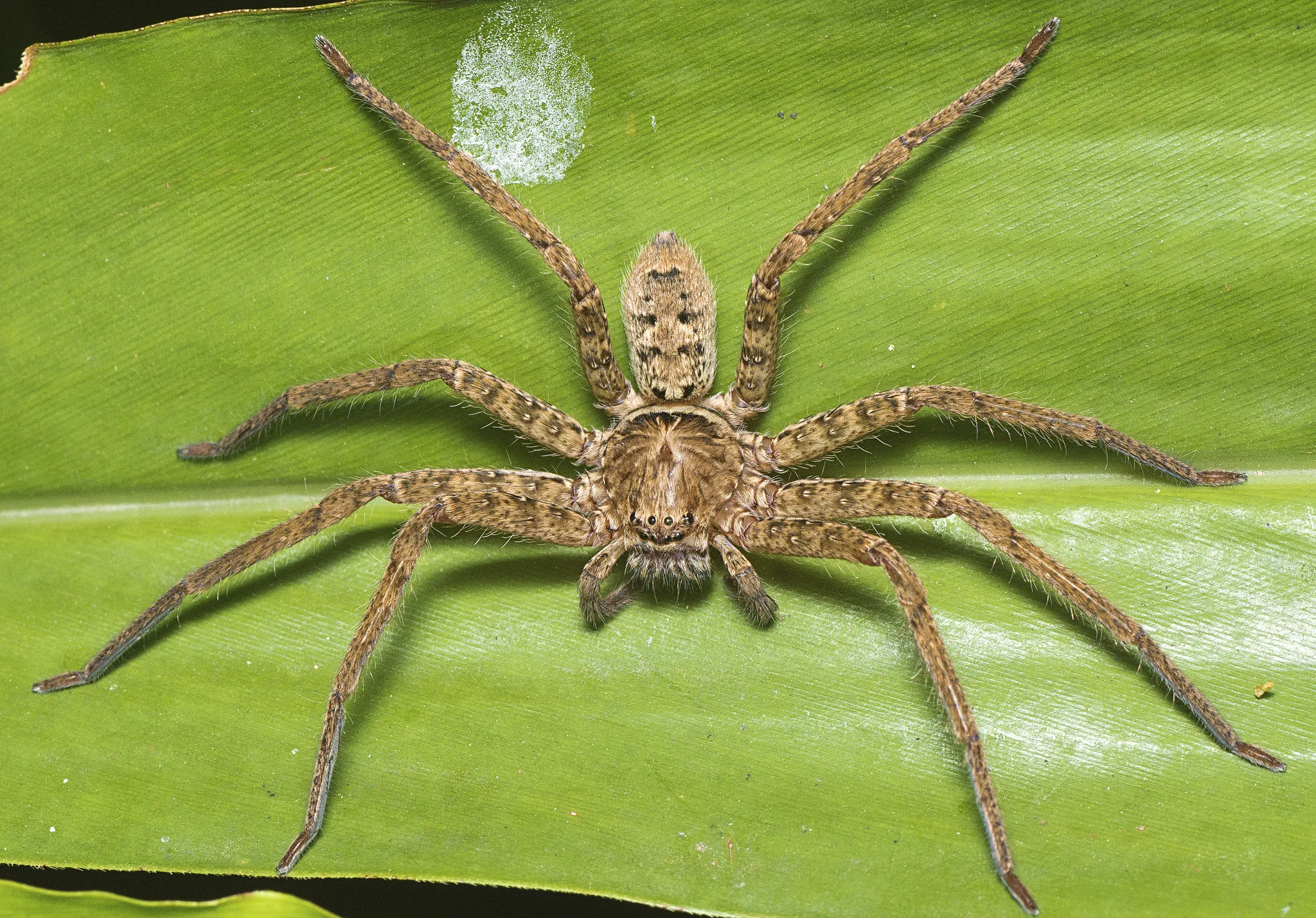
Heteropoda jugulans
Jungle Huntsman Spider Identification Australia
Large mottled Queensland huntsman with dark carapace and abdominal markings, active at night on bark, foliage and buildings; exact identification often needs adult anatomy.
Usually low riskThe jungle huntsman, Heteropoda jugulans, is a large brown Australian huntsman most securely documented from Queensland. A likely field match combines the flattened laterigrade huntsman stance, mottled legs, dark X-like carapace marking, paired dark abdominal chevrons and—when safely photographed—a dark V-like mark beneath the abdomen. Colour and a Brisbane address are not enough: Australia has many Heteropoda, and the defining adult palp or epigyne characters require close expert examination. The Australian Faunal Directory and World Spider Catalog currently restrict the accepted distribution to Queensland, even though Atlas occurrence data contains many New South Wales records. This page preserves New South Wales as a cautious recorded-occurrence filter, not a claim that every southern photograph is taxonomically confirmed.
Quick identification
- Flattened huntsman body with long legs spreading forward and sideways
- Brown-to-grey mottling, often with a dark X-like mark on the carapace and chevrons on the abdomen
- Dark V-like ventral abdominal marking can support the match when clearly photographed
- No prey-catching web; nocturnal hunter sheltering beneath bark or in crevices by day
- Queensland locality is the strongest accepted-range clue
What to check next
Take a natural-light dorsal photograph, a non-contact underside view only if the spider exposes it naturally, and a wider image of its retreat. Measure body length without legs and record locality. Use “Heteropoda species” if the X, chevrons, underside mark or adult characters are unclear.
When to seek medical help
No useful species-specific Australian bite series was found for Heteropoda jugulans. Australian Museum says huntsmans are not considered dangerous and usually try to escape, although any large huntsman can bite defensively if trapped or handled. For a witnessed minor spider bite, healthdirect advises washing with soap and water and applying a cold pack for pain. Seek medical advice if pain is severe or does not settle within a few hours, if swelling or itching worsens after 24–48 hours, or if you are worried; call the Poisons Information Centre on 13 11 26 for advice. Call 000 for collapse, breathing difficulty or anaphylaxis. Treat a suspected funnel-web bite as a separate emergency.
Where it is usually seen
Rainforest, scrubland and other forested Queensland habitats, especially beneath loose bark, on trunks and foliage, in litter and narrow crevices. It also enters houses, sheds, letterboxes and other sheltered structures while hunting at night. Aggregated occurrence data extends down the east coast, but accepted taxonomic sources remain Queensland-only.