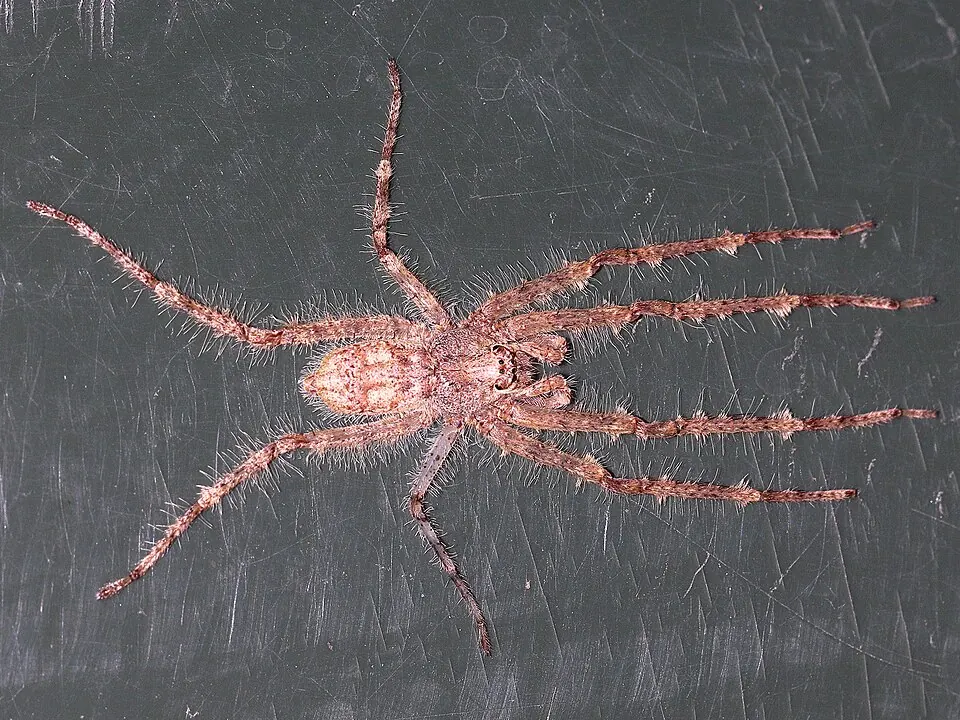
Pandercetes gracilis
Lichen Huntsman Spider Identification Australia
A small, exceptionally camouflaged north Queensland huntsman that rests exposed on lichen-covered rainforest trunks and can accelerate sideways in an instant.
Usually low riskAbout the Lichen huntsman spider
The Australian lichen huntsman is Pandercetes gracilis, a Queensland species whose mottled surface and uneven hairy outline can disappear against bark and lichen. Identification depends on seeing a small huntsman body, sideways-spreading legs, trunk-resting behaviour and intricate disruptive camouflage together—not merely finding a grey spider on a tree.
How to identify a lichen huntsman spider
First confirm the huntsman body plan. The body is flattened and the leg joints are rotated so the legs spread forwards and sideways in a crab-like stance. Pandercetes gracilis is small for a huntsman: a specialist Australian husbandry guide reports a body around 15 mm and a leg span around 50 mm. Its strongest clue is three-dimensional disruptive camouflage. Fine mottling resembles patches of grey, cream, brown or green lichen, while clustered hairs and small fringes interrupt the edges of the body and legs. On a matching trunk the outline can be harder to see than the markings. Look for the spider resting openly against bark without a prey-catching web. A top-down photograph should show the flattened profile and laterigrade legs; a side-lit image may reveal the uneven hair tufts. These combined clues can support P. gracilis in Queensland, but colour alone cannot.
Clues that are not enough on their own
- Grey, green or mottled colour by itself, because many bark-dwelling spiders use similar camouflage
- A spider sitting on a tree, which does not prove Pandercetes or even the huntsman family
- Sideways legs without the small size, dense lichen-like texture and Queensland rainforest context
- A very large leg span estimated from a close photograph with no scale
Colour, sex and life-stage variation
The apparent colour changes with the bark, lichen, light and camera white balance. Some individuals look pale grey and crusted, others brown, greenish or strongly speckled, so matching one online photograph is unreliable. Juveniles are smaller and can resemble textured bark spiders from other families. Mature males tend to be slimmer and longer-legged and have enlarged palpal bulbs, while females are fuller-bodied. The Australian checklist currently recognises P. gracilis as the Australian Pandercetes species, but an ordinary photograph still needs the Queensland range and complete camouflage pattern before the species name is used confidently. The exact-species hero photograph was taken in Cairns, Queensland and is licensed for reuse.
Behaviour, web and retreat
Lichen huntsmans are visual ambush hunters and do not build an orb, sheet or tangled capture web. The Australian Museum records one waiting motionless on a Daintree tree trunk and describes the species as exceptionally fast. When prey or danger approaches, it can accelerate forwards or sideways across the bark, using the huntsman leg arrangement to change direction rapidly. Fine sensory hairs detect air movement, while thicker clustered hairs contribute to camouflage. Remaining still is therefore part of both hunting and concealment, not evidence that the spider is dead. A cast skin may also cling to bark after moulting; check for an open carapace and hollow legs before treating it as a live spider.
Australian distribution
The Australian Faunal Directory accepts Pandercetes gracilis and lists Queensland as its only state entry, with a male type specimen from Port of Mackay. The Australian Museum field record is from Daintree National Park at Cape Tribulation, and the exact-species page image was photographed in Cairns. This evidence supports a north and north-eastern Queensland rainforest profile, not the previous Australia-wide state selection. Records from outside Queensland should be documented carefully and left at huntsman-family level unless confirmed by an arachnologist. Record the locality, date, tree surface and body length without legs so the observation can be assessed properly.
What to do if you find one
Leave the spider on its trunk when practical. Its camouflage is habitat-specific, and removing bark or scraping lichen to expose it damages the microhabitat and may injure the spider. Photograph the whole trunk first, then approach slowly for a dorsal view; sudden movement may make it sprint out of sight. Do not test its speed or prod it for a photograph. If it enters a building, cover it with a wide container, slide stiff card underneath and release it onto a sheltered tree trunk nearby without direct handling. An egg sac or cluster of spiderlings should be left undisturbed. After a suspected bite, follow current Australian health guidance and respond to symptoms rather than relying on a photo identification.
Compare with similar spiders
Use body shape, web or retreat, location and behaviour together before settling on a likely match.
- Huntsman spider — Huntsman spider - the family page is the safer result when a photograph shows sideways legs but not the lichen-like hairs or Queensland trunk setting. Many huntsman genera are larger, smoother or more strongly banded.
- Grey huntsman spider — Grey huntsman spider - can be grey and flattened, but usually has a smoother outline and ordinary mottling rather than dense crustose-lichen texture and fringed edges. Location and a sharp dorsal photograph matter.
- Flattened bark spider — Flattened bark spider - also presses close to bark, but its legs do not have the broad huntsman stance and its body is usually smoother and more ground-spider-like. Confirm the leg orientation before choosing a family.
- Two-tailed spider — Two-tailed spider - is another flat, fast bark specialist, but it has two extremely long rear spinnerets that project like tails. Pandercetes lacks those paired abdominal projections and has a broader huntsman stance.
Sources for this profile
These accessible authoritative sources support the identification and bite-safety context on this page.
- Australian Faunal Directory: Pandercetes gracilis
- Australian Museum: Huntsman Spiders
- Australian Museum: Lichen Huntsman field record
- Minibeast Wildlife: Pandercetes gracilis care guide
- healthdirect: Spider bites
Profile review
Published by Spider Identifier Australia. Last factual review: 10 August 2026.
Quick identification
- Small, flattened huntsman body with legs spreading forwards and sideways
- Dense grey, brown, cream or greenish mottling that resembles crustose lichen
- Tufts and fringes of hair that break up the smooth outline of body and legs
- Resting exposed and motionless on a rainforest tree trunk rather than hidden in a web
- Queensland location, especially humid north-eastern rainforest
What to check next
Take one photograph from directly above and another wider image showing the whole trunk. Confirm the laterally spread huntsman legs, small body, irregular hairy outline and Queensland rainforest setting. A blurred mottled spider may support only a huntsman-family identification.
When to seek medical help
The Australian Museum describes this species as harmless to humans, but any spider can bite if trapped or handled. For a suspected bite, wash the area and use a wrapped cold pack for local discomfort. Seek medical advice if pain is severe, symptoms persist or worsen, swelling or itching increases, or you are worried. Call Triple Zero (000) for breathing difficulty, collapse or other signs of anaphylaxis.
Where it is usually seen
Exposed lichen-encrusted tree trunks in humid rainforest and nearby wet forest in Queensland, especially the tropical north-east. AFD lists Queensland and records the type locality as Port of Mackay; the Australian Museum documents the species at Daintree National Park, Cape Tribulation.