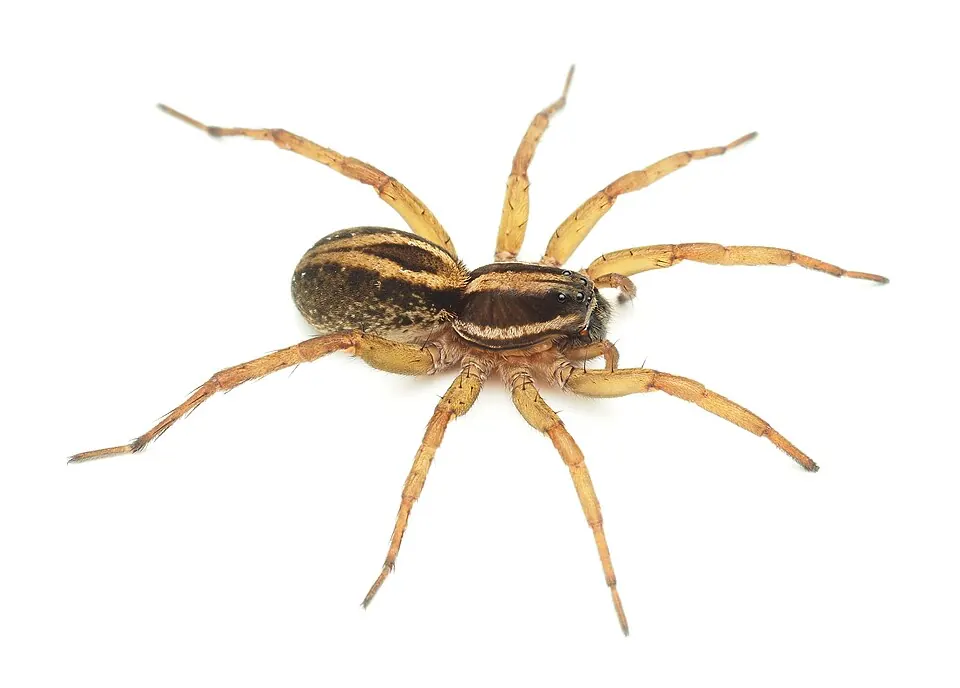
Venatrix furcillata
Little Striped Wolf Spider Identification in Australia
Black-brown Australian wolf spider with cream striping, ground-running hunting behaviour and a simple burrow entrance.
Usually low riskAbout the Little striped wolf spider
Little striped wolf spiders are active eastern Australian wolf spiders often noticed on lawns, garden paths, forest floors and bare ground. Venatrix furcillata is useful to compare when a compact black-brown ground spider has a pale central stripe, cream markings, strong forward-facing eyes and no capture web.
How to identify Venatrix furcillata cautiously
Begin with the wolf-spider body plan and keep the species name provisional. Venatrix furcillata is an accepted Lycosidae species in the genus Venatrix, with the older name Lycosa furcillata appearing in historical literature. The Australian Museum describes wolf spiders as ground hunters with eight eyes in three rows: four small eyes across the front and four larger eyes above in a square-like arrangement. In a sharp full-body view, the little striped wolf spider is black-brown with dull cream markings and lighter brown legs. The front body has a cream outline and a thick cream central stripe that can continue onto the abdomen, sometimes splitting into two lines near the rear. The stripe is a useful field clue, not a species diagnosis. Other Venatrix and unrelated lycosids can be brown, black, cream or patterned, and phone cameras can exaggerate pale bands. The eye arrangement, robust running build, complete body outline, locality and an unadorned ground burrow are more informative together. A blurred image, a lone cream line or a common-name match should remain a wolf-spider or Venatrix possibility rather than a confident exact species result.
Clues that are not enough on their own
- A single cream stripe used as proof, because markings vary and other wolf spiders can look similar
- A black-brown colour or estimated 5c-to-20c size from a photograph without a scale
- A lawn, garden, forest or indoor location treated as a species diagnosis
- A simple hole, absent web or night-time eye shine used to separate Venatrix species
- A female carrying spiderlings used to name this species rather than the wolf-spider family
- An online photograph or common name used without exact taxonomic identity and locality
Colour, sex and life-stage variation
Museums Victoria records adult body lengths of about 13 mm for females and 9 mm for males. These are body measurements that exclude the legs, and a photograph without scale can make a 9 mm male look much larger. Sex changes the silhouette: females are fuller-bodied, while mature males can look leggier and wander more widely while seeking females. Juveniles and freshly moulted spiders may have softer contrast, lighter legs or incomplete-looking stripes. Light, soil, dust, wear and flash also change the pattern. The central cream stripe can appear one band, two bands or a broken series, and the abdomen may show scroll-like or muted markings rather than a crisp stripe. Do not use a pale stripe alone to separate V. furcillata from garden wolf spiders, other Venatrix species or small ground hunters. The exact identity often depends on adult structures that are not safe or realistic to inspect on a live spider, so a good community record should preserve the image and locality for an arachnologist instead of forcing a species label.
Behaviour, web and retreat
This is an active hunting spider rather than a capture-web spider. It roams over lawns, garden paths, forest floor, woodland and grassland, using speed, eyesight and ambush to catch ground-dwelling invertebrates. Museums Victoria describes an agile, robust hunter that lives in a hole in the ground with an unadorned entrance. The Australian Museum likewise notes that wolf spiders are often found in lawns and gardens and may use simple retreats rather than aerial webs. Females carry a white egg sac attached to the spinnerets. After the spiderlings hatch, they ride on the mother until they can fend for themselves. That behaviour is characteristic of wolf spiders as a family but does not by itself prove V. furcillata. A burrow, a night-time ground encounter or eye shine is supporting context only. Do not put fingers, sticks or a camera lens into a hole to provoke the spider, and do not chase a fast runner across a path. Leave the retreat intact and photograph from a safe distance.
Australian distribution
The conservative field filters retain Queensland, New South Wales, Victoria and Tasmania. Museums Victoria gives south-east Queensland, New South Wales and Victoria, specifically excluding western Victoria in its field-guide account. The current World Spider Catalog lists Australia with Queensland, New South Wales, Victoria and Tasmania, so Tasmania is included as a supported catalogue range while the practical habitat description remains eastern and temperate rather than statewide certainty. A state filter is not a species proof. Venatrix furcillata was originally described from Brisbane, and the 2006 Venatrix revision discusses historical material from Queensland and Sydney as well as the limits of old type records. Other Venatrix species overlap across eastern Australia, and an observation outside the familiar south-east pattern should be recorded as Lycosidae or Venatrix until an expert checks it. Do not infer a precise suburb, reserve or western Victorian range from a generic online photograph.
What to do if you find one
Watch from a distance and photograph the whole spider, not only the pale stripe. Useful frames show the dorsal pattern, the front eye row if safely visible, the leg colour, body scale, ground surface and any unadorned burrow entrance. A ruler or coin should be placed beside the animal only if it can be done without approaching or disturbing it. Never hold the spider to expose the eyes or underside. If it is indoors, give it an escape route or use a container-and-card relocation only when that can be done without touching the animal. Keep children and pets away from burrows and garden edges where active wolf spiders may be encountered. This species is usually low risk, but any spider can bite if trapped. For a suspected bite, clean the area, use a wrapped cold pack for pain and seek medical advice if pain is severe or persistent, symptoms spread, an allergic reaction develops, or a funnel-web or mouse-spider bite cannot be ruled out. Follow current healthdirect advice rather than relying on a photograph.
Compare with similar spiders
Use body shape, web or retreat, location and behaviour together before settling on a likely match.
- Wolf spider — Garden wolf spider (Tasmanicosa godeffroyi) - usually a larger, more strongly grey-brown-and-white patterned ground hunter; compare the whole body and eye arrangement rather than a Union Jack-like mark alone.
- Garden wolf spider — Grey wolf spider - a broader field label for similar lycosids where the exact Venatrix or Tasmanicosa characters are not visible; safer than overcalling a species.
- Grey wolf spider — Australian Union-Jack wolf spider - another patterned Australian wolf-spider comparison; the pale cross-like pattern and range overlap do not replace adult examination.
- Australian Union-Jack wolf spider — White-tailed spider - a wandering ground spider can overlap in gardens and indoors, but its body plan and pale rear mark differ; do not use a fast runner or a pale spot alone.
Sources for this profile
These accessible authoritative sources support the identification and bite-safety context on this page.
- Australian Faunal Directory: Venatrix furcillata
- Atlas of Living Australia: Venatrix furcillata
- World Spider Catalog: Venatrix furcillata
- Australian Museum: Wolf spiders
- Framenau 2006: Revision of the wolf spider genus Venatrix
- Exact species photograph: Venatrix furcillata
- healthdirect: Spider bites
Profile review
Published by Spider Identifier Australia. Last factual review: 13 August 2026.
Quick identification
- Black-brown wolf spider with dull cream markings
- Cream outline and central stripe on the front body, often continuing onto the abdomen
- Fast ground hunter rather than a web sitter
- Found in south-east Queensland, New South Wales and Victoria, often near lawns, gardens, forest, woodland or grassland ground
What to check next
Check for the pale stripe, ground-running behaviour and no capture web. Compare with garden wolf spiders, generic wolf spiders and white-tailed spiders if the body stripe or tail mark is unclear.
When to seek medical help
This spider is not usually considered dangerous. Clean any bite, use a cold pack for pain, and seek medical advice for severe pain, allergic symptoms, infection signs, spreading symptoms or uncertainty.
Where it is usually seen
Lawns, gardens, forest floor, woodland, grassland, open ground, simple ground burrows and occasional indoor floors in south-east Queensland, New South Wales and Victoria.