Tetragnathidae
Long-Jawed Orb-Weaver Identification Australia: Tetragnatha
Extremely slender orb-weaver with an elongated body, long legs and jaws, usually associated with a small horizontal or steeply sloping web in vegetation.
Usually low riskAbout the Long-jawed orb-weaver
Long-jawed orb-weavers are members of the family Tetragnathidae, but the name is most often applied to Tetragnatha species. They combine an unusually long, narrow body with long legs and projecting jaws, and they build circular prey-catching webs that are commonly horizontal or strongly sloping rather than upright across a path. In daylight, a Tetragnatha may rest head-up on the web or stretch its legs in line with a twig, grass blade or strip of bark until its outline almost disappears. Use the body proportions, resting posture, web angle and locality together. A distant image of a skinny spider, or a web without the spider, cannot safely establish a species.
How to identify a long-jawed orb-weaver
Start with proportions rather than colour. In Tetragnatha, the abdomen is conspicuously long and narrow, the cephalothorax is slim, and the legs appear disproportionately long. The jaws, or chelicerae, project forward and may be obvious in a side or front view, although they can be hidden by camera angle. The Australian Museum groups these features together: elongated jaws, body and legs. Web architecture provides an independent clue. Its Sydney-region guide illustrates a small orb about 5-30 cm across, held horizontally or on a strong slope. Treat that as a useful regional web range, not a body measurement or a universal limit for every Australian tetragnathid.
Clues that are not enough on their own
- Long legs without a clearly elongated body and jaw region
- Being found near water, because many unrelated spiders use waterside vegetation
- Brown, green or silver colour viewed without the web
- Any circular web without checking whether it is horizontal, sloping or vertical
Colour, sex and life-stage variation
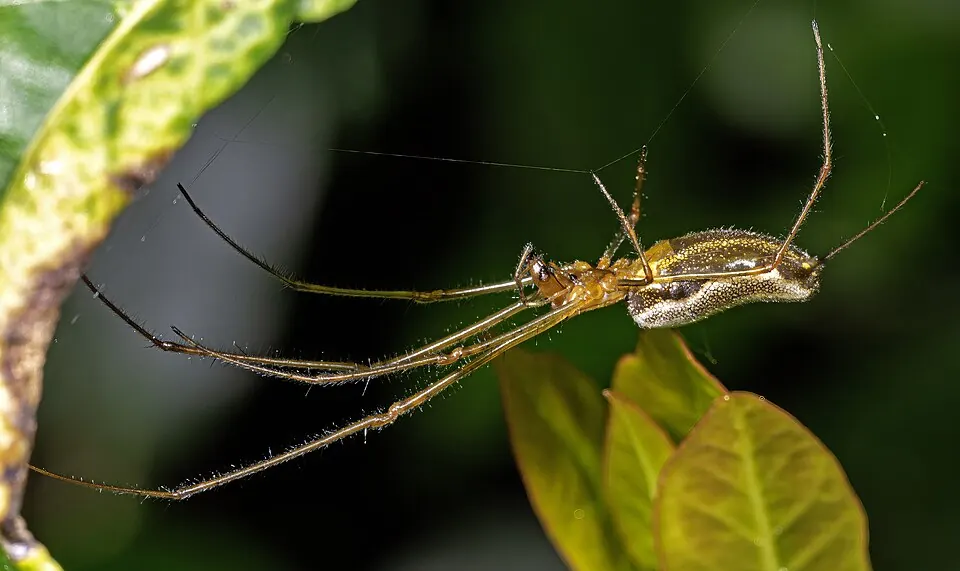
The family includes more than one Australian form, and colour may be brown, straw, greenish, grey, silver or patterned. Sex and maturity can also change the apparent jaw size, abdomen fullness and overall proportions. Some relatives in Tetragnathidae, including silver Leucauge orb-weavers, are broader and more brightly marked than the classic stretch-like Tetragnatha shape. The hero photograph here is an exact-genus Tetragnatha extensa female photographed in France. It demonstrates the elongated build and jaws, but T. extensa should not be inferred for an Australian sighting and its colour pattern is not an Australian identification template.
Behaviour, web and retreat
Long-jawed orb-weavers use an orb web to intercept small flying insects. The web is often low in vegetation and horizontal or distinctly inclined, so it can be missed when viewed straight down or after dew has evaporated. The Australian Museum notes that a Tetragnatha visible on a sloping web by day tends to face up-slope. Away from the hub it may press close to a twig or bark and extend its legs along the same line, producing the stretched resting posture behind another common name, stretch spider. Silk and posture matter more than whether the site is directly beside water: wet margins are common habitat, but a waterside location by itself is not diagnostic.
Australian distribution
The Australian Museum recognises Tetragnathidae as the long-jawed-spider family in the Australian fauna, and its Web2Spider guide documents Tetragnatha among Sydney-region web spiders. This family-level page does not mean every species occurs in every state or habitat, and a photograph ordinarily cannot establish that range. Record the exact suburb or region, date, vegetation and nearby water with the images. Those details can help an expert narrow the identification while preventing a European or other overseas image match from being applied uncritically to an Australian spider.
What to do if you find one
Leave the spider and web in place when practical; the web is catching small flying insects and usually poses no problem. For identification, photograph the web before approaching closely because its angle and diameter are easily lost after disturbance. Do not pull the jaws forward or handle the spider to check the name. If the web crosses a frequently used area, move an outer anchor strand with a long object while the spider is safely on vegetation, or wait until the web is unoccupied. After any suspected bite, follow current Australian health advice and judge urgency from symptoms rather than confidence in a photograph.
Compare with similar spiders
Use body shape, web or retreat, location and behaviour together before settling on a likely match.
- Garden orb weaver — Garden orb-weaver - usually has a broader, rounder abdomen and often builds a larger, more upright orb at night. Long-jawed spiders are markedly slimmer and their web angle and stretched posture are stronger clues.
- Silver orb weaver — Silver orb-weaver - Leucauge is also in Tetragnathidae and may share a small sloping web, but its abdomen is typically silvery with contrasting dark or yellow markings. Use a family-level result if the photograph does not resolve the body form.
- St Andrew's cross spider — St Andrew's cross spider - normally has a broader patterned abdomen, pairs its legs into an X at the centre of a more upright orb and may add a conspicuous silk cross. It does not have the same twig-like stretched profile.
- Golden orb weaver — Golden orb-weaver - female golden orb-weavers are much heavier-bodied and occupy large, strong vertical webs, often with golden silk. A long-jawed orb-weaver is much slimmer and usually uses a smaller horizontal or sloping orb.
Sources for this profile
These accessible authoritative sources support the identification and bite-safety context on this page.
- Australian Museum: Web2Spider long-jawed spider guide
- Australian Museum: Classifying spiders
- healthdirect: Spider bites
Profile review
Published by Spider Identifier Australia. Last factual review: 10 August 2026.
Quick identification
- Very long, narrow abdomen and slim cephalothorax
- Long legs that can align forwards and backwards along a stem
- Elongated projecting jaws visible in a sharp side or front photograph
- Small circular web held horizontally or at a strong slope
- Rests head-up on a sloping web or stretched flat against vegetation
What to check next
Photograph the whole web from the side to record its angle, then photograph the spider from above and side without touching it. Confirm elongated body, legs and jaws together before using the Tetragnatha name; keep species identification tentative.
When to seek medical help
Long-jawed orb-weavers are not among the Australian spiders highlighted by healthdirect as medically dangerous. For a suspected bite, wash the area and use a wrapped cold pack for local discomfort. Seek medical advice if pain is severe, symptoms persist or worsen, swelling or itching increases, or you are worried. Call 000 for breathing difficulty, collapse or other signs of anaphylaxis.
Where it is usually seen
Low vegetation, grass, reeds, shrubs, garden plants and waterside margins where a small horizontal or steeply sloping web can intercept flying insects. The spider and web may be difficult to see until side lighting, dew or movement reveals the silk.