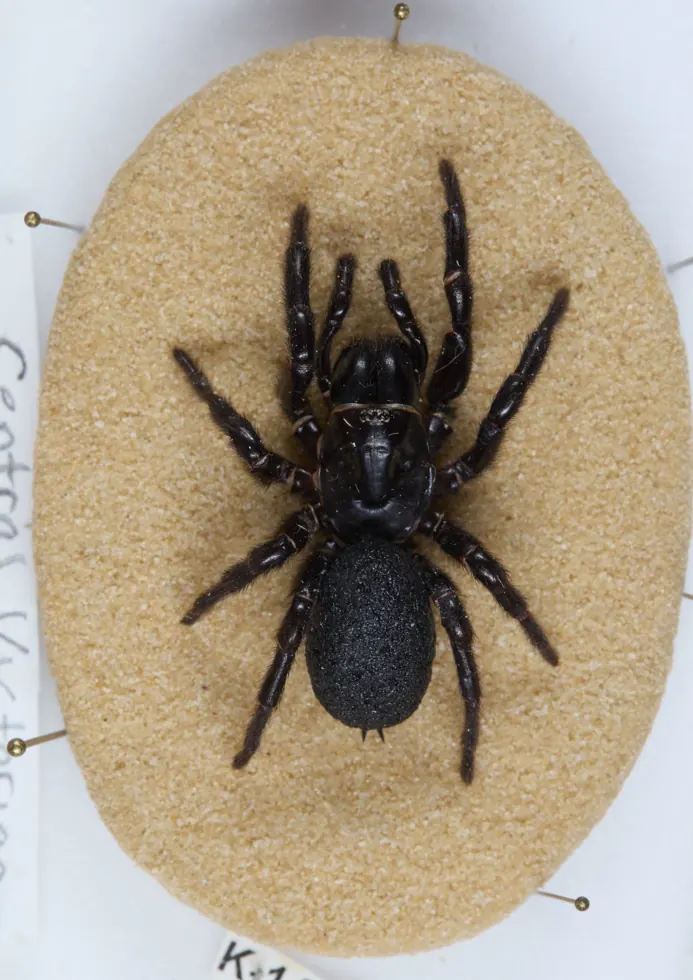
Hadronyche modesta
Victorian Funnel-Web Spider Identification in Australia
Dark Victorian funnel-web spider from silk-lined burrows, with trip-line silk and a defensive rearing posture when threatened.
Medical emergency potentialAbout the Victorian funnel-web spider
Victorian funnel-web spiders are dark mygalomorph spiders from Victoria and nearby southern Australian habitats. Hadronyche modesta is useful to compare when a robust dark spider is found in or near a silk-lined burrow, especially if the entrance has radiating silk trip-lines. Because funnel-web identification can carry bite-safety consequences, this guide keeps the wording cautious and treats any possible funnel-web bite as urgent.
Exact-species specimen views
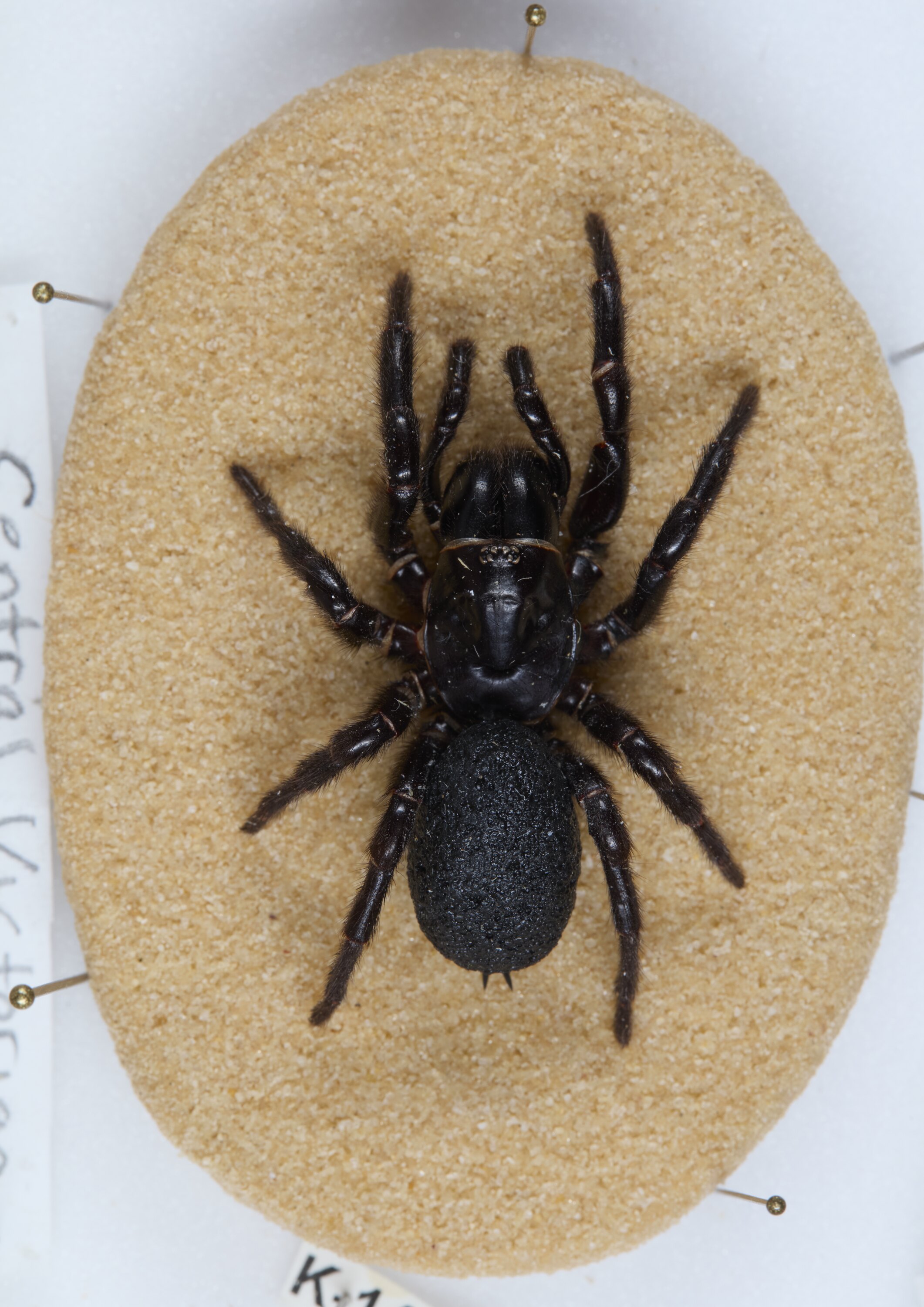
These licensed exact-taxon photographs show useful anatomy and variation. Use each caption for record and image context; no single image set represents every colour, posture or habitat.
How to identify a Victorian funnel-web spider
Start with the broad Hadronyche and Australian funnel-web body plan rather than a colour shortcut. A likely Victorian funnel-web is a robust mygalomorph with a shiny dark carapace, a compact dark abdomen, substantial chelicerae and a ground retreat made of silk. Museums Victoria describes a shiny black cephalothorax and legs, a dark-brown to black oval abdomen, a compact eye group and trip-lines radiating from the burrow entrance. Those are useful reasons to keep a possible funnel-web in the comparison set, not a photograph-only species diagnosis. The accepted name is Hadronyche modesta (Simon, 1891); older records can use Atrax modestus as a synonym. The World Spider Catalog currently lists the species as accepted in Victoria. Species-level separation in Hadronyche relies on fine adult morphology, including genital and spinneret characters that are not safely visible on a live spider. A dark spider beside a hole may instead be another Hadronyche, a trapdoor spider or a mouse spider. Use the combination of broad locality, retreat structure, body proportions and a safely obtained whole-spider photograph to decide whether expert confirmation is warranted. Never turn a live funnel-web over, prise open its fangs or handle it to obtain a diagnostic view.
Clues that are not enough on their own
- A glossy black body by itself, because several Australian mygalomorphs look black in shade or flash
- A funnel-shaped entrance, silk collar or radiating silk, because trapdoor and other ground spiders also make silk retreats
- A Victoria or Tasmania location treated as a species proof without adult characters and a reliable locality record
- A coin-based size estimate, leg span or camera perspective used as if it were a body measurement
- A defensive rearing posture treated as unique to H. modesta rather than a shared mygalomorph response
- A web label or social-media caption that does not document the photographed spider, date and broad locality
- A dark abdomen, pale hairs or flash sheen used to separate closely related Hadronyche species
- A male wandering inside a house assumed to be a female from the nearest garden burrow
Colour, sex and life-stage variation
Museums Victoria gives an approximate body length of up to 2 cm for males and 3 cm for females. Sex, maturity and whether a measurement includes legs can make the same species look very different in field photographs. Mature males wander in late summer and autumn while searching for females and may enter buildings; a wandering male can therefore be photographed away from the retreat that sheltered it earlier. Fresh moulting, wet cuticle, soil, glare and camera flash change the apparent black, brown or blue-black tone. Juveniles may lack the proportions of an adult and should not be forced into a species call. Female abdomen size changes with condition and egg development, while a male often appears slimmer and more long-legged. Use the size label only as a rough scale clue. A photograph cropped tightly around the abdomen, or one taken through a container, can exaggerate proportions and hide the leg, spinneret and retreat characters needed by an arachnologist.
Behaviour, web and retreat
Hadronyche modesta lives in silk-lined ground burrows and uses silk trip-lines around the entrance to detect passing prey. The entrance may be tucked into cool soil, a bank, a log edge, a garden bed or another sheltered place; the surrounding vegetation is not itself diagnostic. The spider waits in or near the retreat and can rear defensively when a hand, tool or probing stick approaches. This is a warning display, not evidence that it is pursuing a person. During the warmer months, mature males may leave their burrows to search for females and can be found under cover or inside buildings. Do not pour water into a burrow, lift logs, scrape away silk, block the entrance or place a camera close to the opening. A retreat is a useful habitat record when photographed from a safe distance, but it is not a species-level character. Funnel-webs are predators of ground-active invertebrates and are part of a living garden food web; leaving the burrow intact is usually the safest and most useful response.
Australian distribution
The World Spider Catalog lists Hadronyche modesta from Australia, specifically Victoria, and Museums Victoria describes its practical range as south-eastern Victoria. The local profile uses Victoria as the primary filter and retains Tasmania and South Australia only as cautious neighbouring-region options because broad state labels and older records can be imprecise. A Victorian common name is not a municipal boundary and does not prove that every dark funnel-web in Melbourne, Gippsland or the ranges is H. modesta. Nearby Hadronyche species, including H. meridiana and southern tree funnel-webs, overlap the wider southern Australian landscape and require specialist characters to separate. Atlas occurrence records and museum specimens are valuable for documenting a broad region, but a single observation should retain its date, habitat, coordinates at an appropriate privacy level and image context. Treat an out-of-range label as a prompt for expert review rather than evidence that the identification is wrong or that the species has established a new population.
What to do if you find one
Keep children and pets away and leave the spider, burrow and surrounding cover undisturbed. Do not pick up a funnel-web, move it into a jar or try to photograph its underside. From a safe distance, a whole-body image beside the retreat entrance, a broad locality, date and habitat note are more useful than a risky close-up. If a suspected funnel-web bite may have occurred, stop trying to identify or catch the spider, call 000, keep the person still and apply a pressure-immobilisation bandage and splint if trained and available. Keep the bandage in place until emergency clinicians take over; do not wash the bite, walk the person around or delay first aid while searching for a name. The relative medical risk of H. modesta must not be used to downgrade first aid for an unknown funnel-web. If there is no bite but a burrow sits beside a path or play area, use distance and a licensed local wildlife or pest professional for advice rather than destroying the retreat.
Compare with similar spiders
Use body shape, web or retreat, location and behaviour together before settling on a likely match.
- Australian funnel-web spiders — Australian funnel-web spiders - the family-level page explains shared atracid body, silk-retreat and bite-safety clues; use it when a photograph cannot support H. modesta.
- Southern tree funnel-web spider — Southern tree funnel-web spider - a different Hadronyche associated more often with trees or logs. Dark colour and a Victorian locality do not separate the two.
- Tasmanian funnel-web spider — Tasmanian funnel-web spider - a southern comparison with overlapping robust, dark morphology. State labels and burrow silk need verified adult characters.
- Mouse spider — Mouse spider - another Australian mygalomorph that may be dark and burrow dwelling. A suspected funnel-web bite should receive the same urgent first-aid response while identity remains uncertain.
Sources for this profile
These accessible authoritative sources support the identification and bite-safety context on this page.
- Museums Victoria: exact Hadronyche modesta CC BY 4.0 specimen asset
- World Spider Catalog: Hadronyche modesta
- Records of the Australian Museum: revision of Australian funnel-web spiders
- Australian Museum: funnel-web spider bite review
- Australian Museum: Australian funnel-web spiders
- Victorian Department of Health: spider pesticide safety note
- Sydney Children's Hospitals Network: Spider bites factsheet
- healthdirect: Spider bites
Profile review
Published by Spider Identifier Australia. Last factual review: 14 August 2026.
Quick identification
- Dark robust funnel-web type body
- Silk-lined burrow with radiating trip-line silk near the entrance
- May rear up defensively and expose large fangs if threatened
- Strong Victoria clue, especially damp sheltered ground, burrows, logs or garden edges
What to check next
Check the location and burrow clue first. If the spider is dark, robust and associated with a silk-lined burrow or trip-lines, do not handle it and compare with other funnel-web profiles and trapdoor lookalikes.
When to seek medical help
Treat any suspected funnel-web bite as urgent. Call 000, keep the person still, apply pressure immobilisation to the bitten limb if trained and available, and seek emergency care immediately.
Where it is usually seen
Silk-lined burrows in damp sheltered ground, forest edges, gardens, logs, banks, rock edges and other cool protected habitats in Victoria and nearby southern regions.