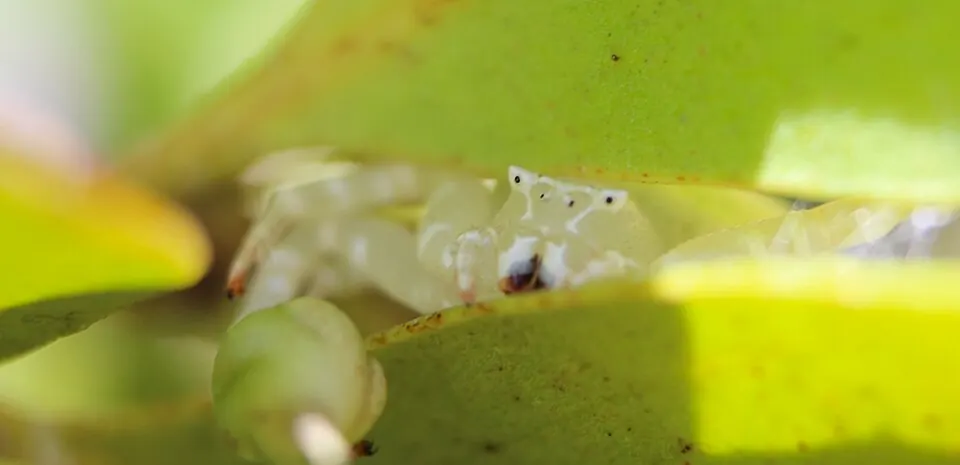
Thomisus spectabilis
White Flower Spider Identification in Australia
White-to-yellow flower ambush spider with a broad angular abdomen and enlarged front legs, often waiting motionless for pollinating insects.
Usually low riskAbout the White flower spider / spectacular crab spider
The white flower spider or spectacular crab spider, Thomisus spectabilis, is an exact species of flower-dwelling crab spider recorded in Australia. A mature female is roughly 10 mm or less in body length, with a broad angular abdomen and the first two leg pairs longer and heavier than the rear pairs. She often sits on a pale flower with those front legs open to seize visiting insects. White and yellow are normal colour states, and research shows that a spider that looks camouflaged to us may contrast strongly in ultraviolet to a bee. Colour, flower choice or the crab-like pose alone cannot prove the species because Australia has many similar Thomisidae.
Exact-species specimen views
These licensed exact-taxon photographs show useful anatomy and variation. Use each caption for record and image context; no single image set represents every colour, posture or habitat.


How to identify Thomisus spectabilis cautiously
Confirm the crab-spider structure before relying on white colour. Australian Museum describes flower spiders as having smooth bodies, a wide shortened abdomen and all legs curving forward; the first two pairs are distinctly longer, heavier and more strongly spined than the hind pairs. For T. spectabilis, James Cook University gives females to 10 mm and males to 6 mm at maturity. The familiar female has a white-to-yellow, broad angular or trapezoidal abdomen, sometimes with a few small darker marks near the rear, and translucent pale legs that may show yellow or reddish tips. Lateral eyes sit toward raised side corners, but phone images rarely resolve diagnostic eye and genital characters. A clear adult female on a flower can support a likely field identification; exact confirmation of a male, juvenile or atypical specimen may require an arachnologist and mature anatomy.
Clues that are not enough on their own
- A white or yellow spider on any flower
- A sideways stance without a clear abdomen and leg-proportion view
- Human-visible colour matching treated as proof, despite ultraviolet signalling
- A small spider catching a bee, because several flower spiders take large prey
- A crowd-sourced map point treated as automatic confirmation of species and range
Colour, sex and life-stage variation
Sex, age and reversible colour change produce substantial variation. Mature males are smaller and slimmer than females, with proportionally leggier bodies and enlarged pedipalps, and may not match the broad white female shown in most photographs. Juveniles are smaller and their adult abdomen proportions and colour may not be settled. Females range from bright white through cream to yellow, and peer-reviewed work demonstrates change between yellow and white over days rather than an instant response. Yellow individuals in experiments preferred yellow daisies, while white individuals used both white and yellow flowers. Dark rear spots, reddish leg tips, abdomen fullness and ultraviolet reflectance also vary. Human-visible matching is therefore incomplete: the same white spider that disappears against petals to our eyes can form a conspicuous ultraviolet signal to a pollinating bee.
Behaviour, web and retreat
This is a daytime ambush predator and does not build an orb, tangle or funnel to catch food. A spider waits motionless on a flower, often with the enlarged front legs spread, then grips a bee, fly, butterfly or other visitor and bites to immobilise it. Prey can exceed the spider’s body size. Research at Macquarie University and in Nature shows that the white form reflects ultraviolet and can increase a honeybee’s attraction to an occupied flower, so its colour may function as a prey-facing signal as well as human-visible camouflage. Australian Museum notes that flower spiders may stay until petals wilt, hide beneath petals or leaves at night, and usually occupy flowers singly except around mating. Silk is still used for safety lines, moulting and reproduction; eggs are enclosed in a silken retreat or covered egg sheet rather than a prey-catching web.
Australian distribution
Australian Faunal Directory accepts Thomisus spectabilis Doleschall, 1859, while World Spider Catalog gives a broader range from India to Australia. At review time an exact Atlas of Living Australia taxon query returned 2,215 occurrence records: 1,765 Queensland, 204 New South Wales, 105 Western Australia, 64 Northern Territory, 33 Australian Capital Territory, two Victoria, one South Australia, one Eastern Sepik Province and 40 without a supplied state. The overwhelming Queensland concentration fits the strong tropical and eastern field evidence, but sparse southern points should be treated as records to inspect rather than proof of an evenly Australia-wide population. Atlas totals reflect contributed observations and specimens, not abundance, and can include duplicate, historical, georeferencing or identification issues.
What to do if you find one
Leave the spider on its flower where practical; it is performing normal insect-predator behaviour, not guarding the plant from people. Watch without placing fingers near the enlarged front legs, and check blossoms before cutting flowers or allowing a child to handle them. For a useful record, take a dorsal image showing abdomen outline, a front or side view showing the two enlarged leg pairs, a body-only scale and a wider image of the plant and flower. If relocation is essential, place a container below the blossom and clip the flower with a short stem, moving the spider and its support together to sheltered flowering vegetation nearby. Do not spray the plant or pull apart an egg retreat. Send unusual southern records or uncertain males to a museum or Atlas with date and locality, and label them Thomisidae rather than forcing an exact species.
Compare with similar spiders
Use body shape, web or retreat, location and behaviour together before settling on a likely match.
- Flower spider / crab spider — Flower spider / crab spider - this family-level page covers many Thomisidae with the same sideways stance and enlarged front legs. Use it when an image lacks the adult female’s broad angular white-to-yellow form.
- Pink flower spider — Pink flower spider - Tharrhalea evanida is commonly green with pinkish or reddish areas and a different, less starkly trapezoidal abdomen. Colour overlaps, so compare adult structure rather than the flower.
- Green crab spider — Green crab spider - other green thomisids blend with foliage and may visit flowers, but a uniformly green body does not fit the familiar mature female T. spectabilis. Males and juveniles still need expert caution.
- Pill flower spider — Pill flower spider - Cymbacha species have a compact pill-like or domed abdomen and often mottled green, cream or brown camouflage. They lack the characteristic broad angular silhouette of a likely adult female T. spectabilis.
Sources for this profile
These accessible authoritative sources support the identification and bite-safety context on this page.
- Australian Faunal Directory: Thomisus spectabilis
- Atlas of Living Australia: Thomisus spectabilis
- Australian Museum: Flower spiders
- Sunshine Coast Council: Spectacular crab spider
- Macquarie University: Colouration in crab spiders
- Nature: Crab-spiders manipulate flower signals
- healthdirect: Spider bites
Profile review
Published by Spider Identifier Australia. Last factual review: 11 August 2026.
Quick identification
- Smooth white, cream or yellow body in the common adult-female form
- Broad, short and angular abdomen, sometimes with small dark rear marks
- First and second leg pairs longer, thicker and more strongly spined than the hind legs
- Sideways crab-like stance with the enlarged front legs open toward visiting insects
- Usually on a flower or nearby vegetation without a prey-catching web
What to check next
Photograph the spider directly above and from the front or side, measure body length without legs, and include the flower and wider plant. Compare the abdomen outline, eye area and leg proportions; keep an uncertain juvenile, male or blurry image at family level.
When to seek medical help
James Cook University describes a bite, if it occurs, as capable of mild localised pain; no useful species-specific Australian case series establishing more serious effects was found. Thomisus spectabilis is not listed among Australia’s medically important spiders, but it should not be handled. For a witnessed minor bite, wash the area and apply a cold pack for pain. Call the Poisons Information Centre on 13 11 26 if symptoms concern you, seek medical advice for severe or persistent pain, worsening swelling or illness, and call 000 for collapse, breathing difficulty or anaphylaxis. Do not use this minor-bite guidance when the spider could instead be a funnel-web or mouse spider; those uncertain large dark-spider bites need emergency pressure immobilisation and 000.
Where it is usually seen
Flowers and adjoining foliage in gardens, shrublands, woodland edges and other sunny flowering vegetation. James Cook University records the species at Townsville and notes white or pale flowers and the undersides of leaves; Atlas occurrence data are strongly concentrated in Queensland, with smaller clusters and scattered records elsewhere.