Missulena bradleyi
Eastern Mouse Spider Identification: Missulena bradleyi
Stocky eastern Australian mouse spider with a very wide shiny head and jaws, short spinnerets and, in mature males, a pale blue-grey abdominal patch.
Medically significantAbout the Eastern mouse spider
Eastern mouse spiders are robust burrowing spiders that can be mistaken for funnel-webs, especially when a dark male is wandering after rain. The safest identification starts with the mouse-spider structure: a very wide, shiny head and jaw region, small eyes spread across the front of the carapace and short rear spinnerets. Mature Missulena bradleyi males add a useful pale blue-grey or whitish patch at the front of the abdomen. Females are larger, stockier and mostly uniform black, so an ordinary photograph may support only Missulena rather than the exact species. Because a bite can produce serious funnel-web-like effects, never handle a suspected mouse spider to check a mark.
How to identify an eastern mouse spider
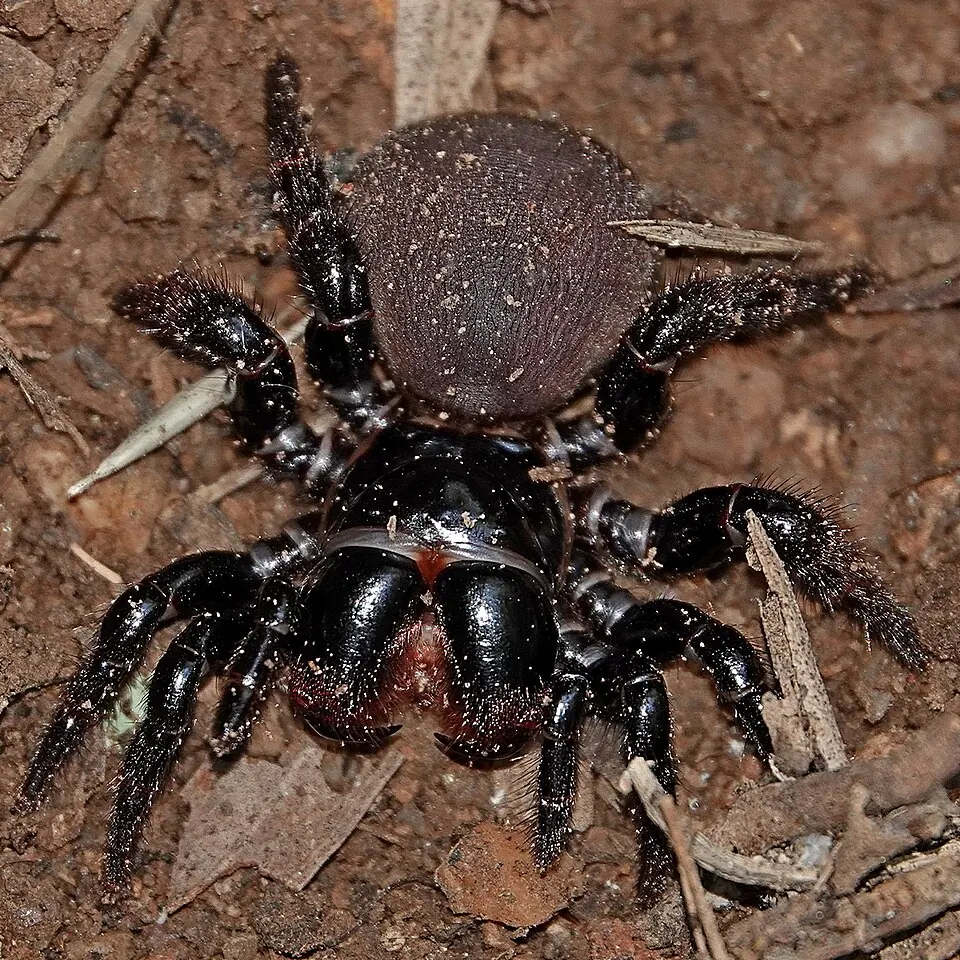
First confirm the mouse-spider body plan. Missulena has a compact, heavy mygalomorph build, but the front body is unusually broad: the shiny carapace expands into a bulbous head and powerful jaw region. The Australian Museum highlights small eyes spread across the front of the carapace and short spinnerets as practical distinctions from other large black spiders. In a clear dorsal photograph, the head can look almost as wide as the abdomen. Published museum measurements place mature M. bradleyi males around 20 mm and females around 30 mm in body length, within the Australian Museum’s broader 10–35 mm mouse-spider range. A mature male usually has the best species-level clue: a pale blue-grey, blue-white or whitish patch across the front portion of the otherwise dark abdomen. The carapace and legs remain glossy black. Do not confuse that muted patch with glare on a shiny surface, soil stuck to hairs or the bright red-orange head and jaws of a male red-headed mouse spider. These clues can support M. bradleyi in eastern mainland Australia, but a sharp expert examination may still be needed for an exact identification.
Clues that are not enough on their own
- Black colour alone, because funnel-web, trapdoor, wishbone and several other mygalomorph spiders can be dark
- A stocky body without a clear view of the spread eyes and short spinnerets
- A pale mark created by flash glare, mud or damaged hairs rather than a true male abdominal patch
- Finding a spider in a pool, garden or after rain, which applies to several wandering burrow spiders
- A trapdoor by itself, because many unrelated mygalomorph spiders build covered burrows
Colour, sex and life-stage variation
Sex changes the appearance substantially. Females are larger, stouter and usually uniform black or very dark grey, with a rounded abdomen and heavy jaws. They lack the easy male colour patch and can be difficult to separate from females of other Missulena species in a photograph. Mature males are smaller and relatively longer-legged, with enlarged pedipalps held forward while searching for females. Their pale anterior abdominal patch can look steel-blue, powder blue, light grey or white depending on lighting and camera exposure. Juveniles are smaller and do not necessarily show adult sexual markings. Dirt, worn hairs and wet surfaces can also change the apparent colour. The exact-species hero photograph is licensed as Missulena bradleyi photographed in Australia; its Commons record does not state a sex or finer locality, so it demonstrates the broad head, jaws and short-spinneret build rather than a universal colour pattern.
Behaviour, web and retreat
Eastern mouse spiders spend most of their lives in silk-lined burrows in soft soil. The Australian Reptile Park describes oval entrances covered by a single or double trapdoor, including burrows in creek or river banks and suburban gardens. The resident spider waits near the entrance for insects and other small prey, then retreats underground when disturbed. Females remain closely tied to the burrow, while mature males leave to find mates. Unlike many other mygalomorph males that wander mainly at night, eastern mouse spider males are often active in daylight during autumn and early winter, particularly after rain. They may cross paths, lawns or driveways and can fall into swimming pools. A few strands around a burrow or a dragline behind a wanderer are not a capture web. Do not probe a burrow, lift its lid or pour water into it; those actions remove the safest distance between the spider and the observer.
Australian distribution
Missulena bradleyi is an Australian species of the eastern mainland. The current Australian Faunal Directory explicitly lists New South Wales and records the male type from North Sydney. The Australian Reptile Park describes an east-coastal and highland range, while Atlas of Living Australia brings together hundreds of mapped occurrence records under the accepted exact taxon. Identified museum records reviewed for this profile include specimens from Victoria, including French Island and Swifts Creek, and Queensland at Kenilworth. Together, that evidence supports the NSW, Queensland and Victoria filters used here. The former ACT filter has been removed because the exact sources reviewed for this cycle did not provide equivalent state-level evidence. Distribution data can change as specimens are re-examined, so a sighting outside the mapped states should be documented with locality, date, body length and clear dorsal and rear photographs rather than rejected or accepted from range alone.
What to do if you find one
Do not touch, corner or deliberately provoke a mouse spider. Keep children and pets away and photograph it from a safe distance only if nobody has been bitten. A wide container and stiff card can be used by a confident adult only when this can be done without putting hands near the spider; otherwise close the area and contact a licensed pest professional or local wildlife service. A spider found in a pool should be treated as alive even if it appears motionless, because immersed spiders can recover. Do not dig out a burrow for identification. If a bite is possible, stop the photography or capture attempt, call 000 and begin pressure immobilisation immediately. Emergency care takes priority over collecting the spider, and a blurry image is never evidence that a large dark mygalomorph is harmless.
Compare with similar spiders
Use body shape, web or retreat, location and behaviour together before settling on a likely match.
- Mouse spider — Mouse spider - use the broader Missulena page when the bulbous head, spread eyes and short spinnerets fit but sex, abdominal patch or locality does not support M. bradleyi. Uniformly dark females are especially difficult to name from a photograph.
- Red-headed mouse spider — Red-headed mouse spider - mature Missulena occatoria males have a conspicuous red-orange head and jaws and a broader mainland range. Eastern mouse spider males retain a black head and instead show a pale blue-grey patch on the front of the abdomen; females can be much harder to separate.
- Australian funnel-web spiders — Australian funnel-web spider - can also be glossy, dark and medically significant. Funnel-webs generally have the eyes more tightly grouped and longer, more conspicuous rear spinnerets; do not approach a live spider to inspect these features, and treat any suspected bite urgently.
- Trapdoor spider — Trapdoor spider - many are brown, dusty or hairy rather than uniformly glossy black and often lack the extremely wide bulbous head. Burrow lids overlap, so a trapdoor without a sharp view of the spider cannot establish Missulena.
Sources for this profile
These accessible authoritative sources support the identification and bite-safety context on this page.
- Australian Faunal Directory: Missulena bradleyi
- Australian Museum: Mouse Spiders
- Australian Reptile Park: Mouse Spider
- Atlas of Living Australia: Missulena bradleyi
- Medical Journal of Australia: Mouse spider bites
- healthdirect: Spider bites
Profile review
Published by Spider Identifier Australia. Last factual review: 10 August 2026.
Quick identification
- Very wide, bulbous and glossy black head and jaw region
- Small eyes spread across the front of the carapace rather than forming an obvious tight central cluster
- Short spinnerets at the rear of the abdomen
- Mature male may show a pale blue-grey to white patch across the front of the abdomen
- Soft-soil trapdoor burrow or a wandering male in daylight during autumn to early winter
What to check next
Keep your distance and photograph the entire spider from above, including the rear of the abdomen. Check the wide head, spread front eyes, short spinnerets and any pale anterior abdominal patch. A uniformly dark female or a photo that misses the eyes and spinnerets should remain at mouse-spider or large-mygalomorph level.
When to seek medical help
Treat a suspected eastern mouse spider bite as a medical emergency. Call Triple Zero (000), keep the person lying still and apply a pressure-immobilisation bandage to the bitten limb if trained, then splint the limb and wait for the ambulance. Do not wash the bite site, cut or suck the wound, or use a tourniquet. Healthdirect recommends pressure immobilisation specifically for funnel-web or mouse spider bites and for bites from an unidentified big black hairy spider. Serious mouse-spider envenomation is uncommon, but photo identification must not be used to delay emergency care.
Where it is usually seen
Silk-lined trapdoor burrows in soft soil in forests, woodland, gardens and other ground habitat across documented parts of New South Wales, Queensland and Victoria. Mature males may wander into open areas, pools or buildings while searching for females.