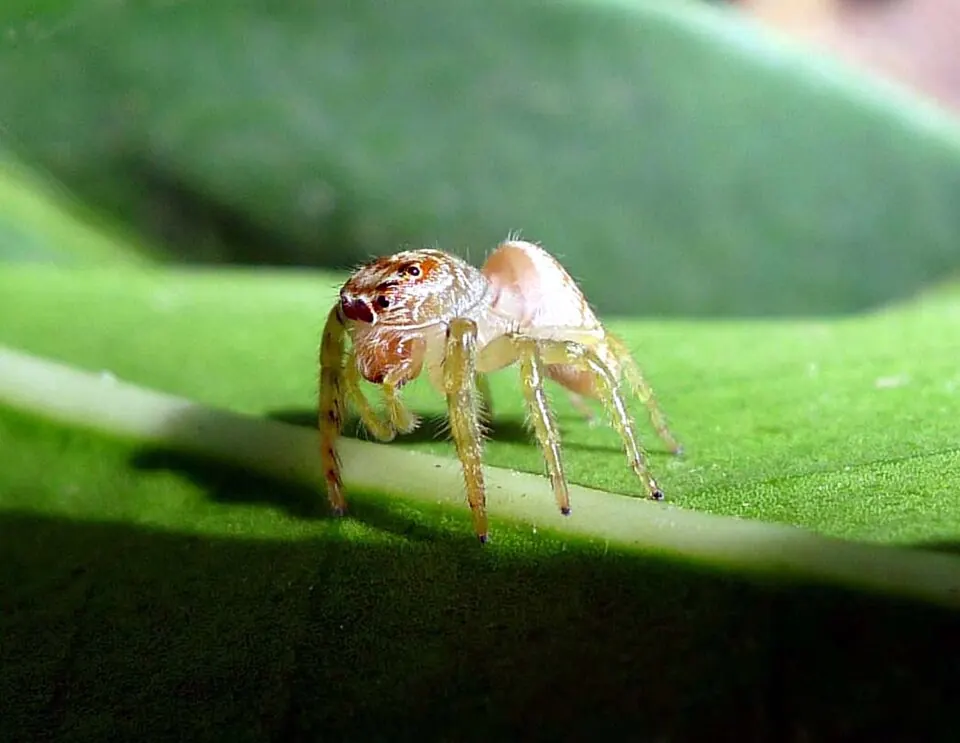
Opisthoncus parcedentatus
Garden Jumping Spider Identification in Australia
Small active jumping spider, usually brown, cream or patterned, often seen on garden plants, walls, fences and windows.
Usually low riskAbout the Garden jumping spider
Garden jumping spiders are small salticid spiders noticed in Australian gardens and around houses. They hunt by sight rather than using a capture web, so the best clues are the large front-facing eyes, short jumping movements and patterned body. Brown, cream or grey markings can vary and overlap with other jumpers, so use the eye arrangement, active movement and setting together rather than relying on pattern alone.
Exact-species specimen views
These licensed exact-taxon photographs show useful anatomy and variation. Use each caption for record and image context; no single image set represents every colour, posture or habitat.


How to identify a Garden jumping spider cautiously
This page uses the accepted species Opisthoncus parcedentatus L. Koch, 1880 as a practical candidate behind the common name Garden jumping spider. It is a Salticidae jumping spider, not a web-building garden orb-weaver: the large forward-facing principal eyes, raised head, compact body and short visual pounces are the useful first clues. Lucid Central describes Opisthoncus as a varied Australian genus whose species are generally about 5-13 mm in body length, with a high carapace and a midline bulge near the rear eyes; the Brisbane field account gives about 8 mm for the garden jumper. Brown, orange-brown, cream and white patterning can support the candidate but cannot prove it. For a useful record, photograph the whole spider, front eyes, dorsal pattern, side profile and substrate rather than uploading a colour crop. Exact species identification may still require adult genital or palp characters that are not safe or realistic to inspect on a live spider.
Clues that are not enough on their own
- Any spider in a garden, because many salticids, crab spiders and juveniles share the same plants and walls
- Brown, orange, cream or white colour alone, because light, moult, dust and related Opisthoncus overlap
- An estimate near 8 mm without a whole-body scale view; leg span and crop size are easily confused
- Large front eyes or a short jump used to identify a species rather than the jumping-spider family
- A leaf, fence or window location treated as unique to O. parcedentatus
- A female or juvenile matched to a darker adult-male photograph
- A rolled leaf or silk line assumed to be an orb web or a fixed species character
- A Queensland or NSW locality treated as proof without the complete body and current taxonomy
- A social-media label or old Opisthoncus photograph copied forward without checking the source and licence
Colour, sex and life-stage variation
Garden jumper photographs often show more variation than a name suggests. The Brisbane account reports that larger spiders tend to be darker, smaller individuals paler, and males slimmer with larger pedipalps; females are more often encountered. Age, moult, dust, moisture and flash alter the apparent orange, brown, cream or grey tones, while a juvenile may lack the adult proportions and contrast. Opisthoncus as a whole contains many Australian species and the genus-level body range is broad, so an 8 mm estimate or a familiar garden setting is not a species key. A plain female, immature spider or blurred male should be left at jumping-spider or Opisthoncus level unless the complete body, locality and specialist characters agree. Keep older labels and casual “garden jumper” names as search notes, not as proof that every Opisthoncus in a yard is O. parcedentatus.
Behaviour, web and retreat
This is a daytime, sight-guided hunter. The Brisbane field account describes individuals hunting from green leaves and jumping from a higher leaf onto prey, including small flies and other spiders; Opisthoncus can also take moving or flying targets. It does not build a prey-catching orb or tangle web. Instead, a small silk retreat may run between leaves or partly rolled foliage, often with openings at both ends, where the spider rests at night and through colder periods. Walls, fences, windows, shrubs and outdoor furniture are useful search surfaces because a jumper patrols edges and leaf faces rather than waiting in a web. Do not pull a retreat open or shake foliage to trigger a jump. A still spider may be watching through the large principal eyes, and repeated flash or breath can make it leave before the useful view is recorded.
Australian distribution
The current World Spider Catalog lists Opisthoncus parcedentatus from Queensland and New South Wales. The Australian Faunal Directory keeps a compiled concept with the type locality at Peak Downs and regional records across Queensland, New South Wales and the ACT, but its own record structure is not a reason to call every Australian garden jumper this species. The state filters on this page therefore stay with the current WSC Queensland-New South Wales range. Atlas records and community photographs are discovery aids shaped by reporting effort, historical names and uneven verification. A sighting outside those filters deserves expert review rather than an automatic range expansion, while a Queensland or NSW garden location is only supporting context. Preserve broad locality, date, substrate and the full image set without publishing a precise home address.
What to do if you find one
Leave a garden jumper where it is whenever practical: it is a small predator of other arthropods and is easy to injure with fingers, sticky tape or a macro setup. Photograph the whole body first, then take a front-oblique eye view, side view and wider garden frame with a scale beside the leaf or wall rather than beneath the spider. If it is indoors, place a clear cup over it only when hands can stay well away, slide stiff card underneath and release it onto nearby sheltered foliage. Do not spray the occupied leaf, unfold a silk retreat or stage a jump on a hand. These spiders are not usually considered medically significant, but wash a suspected bite and seek medical advice for marked or persistent pain, allergic symptoms, infection signs or uncertainty. If a different large or medically important spider may be involved, follow current Australian emergency advice rather than relying on this small-jumper page.
Compare with similar spiders
Use body shape, web or retreat, location and behaviour together before settling on a likely match.
- Jumping spider — Jumping spider - use the broader Salticidae page when the eyes and visual hunting are clear but the body, locality and adult characters do not support O. parcedentatus.
- Green jumping spider — Green jumping spider - Mopsus mormon is usually larger and greener with a different head and body profile; a green garden visitor should not be forced into either name from colour alone.
- Peacock spider — Peacock spider - Maratus species are also visual hunters, but their tiny scale and male fan or abdominal display evidence are different clues from a medium-sized Opisthoncus garden jumper.
- Aussie bronze hopper — Aussie bronze hopper - Simaetha or related small bark jumpers can share brown-gold tones and forward eyes. Compare the whole body, substrate, scale and current range rather than the shine of one patch.
Sources for this profile
These accessible authoritative sources support the identification and bite-safety context on this page.
- World Spider Catalog: Opisthoncus parcedentatus
- Australian Faunal Directory: Opisthoncus parcedentatus
- Atlas of Living Australia: Garden Jumping Spider
- Lucid Central: Opisthoncus factsheet
- Australian Museum: Jumping spiders
- Australian Museum: Spiders in the house and garden
- Queensland Museum: New jumping-spider species
- Brisbane Insects: Garden Jumping Spider field account
- Zenodo: Opisthoncus redescription record
- Zootaxa: Opisthoncus redescription
- Wikimedia Commons: exact Opisthoncus parcedentatus photograph
- Wikimedia Commons: exact Opisthoncus parcedentatus second photograph
- Wikimedia Commons: exact Opisthoncus parcedentatus third photograph
- healthdirect: Spider bites
Profile review
Published by Spider Identifier Australia. Last factual review: 14 August 2026.
Quick identification
- Small jumping spider with large front eyes
- Brown, cream, grey or strongly patterned markings
- Short stop-start movement and sudden jumps
- Often on leaves, fences, windows, walls or outdoor furniture
What to check next
Check for the front-facing eyes and jumping movement. A clear close photo is helpful because many Australian jumping spiders look similar.
When to seek medical help
Jumping spiders are not usually considered dangerous. Seek medical advice for severe pain, allergic symptoms, infection signs, spreading symptoms or uncertainty after any bite.
Where it is usually seen
Garden plants, shrubs, fences, window frames, walls, outdoor furniture and nearby indoor surfaces, especially in eastern and south-eastern Australia.