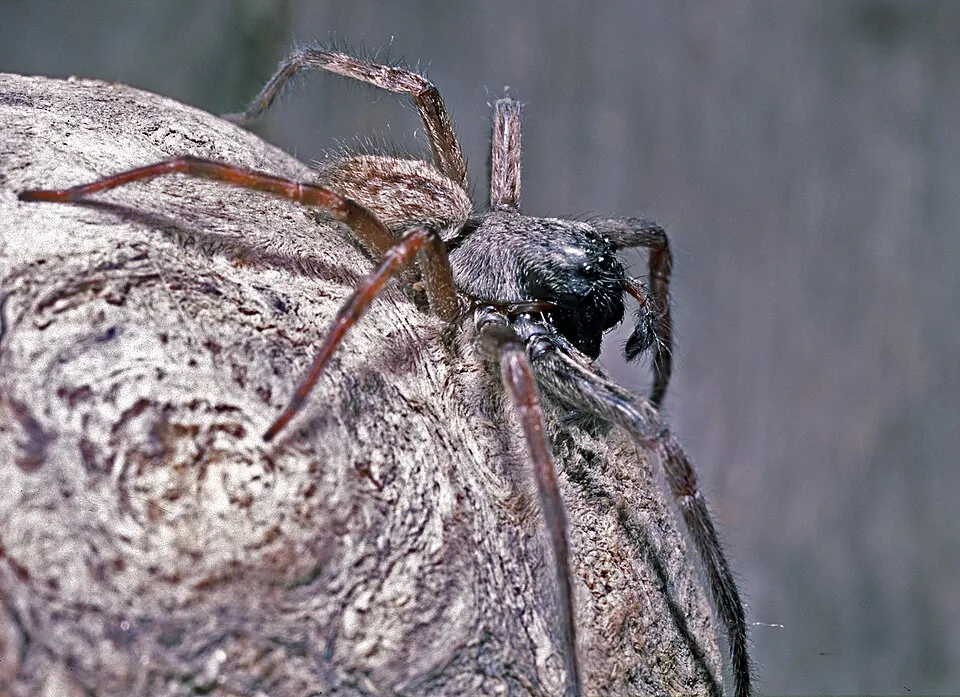
Badumna longinqua
Grey or Brown House Spider Identification Australia
A brown-grey Badumna spider with banded legs that lives in a fuzzy lace web with a funnel-like retreat on bark, foliage or a building.
Usually low riskAbout the Grey house spider
People often search for Badumna longinqua as the grey house spider, although the Australian Museum favours Brown House Spider for this species. It is a smaller, browner close relative of the black house spider and the web is usually more useful for identification than colour alone.
How to identify a grey or brown house spider
Start with the web and retreat, then examine the spider. The Australian Museum describes Badumna longinqua as slightly smaller than the black house spider, with a brownish carapace and grey-brown banded legs. Its lace web has exposed fuzzy silk and usually spreads from a hole, crack or sheltered tube. The Web2Spider guide illustrates a lacy web about 10 to 30 cm across on tree trunks or bark, with a funnel-like entrance leading to a retreat. Old silk becomes matted and coarse, so a long-established web may look like an irregular grey jumble rather than neat lace. This is cribellate silk: many fine fibres snag prey without glue droplets. Confirm the body, banding, web texture and retreat together. The funnel-like entrance describes the shape of this lace web and does not make the spider an Australian funnel-web spider in the medically important family Atracidae.
Clues that are not enough on their own
- Grey or brown colour by itself, because lighting and many unrelated species produce the same impression
- A messy web without a visible fuzzy lace surface and retreat entrance
- Being found on a house, window or fence, which is habitat rather than a diagnostic feature
- A funnel-shaped web entrance by itself; several unrelated spiders make funnels and Badumna is not an atracid funnel-web
Colour, sex and life-stage variation
Individuals range from brown to grey-brown, and lighting, dust and a pale skin left after moulting can distort colour. Females are generally more robust, while males and juveniles may look slimmer or less strongly marked. Badumna longinqua and B. insignis overlap in body shape, habitat and web design, so a distant image may justify only a genus-level Badumna identification. The common name is also inconsistent: Australian Museum uses Brown House Spider for B. longinqua and notes that Grey House Spider is used overseas, while many Australian searchers still use grey house spider. The exact-species hero photograph is credited to the New Zealand Arthropod Collection; it is a useful anatomical reference but is not evidence that the pictured individual came from Australia.
Behaviour, web and retreat
This is a resident web-building spider rather than a roaming hunter. It waits in a secure retreat connected to the lacy catching surface and can rush out when an insect becomes entangled in the fuzzy fibres. The silk is not a sticky orb web: its combed fibres snag legs and wings. Newer areas can show a more organised lace pattern, whereas repairs, dust and successive layers make older sections look woolly and untidy. A spider may remain hidden during daylight, so an apparently empty web should not be probed with fingers. The permanent retreat and exposed catching silk are more informative than seeing one brown spider walk across a wall.
Australian distribution
The Australian Faunal Directory recognises Badumna longinqua as an Australian taxon. It is encountered in natural and modified habitats and has also been introduced beyond Australia, including New Zealand. State filters on this page are broad discovery aids, not verified occurrence records for every locality. For a useful observation, record the town or region, date, substrate, approximate body length without legs, a dorsal photograph and a wider photograph of the web. Those details are much more valuable than assuming the species from a house location alone.
What to do if you find one
Leave an outdoor web in place when practical; the spider is an insect predator and normally remains within its retreat. If a web must be removed from a doorway or window, wear gloves, keep fingers out of the tube, and use a long brush after giving the spider a chance to move away. A spider found away from the web can be covered with a container, slid onto stiff card and released into sheltered vegetation without direct handling. Photograph first if identification matters. After any suspected bite, follow current Australian health guidance and base urgency on symptoms rather than an uncertain species match.
Compare with similar spiders
Use body shape, web or retreat, location and behaviour together before settling on a likely match.
- Common house spider — Black house spider - Badumna insignis is usually larger and darker, but the two species overlap. Brownish colour, grey-brown banded legs and a foliage web favour B. longinqua; a poor photo may support only Badumna.
- Black house spider — Common house spider - this broad common name is not a species diagnosis. Compare body shape, leg banding, fuzzy lace silk and a fixed retreat rather than relying on where the spider was found.
- Brown house spider / cupboard spider — Brown house spider / cupboard spider - this site uses that page for a Steatoda comb-footed spider, creating a genuine common-name collision. Steatoda usually has a rounder abdomen and a three-dimensional gum-footed tangle, not the exposed woolly lace surface and tubular Badumna retreat.
- Daddy-long-legs spider — Daddy-long-legs spider - has an extremely small body, very long threadlike legs and a loose ceiling or corner web. Badumna is compact and sturdy-legged, with a dense lace web leading into a retreat.
Sources for this profile
These accessible authoritative sources support the identification and bite-safety context on this page.
- Australian Faunal Directory: Badumna longinqua
- Australian Museum: Black House Spider and Brown House Spider comparison
- Australian Museum: Web2Spider lace-web guide
- healthdirect: Spider bites
Profile review
Published by Spider Identifier Australia. Last factual review: 10 August 2026.
Quick identification
- Brownish carapace and grey-brown legs that are often visibly banded
- Compact Badumna build, usually smaller and browner than a black house spider
- Exposed fuzzy or woolly lace web spreading from a crack, hole or silk tube
- Funnel-like entrance leading into a secure retreat
- Common on foliage and bark as well as window frames, walls, fences and other sheltered structures
What to check next
Photograph the spider from above and the whole web from the side, including the retreat entrance. Confirm several features together: a Badumna-shaped spider, brown-grey banded legs and a fuzzy lace web. A dim phone photograph may support only Badumna rather than a confident B. longinqua identification.
When to seek medical help
Badumna longinqua is not one of the Australian spiders highlighted by healthdirect as causing severe envenoming. For a suspected bite, wash the area, apply a wrapped cold pack for local pain and swelling, and monitor symptoms. Seek medical advice if pain is severe, symptoms persist or worsen, swelling or itching increases, or you are concerned. Call Triple Zero (000) for breathing difficulty, collapse or other signs of anaphylaxis.
Where it is usually seen
Foliage, tree trunks and bark, plus protected crevices on window frames, walls, fences, sheds and house exteriors. Its presence on a building does not make it an indoor-only species; foliage webs are an especially useful clue when separating it from the larger black house spider.