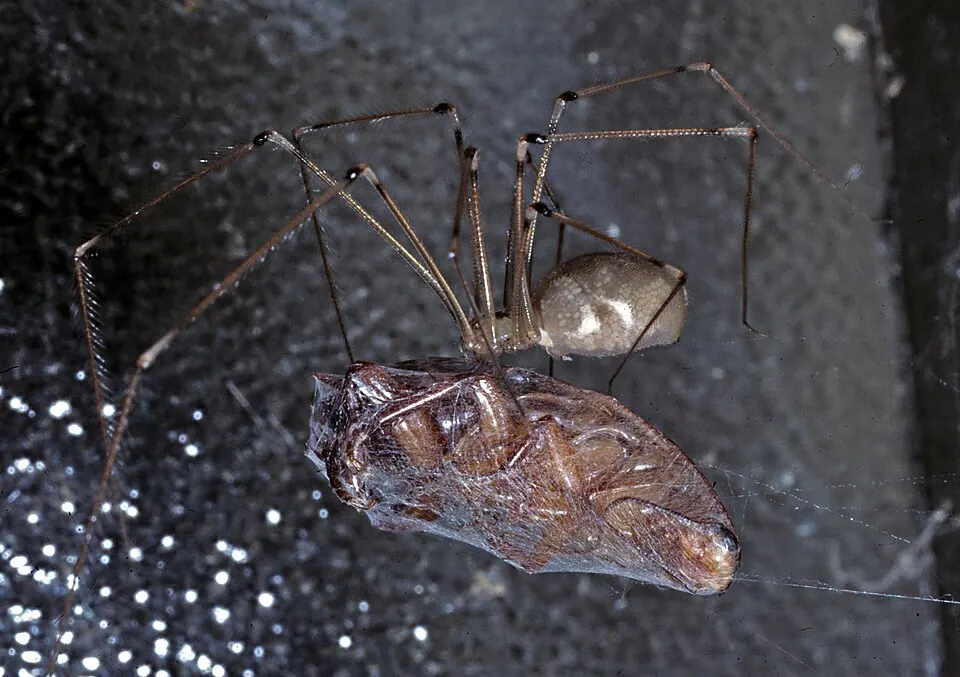
Parasteatoda tepidariorum
Common House Spider Identification: P. tepidariorum
Small variable comb-footed spider with a high rounded abdomen, banded slender legs and a loose three-dimensional cobweb in sheltered household sites.
Usually low risk; bites can be painfulThe common house spider, Parasteatoda tepidariorum, is a small cobweb-building theridiid associated with buildings around much of the world. In Australia it is still indexed by the Australian Faunal Directory and Atlas of Living Australia under the older combination Achaearanea tepidariorum, so both names can appear in museum records and search results. Look for a pea-sized spider with a high rounded abdomen, fine ringed legs and mottled cream, tan, brown or charcoal markings, hanging upside down in a loose three-dimensional tangle web. Do not identify it from “brown spider in a corner” alone: native white porch spiders, red house spiders, cupboard spiders, redbacks and lace-web house spiders can occupy the same structures. Web form, body proportions, egg-sac shape and clear dorsal photographs can support a likely match, but exact small-theridiid identification may require a mature specimen and microscopic genital characters.
Quick identification
- Tiny comb-footed spider, usually about 3.8–8 mm in body length
- Adult female with a high rounded or teardrop abdomen above a much smaller front body
- Cream, tan, grey or brown mottling with darker chevrons or patches and pale speckles
- Slender yellow-brown legs with visible darker rings at several joints
- Loose three-dimensional tangle web in a protected corner, often with a brown papery egg sac
What to check next
Photograph the whole spider from above and side-on without disturbing the web, then include the web and any egg sac in a wider frame. Record body length without legs and whether the web has irregular support lines rather than a flat lace sheet. Check for leg banding, abdominal mottling and a brown papery egg sac; never rely on the absence of a red mark to rule out a redback.
When to seek medical help
This spider is usually treated as low medical risk, but “harmless” is too absolute. An Australian prospective study included five definite bites by spiders then placed in Achaearanea; they produced moderate to severe persistent pain but no systemic effects. The group was small and not every specimen was P. tepidariorum, so it cannot provide a species-level bite rate. For a witnessed minor bite, healthdirect advises washing the area with soap and water and using a cold pack; seek medical advice for severe or persistent pain, spreading symptoms, infection signs or uncertainty, and call the Poisons Information Centre on 13 11 26 for Australian poisons advice. Call 000 for collapse, breathing difficulty or a severe allergic reaction. If a funnel-web, mouse spider or unidentified big black spider could be involved, call 000 and follow pressure-immobilisation guidance instead of this minor-bite advice.
Where it is usually seen
Protected, relatively undisturbed sites around buildings: window and ceiling corners, eaves, garages, sheds, laundries, bathrooms, under furniture, beneath outdoor structures and among stored objects. The species can also web under bridges, rocks, boards and other dry shelter where small insects are available.