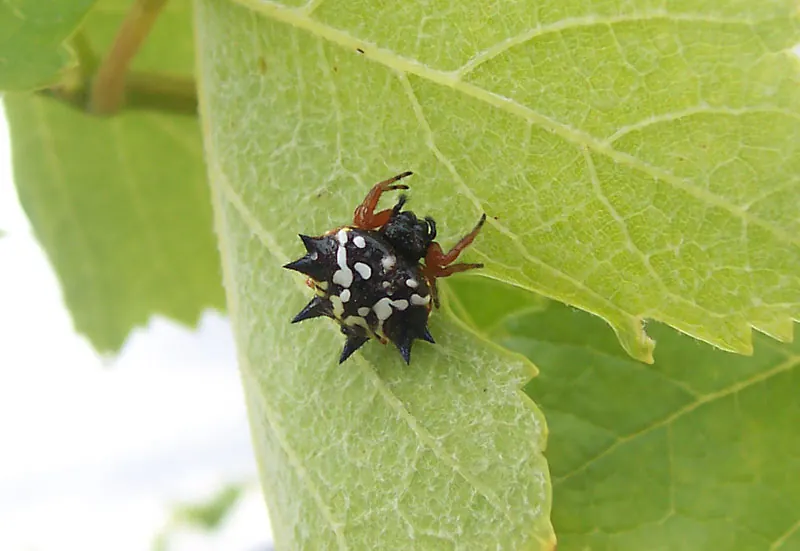
Austracantha minax
Jewel Spider Identification in Australia
Small hard-bodied orb-weaver with bright jewel-like colours and spiny projections.
Usually low riskAbout the Jewel spider
Jewel spiders are small but distinctive because of their bright, hard, spiked abdomen. Their small orb web in low vegetation is an important confirmation clue: a bright, pointed shape away from a circular web may be a different garden invertebrate altogether. Pattern and colour can vary, so use the hard outline, short spines and web together, then compare with other small spiny or knobbled orb-weavers. These are usually low-risk garden spiders and are best observed in place rather than removed from their web.
How to identify a Jewel spider
The Jewel spider is the accepted Australian species Austracantha minax (Thorell, 1859), an orb-weaver in the family Araneidae. It is also called the Christmas spider, Christmas jewel spider, six-spined spider or spiny spider. The name is useful, but a common-name label or a bright photograph is not enough to make a species-level identification. Start with the whole encounter: a small, hard-looking abdomen with six strong triangular projections, a black, white, yellow or orange pattern that may be partly or completely dark, and an orb web held in open vegetation. Museums Victoria describes the abdomen as shiny black with a variable yellow-and-white pattern and six large spines; Queensland Museum also identifies the Jewel spider as Austracantha minax. The combination of the armoured outline and the web is more informative than a colour patch on a cropped image. A soft, rounded abdomen, a flat crab-spider stance or a web that is only loose mesh should keep the identification broader. A suspected Jewel spider is normally sitting in its web or among nearby vegetation rather than hiding in a crevice. The accepted scientific name and the six-spined outline are the safest anchors when comparing photographs, records and lookalikes.
Clues that are not enough on their own
- A jewel-like yellow, white, orange or red patch by itself, because colour varies and other orb-weavers can be patterned
- A common name copied from a photo caption without the six-spined abdomen, web and Australian context
- A tiny size estimate made from a cropped image, because perspective and legs distort scale
- A web photographed without the spider, because many garden orb-weavers use similar circular webs
- A dark or almost black individual rejected as a different species, because melanic and other dark forms are recorded
- A location in one state treated as a complete identification when the accepted species occurs across mainland Australia and Tasmania
- A single triangular point counted as six spines without seeing the abdomen outline from a useful angle
- A bright abdomen assumed to be female, because sex and life stage cannot be assigned safely from colour alone
Colour, sex and life-stage variation
Females are much larger and more conspicuous than males. Museums Victoria gives a body length of up to about 10 mm for females and about 3 mm for males, while field accounts often describe a female as smaller than a 5-cent coin once legs and perspective are excluded. Juveniles, moulting spiders and newly mature individuals may have less contrast than the familiar black, white and yellow pattern. Colour can range from strongly patterned black-and-white or yellow forms through orange or reddish accents to almost entirely black individuals. The abdomen may look more swollen when a female is carrying eggs, and flash, wet silk, backlighting and camera compression can alter the apparent hue. The six spines remain a useful structural clue, but their visibility changes with angle: a dorsal view can show the projections clearly while a side or underside view can hide some of them. Do not infer sex, maturity, subspecies or health from one close-up. Record the whole spider, web, substrate, season and broad locality instead. A male near a female or on vegetation may look like a much smaller, duller spider and should not be forced into the female pattern. Photos of spiderlings or an empty web should remain at a broader orb-weaver level unless additional evidence is available.
Behaviour, web and retreat
Jewel spiders build individual orb webs in open situations, often among grass, shrubs, low branches, fences or other garden vegetation. The Australian Museum Web2Spider guide describes strong webs about 15–40 cm across, with black, white and yellow spiders that often occupy webs by day. A female normally rests in the web rather than using a separate retreat, and neighbouring webs can become linked by support silk. In favourable warm periods, many individuals may live close together in a colony or aggregation that spreads over a shrub, branch or human-made structure. Each spider still has its own web, so a mass of silk is not one giant web with one spider. The broad aggregation is a useful encounter clue but is not exclusive proof: other orb-weavers can occur together, and wind or maintenance can leave only fragments. Adults and juveniles may move between web sites, and a male may be found on nearby vegetation rather than at the centre of a female web. Their prey is flying or crawling invertebrate traffic intercepted by the orb; the spider should be allowed to remain in place. Do not walk through a colony, brush a branch, or pull apart the support threads to make the web easier to see. A day photograph from the side of the path is usually more useful than a close approach that damages several webs.
Australian distribution
The World Spider Catalog lists Austracantha minax as an accepted species distributed in Australia and Tasmania. Museums Victoria likewise records mainland Australia and Tasmania and describes the species in shrubby woodland and urban settings. Australian records and museum material show that it can be encountered in eastern, southern and western parts of the country, so a state label is supporting context rather than a species boundary. The local filters therefore include New South Wales, Queensland, Victoria, Tasmania, Western Australia, South Australia and the Australian Capital Territory; a Northern Territory label should be checked carefully against the current record and image because the conservative baseline does not assume every Australian location. Queensland Museum lists the species in its Australian spider coverage, while the Australian Museum web guide uses it as a Sydney-region example. Keep the broad locality, habitat, season, web diameter, spider sex if known and the full image context with a record. An old caption may use Gasteracantha minax or another historical combination; check the current World Spider Catalog and Australian Faunal Directory-linked records before copying that name into a report. Distribution evidence narrows the possibilities, but it does not replace the six-spined body and web.
What to do if you find one
Leave a Jewel spider, its web and any colony undisturbed. Keep children, pets and cyclists away from a shrub or fence covered in linked webs, and do not collect a spider or carry it indoors for a closer photograph. From a stable position outside the web, take one wide image showing the plant or structure, one image of the whole web and a close image only if it can be made without touching silk. Note the date, broad locality, weather, web height and whether one or many spiders are present. Do not climb, lean into dense scrub, step into a road or use a ladder for a better angle. These spiders are considered low risk; a bite is uncommon, but any suspected bite should be washed and monitored, with healthdirect or a poisons service contacted for severe, unusual or worsening symptoms. Do not rely on a web search to diagnose a bite or on a common name to identify a species. If a colony is in a doorway, play area or work route, reroute people rather than spraying or sweeping it away; ask a licensed local pest or wildlife professional for advice when removal is genuinely necessary. A clear record that preserves the living web is more valuable than a specimen obtained by handling.
Compare with similar spiders
Use body shape, web or retreat, location and behaviour together before settling on a likely match.
- Spiny spider — Spiny spider - often the same Austracantha minax species and overlapping common name; compare the exact scientific record rather than treating the names as different species.
- Garden orb weaver — Garden orb weaver - a larger round-bodied orb-weaver can share a garden web and bright pattern. Look for the hard six-spined abdomen and smaller scale before using the Jewel name.
- Bird-dropping spider — Bird-dropping spider - a cryptic Celaenia can look lumpy or pale and may have egg sacs; an odd silhouette without six spines is not enough for Austracantha.
- Knobbled garden orb weaver — Knobbled garden orb weaver - knobbly or spined araneids can overlap in vegetation. Compare abdomen projections, web position, body texture and locality, and keep the identification broad when the image is cropped.
Sources for this profile
These accessible authoritative sources support the identification and bite-safety context on this page.
- World Spider Catalog: Austracantha minax
- Australian Faunal Directory: Austracantha minax
- Atlas of Living Australia: Austracantha
- Queensland Museum: Spiders of Queensland
- Australian Museum: Web2Spider guide
- Fauna Portal: Austracantha genus
- ABC News: Christmas spiders in Western Australia
- Australasian Arachnological Society: Australian spider checklist
- Butterfly House: Austracantha minax
Profile review
Published by Spider Identifier Australia. Last factual review: 14 August 2026.
Quick identification
- Small bright spider
- Hard spiny abdomen
- Often white, yellow, orange or black markings
- Sits in a small orb web
What to check next
Check for the hard spiked body outline and small web in low vegetation.
When to seek medical help
Seek advice for severe or unusual symptoms.
Where it is usually seen
Grass, shrubs, fences, gardens and low vegetation.