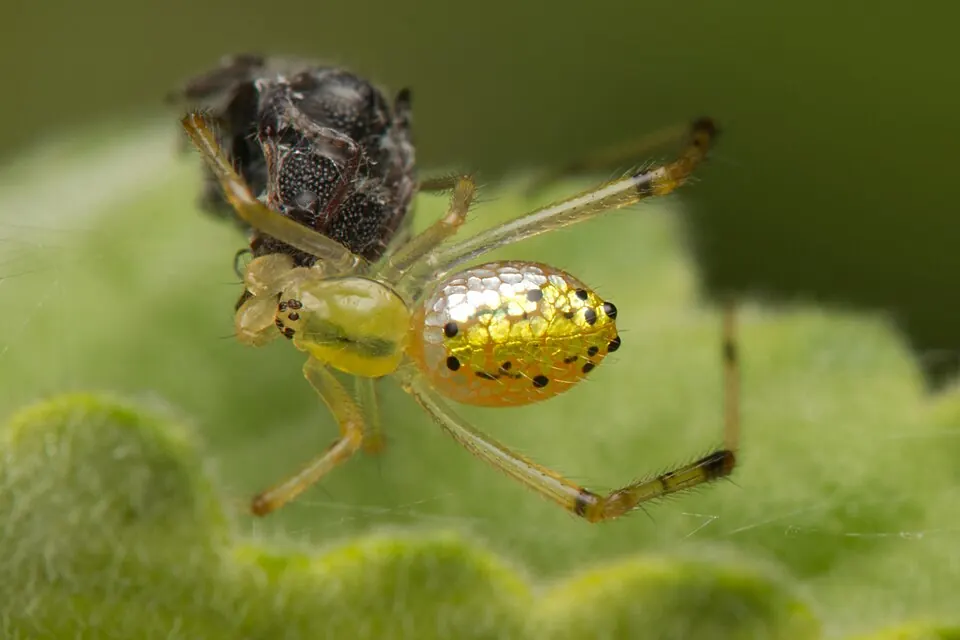
Thwaitesia species
Mirror Spider Identification in Australia
Conservative genus-level guide to tiny Australian Thwaitesia comb-footed spiders with a high abdomen carrying silver, cream and coloured mosaic-like patches.
Usually low risk“Mirror spider” or “sequinned spider” is an appearance label used for Thwaitesia, not a guaranteed species identification. Australia has two formally accepted named species, T. argentiopunctata and T. nigronodosa, both documented from Queensland; contributed observations labelled only to genus extend farther south. A likely match is only a few millimetres long, has delicate comb-footed-spider legs and a high, often square or twin-peaked abdomen broken into reflective silver plates and cream, green, yellow, red or dark areas. Macro views of the abdomen, eyes, underside and adult reproductive structures are needed to move beyond genus.
Quick identification
- Minute comb-footed spider, usually only a few millimetres in body length
- High, deep or square abdomen rather than a flat metallic body
- Distinct silver mirror-like plates separated by cream, green, yellow, red or dark tissue
- Delicate legs on or beneath foliage in rainforest, creekside vegetation or a humid garden
- No species name from shine alone; adult anatomy and locality must separate the two accepted Australian species
What to check next
Use a macro lens or clip-on phone lens and take dorsal, side, underside and front views without touching the spider. Include a millimetre scale beside the leaf, record exact locality and photograph any silk before it is disturbed. Keep the result at Thwaitesia species if adult reproductive structures are not clear.
When to seek medical help
No reliable Australian clinical series was found for Thwaitesia, and a tiny spider photographed on a leaf is not proof that it caused an unexplained skin mark. Avoid handling. For a clearly witnessed minor spider bite, wash with soap and water and use a wrapped cold pack. Seek medical advice if pain is severe or persistent, swelling or itching worsens after 24–48 hours, the wound deteriorates or you feel unwell. Call 000 for breathing difficulty, collapse or anaphylaxis. Pressure immobilisation is for suspected funnel-web or mouse-spider bites, not a confidently identified mirror spider.
Where it is usually seen
Rainforest and rainforest margins, especially humid foliage and creekline vegetation, plus shaded subtropical gardens. The accepted Australian species records are Queensland-centred; genus-labelled contributed observations occur through eastern Australia.