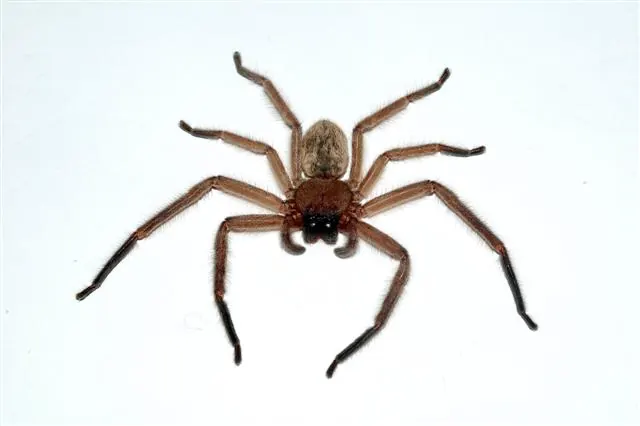
Delena cancerides
Social Huntsman Spider Identification: Delena cancerides
A very flat red-brown and grey-brown huntsman with dark leg tips, adapted to tight bark retreats and sometimes living in persistent groups.
Usually low riskAbout the Social huntsman spider
The social huntsman, Delena cancerides, is an Australian huntsman adapted to narrow spaces beneath loose bark, timber and slabs of wood. It has the sideways-spreading huntsman legs, but is especially flat and often shows a red-brown carapace, grey-brown abdomen, longer front legs and dark tips on the feet. Finding several together strongly supports this species, yet a solitary spider can still be D. cancerides and a temporary cluster of young huntsmans does not prove it. Identification should combine body form, colour pattern, size, locality and retreat. The name “social” describes prolonged group living, not aggression toward people or a communal capture web.
How to identify a social huntsman spider
Confirm the huntsman body plan first: the leg joints are rotated so the legs spread broadly forwards and sideways, and the spider can move laterally as readily as forwards. Delena cancerides is flatter than many familiar house huntsmans, allowing it to occupy crevices only slightly deeper than its body. Museums and Victorian field-guide records describe a red-brown front body, grey-brown abdomen, front legs longer than the rear pair and dark brown to black leg tips. Adult males reach about 20 mm in body length, while females can approach 40 mm; leg span is much greater and should not be confused with body length. A group containing one or more adults with differently sized juveniles beneath the same bark is powerful supporting context, but the species is also encountered alone. Species confidence needs the complete dorsal pattern and proportions, because many Australian Sparassidae are brown, flat and fast.
Clues that are not enough on their own
- Finding several huntsmans together, because many species remain briefly clustered after hatching
- Brown or grey colour alone, which is shared by numerous huntsman genera
- A very large leg span estimated from a close photograph without a ruler or body-length measurement
- Being under bark by itself, because other huntsmans and unrelated flattened spiders use the same retreat
Colour, sex and life-stage variation
The red, brown and grey tones vary with age, moulting, bark colour, lighting and camera white balance. Juveniles are smaller and may show less obvious contrast between the carapace, abdomen and dark feet. Adult males are usually slimmer and have enlarged palpal bulbs; adult females are broader and may be associated with a flattened white silk egg sac. Group composition also varies, so a retreat is not always a simple mother-and-young family. Peer-reviewed 2025 research found more complex summer groups that could include several adult females, males and juveniles, whereas spring groups were more often dominated by one adult female and juveniles. The licensed exact-species hero is a female photographed in New Zealand, where D. cancerides is naturalised. It is an anatomical reference, not evidence of an Australian locality or universal colour tone.
Behaviour, web and retreat
Social huntsmans are active hunters and do not construct an orb, sheet or tangled prey-catching web. They leave the bark retreat to take insects and other invertebrates, then return to a narrow shared shelter. Their sociality is unusual because it persists well beyond the brief period when ordinary huntsman spiderlings remain together after hatching. Recent research reports that juveniles can share prey beyond that early stage, particularly larger prey, and that colony structure changes with season. “Social” should therefore be read as tolerant, prolonged group living with a complex membership, not as a promise that every individual shares food or that unrelated spiders are welcomed. A cluster exposed by lifting bark may scatter rapidly; this is normal escape behaviour and not a coordinated attack.
Australian distribution
Delena cancerides is native to Australia and has been introduced to New Zealand. The current Australian Faunal Directory explicitly lists the Australian Capital Territory, New South Wales, Tasmania and Western Australia, and its locality notes include Victoria. Victorian museum and field-guide records describe the species across eastern and south-western mainland Australia and Tasmania. This guide therefore uses ACT, NSW, Victoria, Tasmania and Western Australia as documented state filters rather than retaining the previous all-state selection. That does not prove absence from every unlisted locality, but reports outside the mapped range should include exact location, scale, a clear dorsal photograph and the retreat context before a species name is applied.
What to do if you find one
Do not strip loose bark from a living or dead tree merely to expose or count a colony. Bark shelters are limited habitat, and lifting a slab can separate juveniles, damage egg sacs and remove protection from weather and predators. Photograph the retreat entrance and visible spiders without placing fingers beneath the bark. If one enters a house or car, stop movement first, keep hands away, cover the spider with a wide container, slide stiff card underneath and release it at a sheltered bark or timber site nearby. Move only the wandering individual rather than trying to collect an entire outdoor group. A spider seen near a skin mark is not proof that it caused the mark; follow current Australian bite guidance and respond to symptoms.
Compare with similar spiders
Use body shape, web or retreat, location and behaviour together before settling on a likely match.
- Huntsman spider — Huntsman spider - use the family page when sideways legs are clear but the extreme flattening, dark foot tips, colour pattern or retreat evidence is missing. Social behaviour supports Delena but is not required for every individual.
- Brown huntsman spider — Brown huntsman spider - can share a warm brown colour and household setting. Compare the social huntsman’s flatter body, red-brown carapace, grey-brown abdomen, dark feet and bark-group context rather than relying on size.
- Grey huntsman spider — Grey huntsman spider - grey or brown huntsmans overlap strongly in photographs. Delena is typically more compressed for life beneath bark and has longer front legs with dark tips; a poor image may justify only Sparassidae.
- Lichen huntsman spider — Lichen huntsman spider - Pandercetes gracilis is much smaller, restricted to Queensland in current AFD data and covered in dense lichen-like disruptive hairs. Delena is larger, smoother and associated with tight bark retreats and group living.
Sources for this profile
These accessible authoritative sources support the identification and bite-safety context on this page.
- Australian Faunal Directory: Delena cancerides
- Australian Museum: Huntsman Spiders
- Biodiversity of the Western Volcanic Plains: Social Huntsman
- Macquarie University: Seasonal group structure in Delena cancerides
- healthdirect: Spider bites
Profile review
Published by Spider Identifier Australia. Last factual review: 10 August 2026.
Quick identification
- Very flat body and laterigrade legs spreading forwards and sideways
- Red-brown carapace with a grey-brown abdomen and dense fine hairs
- Front legs longer than the rear legs, often ending in dark brown or black tips
- Adult females may reach about 40 mm body length; males are slimmer and up to about 20 mm
- Often beneath loose bark, wood or slabs, sometimes beside adults and juveniles of several sizes
What to check next
Photograph the whole spider directly from above, then take a side view that shows how flat the body is and a wider image of the bark or timber retreat. Record body length without the legs, locality and whether spiders of several sizes were genuinely sharing the same crevice. Do not peel more bark away to count a group. A single brown huntsman with no clear dorsal or retreat context may remain at family level.
When to seek medical help
Social huntsmans can bite if trapped or handled, and a large individual may cause local pain, redness, swelling, burning or itching. Avoid direct handling. For a suspected bite, wash the area and apply a wrapped cold pack for local discomfort. Seek medical advice if pain is severe, symptoms persist or worsen, swelling or itching increases, or you are concerned. Call Triple Zero (000) for breathing difficulty, collapse or other signs of anaphylaxis.
Where it is usually seen
Tight crevices beneath loose bark on dead trees and stumps, beneath bark slabs, logs, woodpiles, timber and rocks, plus sheds and occasional indoor hiding places. Documented Australian range is strongest in eastern and south-western regions and Tasmania.