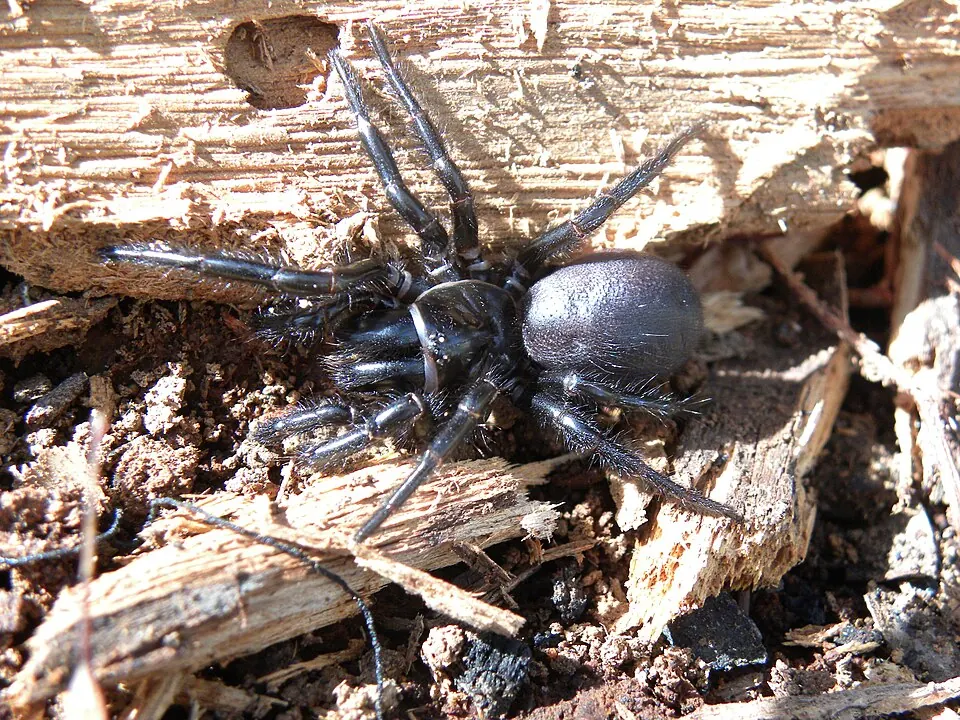
Hadronyche cerberea
Southern Tree Funnel-Web Identification: H. cerberea
Medically important tree-dwelling funnel-web from eastern New South Wales, identified most usefully by funnel-web anatomy, range and a silk retreat in rough-barked timber.
Medical emergency — call 000 for suspected biteAbout the Southern tree funnel-web spider
The southern tree funnel-web, Hadronyche cerberea, is a medically important funnel-web spider found along the south-eastern coast and highlands of New South Wales, north to the Hunter River region. It is a tree specialist rather than simply a dark spider found near wood: established retreats occur in trunk fractures, rot holes and old borer holes in rough-barked paperbarks, banksias, she-oaks and eucalypts. Look for the funnel-web group first—a robust spider with a glossy, mostly unpatterned carapace, closely grouped eyes, powerful down-striking jaws and visible rear spinnerets—then combine those features with an eastern NSW locality and a concealed silk-lined tree retreat. Colour or a single photograph cannot safely prove H. cerberea, and the characters that separate it from close Hadronyche species require expert examination. Any suspected bite is a medical emergency, whether or not the exact species is known.
Exact-species specimen views
These licensed exact-taxon photographs show useful anatomy and variation. Use each caption for record and image context; no single image set represents every colour, posture or habitat.


How to identify Hadronyche cerberea safely
Begin at family level. Australian funnel-web spiders have a hard, shiny carapace with no strong dorsal pattern, a softer and hairier abdomen, eyes packed into a compact group, powerful parallel-moving jaws and four spinnerets at the rear. H. cerberea is a smaller tree-dwelling Hadronyche than the northern tree funnel-web, H. formidabilis. Gray’s revision described one male at about 16 mm body length and one female at about 25 mm; these are documented specimens, not absolute size limits. Species diagnosis uses the shape and spination of the mature male’s second-leg swelling and mating organ, together with thorn-like hairs around the first two leg bases and sternum. Those are specialist microscope characters and must never be checked on a live spider. For a useful field identification, require the broad funnel-web structure, an eastern NSW locality south of the Hunter and a silk retreat in rough-barked timber. If any part is missing, identify it only as an Australian funnel-web or Hadronyche.
Clues that are not enough on their own
- Glossy black colour by itself, because many funnel-webs, mouse spiders and trapdoor relatives are dark
- Finding a spider on a tree or log without documenting a silk-lined cavity retreat and funnel-web structure
- A Sydney, Central Coast or eastern NSW location alone, because several medically important funnel-web species overlap
- Large fangs or a defensive posture, which are not species-level characters and must never be provoked for a photograph
- Body size estimated from leg span or camera perspective instead of a safe scale beside the spider
Colour, sex and life-stage variation
A southern tree funnel-web is not always jet black. The carapace can appear black, mahogany or reddish brown as light reflects from it, while the softer abdomen can range from dark brown to a lighter maroon or plum tone. Adult males are usually slimmer and leggier and have enlarged palps; females are broader-bodied and remain associated with established retreats. Juveniles are smaller and may be browner or less heavily hardened. The four licensed photographs on this page are all exact H. cerberea: two live female views show the natural posture and defensive display, while the Australian Museum specimens show a male and a male–female comparison. Preserved specimens can lose natural colour and posture, so use them for proportions and anatomy rather than as a colour chart.
Behaviour, web and retreat
This species builds a silk-lined retreat inside a tree-trunk fracture, rot hollow or insect-borer hole. The exposed silk entrance and tunnel can be disguised with bark particles, leaf litter, wood fragments and insect frass, while irregular trip lines cross the bark and transmit vibrations from passing prey. Australian Museum observations note that retreats often have two entrances and that prey can include beetles and small tree frogs. This is a hidden shelter with radiating signal lines, not a neat circular orb web. Females and juveniles can remain within a suitable timber cavity, whereas mature male funnel-webs may leave shelter and wander in humid weather while seeking mates. A spider found walking on the ground, indoors or in a pool has lost the strongest species-level clue, so do not assume H. cerberea from locality and colour alone.
Australian distribution
Gray’s taxonomic revision places H. cerberea along the south-eastern coast and highlands of New South Wales as far north as the Hunter River, and the Australian Museum summarises it as common in Sydney and the Central Coast while ranging through eastern NSW south of the Hunter. Examined records extend from the Newcastle and Central Coast districts through the Sydney basin and Blue Mountains to the Southern Highlands and south coast, with additional highland records. The old type locality “Sydney” was used more broadly than the modern city boundary and should not be read as a Sydney-only range. The Hunter boundary is a useful ecological guide, not proof from a postcode: other Hadronyche, Atrax, mouse spiders and trapdoor relatives overlap parts of the range. Keep the locality and retreat context with every photograph, but do not publish a vulnerable household coordinate.
What to do if you find one
Keep children and pets away and do not touch, corner or provoke the spider. Tree hollows and loose bark are the main practical hazard: gardeners, arborists and firewood handlers should inspect from a distance and use appropriate tools and protective work practices rather than putting fingers into holes or splitting suspect timber by hand. If a spider is indoors and nobody has been bitten, close the room, place a towel under the door if useful and photograph with zoom. A licensed pest professional is safer than bare-handed relocation. Only a confident adult should consider a wide-container and stiff-card capture when hands can remain well away and there is no fall or bite risk; isolation is preferable. If a bite may have occurred, stop identification or capture, call 000, keep the person still and begin pressure immobilisation immediately. Do not wait for pain, sweating, tingling around the mouth, nausea, twitching, breathing difficulty or confusion.
Compare with similar spiders
Use body shape, web or retreat, location and behaviour together before settling on a likely match.
- Australian funnel-web spiders — Australian funnel-web spiders - use the family-level page when the glossy carapace, compact eye group, jaws and spinnerets fit but the retreat, locality, sex or specialist anatomy cannot establish H. cerberea. This is the safest result for many photographs.
- Sydney funnel-web spider — Sydney funnel-web spider - Atrax robustus overlaps the Sydney and Central Coast region but is usually associated with a moist ground burrow rather than a concealed rough-barked tree cavity. A wandering male away from a retreat may require expert examination.
- Blue Mountains funnel-web spider — Blue Mountains funnel-web spider - Hadronyche versuta occurs west and south of Greater Sydney and is primarily ground-dwelling. The species differ in expert adult anatomy, so a dark spider beside timber is not enough to separate them.
- Mouse spider — Mouse spider - Missulena can also be dark, glossy, robust and medically significant, but usually has a broader bulbous head, eyes spread farther across the front and shorter spinnerets. Never approach a live spider to check; a suspected bite receives the same emergency response.
Sources for this profile
These accessible authoritative sources support the identification and bite-safety context on this page.
- Australian Faunal Directory: Hadronyche cerberea
- Atlas of Living Australia: Hadronyche cerberea
- Australian Museum: Australian funnel-web spiders
- Records of the Australian Museum: Revision of the Australian funnel-web spiders
- PubMed: Systematic review of funnel-web spider bites
- PubMed: Venom of tree-dwelling Australian funnel-web spiders
- healthdirect: Spider bites
Profile review
Published by Spider Identifier Australia. Last factual review: 10 August 2026.
Quick identification
- Robust dark mygalomorph with a hard, glossy and mostly unpatterned carapace
- Small eyes grouped closely above powerful jaws, with four rear spinnerets
- Silk-lined retreat in a trunk fracture, rot hole or old borer hole in rough-barked timber
- Eastern New South Wales south of the Hunter River, including Sydney and the Central Coast
- Exact species cannot be established safely from dark colour or a close-up photograph alone
What to check next
From a safe distance, photograph the whole upper surface and rear spinnerets, the retreat entrance and the surrounding tree. Record body length, locality, date, tree species if known and whether silk trip lines crossed the bark. Never peel bark, split timber or probe a hole to expose the spider.
When to seek medical help
Treat a suspected bite as a medical emergency. Call Triple Zero (000) and ask for an ambulance, lie the person down and keep them completely still. Apply an elasticated pressure-immobilisation bandage over the bite and then over the entire bitten limb, and splint the limb, if you can do so safely; mark the bite site, note the time and wait for the ambulance. Do not wash the bite, use a tourniquet or delay first aid to catch, photograph or identify the spider. Healthdirect applies this response to a funnel-web bite or a bite from any big black spider. A systematic review found severe envenoming in 3 of 4 eligible, expertly identified H. cerberea bites—75%, with a very wide 95% confidence interval of 19%–99%. That tiny historical sample cannot predict an individual bite; it supports treating every suspected bite urgently.
Where it is usually seen
Sclerophyll forest, open forest and wooded gardens in eastern New South Wales south of the Hunter River, especially rough-barked Melaleuca, Banksia, Allocasuarina and eucalypt trunks containing fractures, rot cavities or borer holes. Retreats may also occur in fallen timber and sheltered wood around homes.