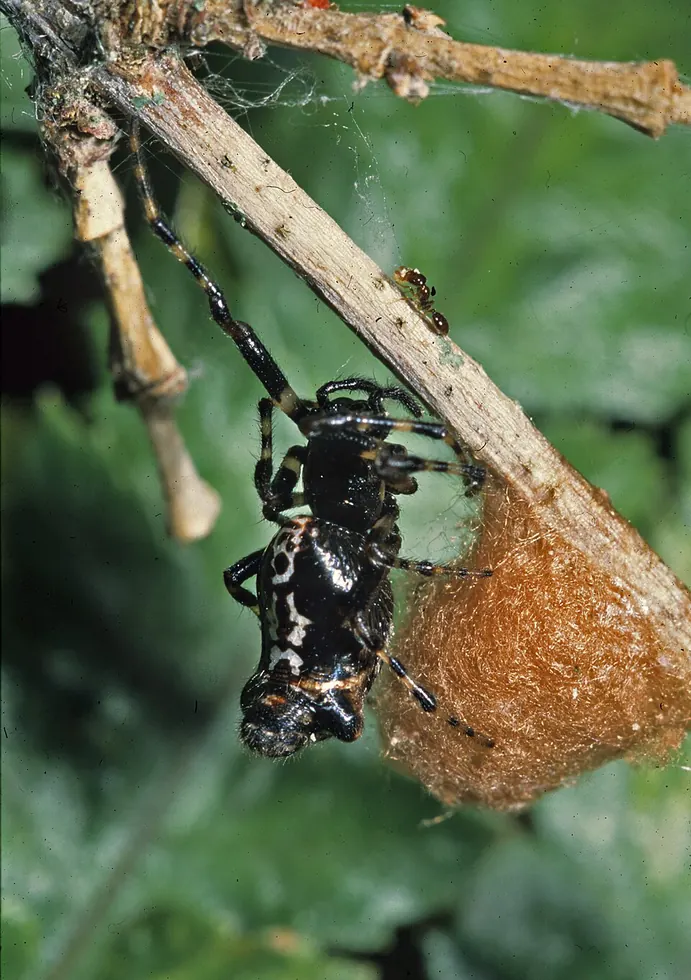
Cyclosa trilobata
Three-Lobed Spider Identification in Australia
Small dark orb-weaver with three blunt rear abdominal projections, banded legs and a debris-decorated web among low vegetation.
Usually low risk; bites are not well documentedThe three-lobed spider, Cyclosa trilobata, is a distinctive but easily overlooked orb-weaver recorded across southern and eastern Australia and also in New Zealand. An adult female is not simply “lumpy”: her broad oval abdomen ends in three blunt, transversely wrinkled projections, with the central projection much longer and stouter than the two beside it. Combine that rear outline with a glossy dark front body, broadly banded legs and a small orb web that may carry a pad or line of silk, prey remains or plant debris through the hub. The spider can sit against that decoration and visually merge with it. A debris line alone does not prove C. trilobata because several Cyclosa species decorate their webs, and Australian members of the genus remain difficult to separate. Photograph the dorsal outline, side profile and entire web before suggesting the species. The accepted name is C. trilobata; Australian databases also retain its original 1885 combination, Arachnura trilobata, as a synonym.
Quick identification
- Adult female about 9–9.5 mm long; adult male about 5 mm
- Female abdomen broad and oval, ending in three blunt wrinkled projections
- Centre rear projection visibly longer and stouter than the paired side projections
- Glossy dark front body with pale-to-dark legs marked by broad dark bands
- Small orb web, sometimes with a silk pad or debris line through the hub
What to check next
Photograph the spider from directly above and side-on, then include the entire orb and any debris or egg sacs in a wider frame. Measure body length without the legs. Confirm three separate blunt rear projections rather than one soft tail, ordinary paired humps or a blur of folded legs. A clear adult female can support a likely field identification; a male, juvenile or ventral-only photograph may justify only Cyclosa or Araneidae.
When to seek medical help
No useful species-specific Australian bite series was found, so low risk should not be translated as a guarantee that a bite cannot hurt. Avoid handling any spider solely to confirm the lobes. For a witnessed minor bite, healthdirect advises washing the area with soap and water and applying a cold pack. Seek medical advice for severe or persistent pain, spreading symptoms, infection signs, allergic symptoms or uncertainty about what bit you; call the Poisons Information Centre on 13 11 26 for Australian poisons advice. Call 000 for collapse, breathing difficulty or a severe allergic reaction. If an unidentified large dark ground spider could instead be a funnel-web or mouse spider, use emergency pressure-immobilisation guidance rather than this minor-bite advice.
Where it is usually seen
Small orbs between stems, shrubs, grasses and low woodland or garden vegetation. Exact-species observations include low scrub and gaps between shrubs; the web can be only a few centimetres across, although historical accounts also describe larger structures and groups of neighbouring orbs.