Australian spider questions
Where Should I Release an Indoor Spider?
A practical Australian guide to moving an indoor spider without bare-hand contact, and choosing a sheltered release spot that suits what it was doing.
Quick answer
Start here
For a wandering spider such as a huntsman, use a clear container and stiff card, then release it close to the building in a sheltered place with bark, shrubs, leaf litter or a protected wall edge. Do not carry an unknown spider in your hands. A spider living in a fixed web is different: if it is not in a risky spot, leaving the web alone may be kinder and more effective than moving it.
Useful clues
Read the situation first
Wandering across a wall or floor
A huntsman, wolf spider, jumping spider or white-tail is usually looking for shelter or prey rather than maintaining that exact indoor spot.
Living in a web
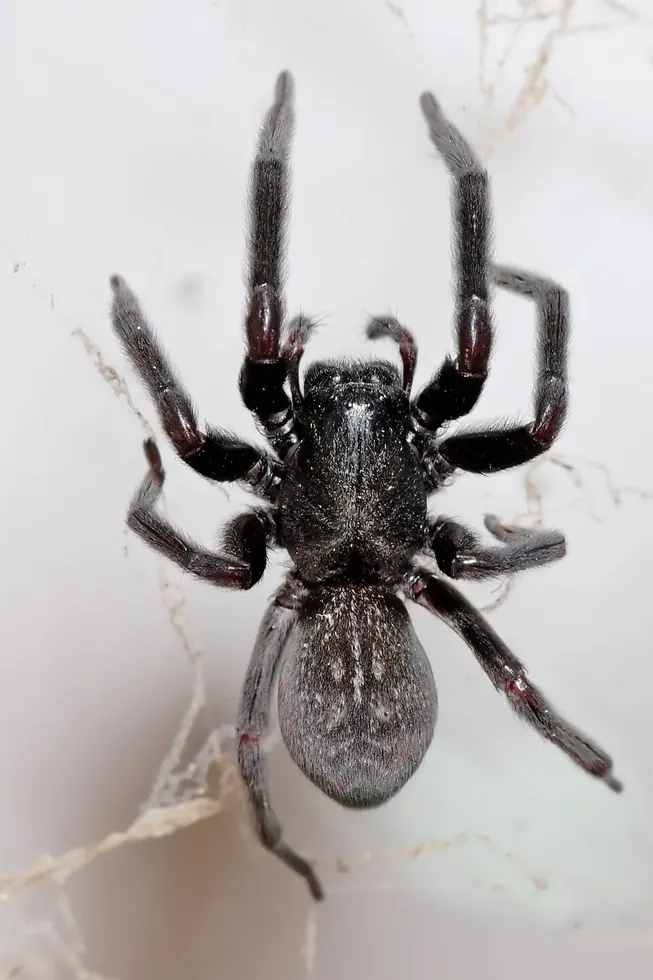
A black house, cupboard or other web-building spider may depend on its retreat. Moving only the spider can leave it exposed, so first decide whether relocation is necessary.
Unknown robust ground spider
Do not handle it or improvise with a tiny cup. Keep children and pets back and use a large container only if capture is clearly safe.
Redback-style tangled web
Avoid reaching into the web or lifting stored objects around it. Wear gloves and use professional pest help if the site cannot be approached safely.
Practical steps
What to do next
- Clear people and pets from the room and close nearby doors so the spider has fewer places to disappear.
- Place a wide, clear container over the spider, keeping fingers away from the rim.
- Slide firm cardboard underneath until the opening is fully covered, then keep the container upright.
- Take a photograph through the container if identification is still uncertain.
- Choose a nearby sheltered release point out of foot traffic, not an exposed lawn or hot paved area.
- Set the container down, lift it away from you, and give the spider a clear escape route without shaking it toward your body.
Match the release spot to the spider's broad lifestyle
Huntsmans use bark, tree trunks, fence gaps and sheltered exterior surfaces. Jumping spiders use sunlit vegetation and walls where prey is available. Wolf spiders are ground hunters, so leaf litter and low cover make more sense than a high branch. You do not need a species-level identification to make a sensible broad match.
Nearby is usually more practical than far away
An indoor spider may have entered through a door, window, roof gap or items brought inside. Releasing it into suitable cover near the building avoids a long trip in a container and keeps the encounter simple. If spiders repeatedly enter, weather strips, flyscreens and reducing clutter at entry points address the route more reliably than moving one spider a long distance.
A fixed-web housemate needs a different decision
Black house spiders often build around windows, cracks and sheltered building edges. If the web is away from beds, shoes, children's areas and frequently handled objects, leaving it may be reasonable. If renovation or cleaning makes movement necessary, shift the web and retreat together with a long-handled tool rather than trying to pick up the spider.
Do not relocate every spider the same way
Funnel-web and mouse-spider lookalikes, redbacks in protected webs, and any spider involved in a suspected bite need extra caution. Identification photos should be taken without opening the container. If capture would require bare hands, reaching into clutter or working close to a suspected medically significant spider, step back instead.
If it comes back inside
A returning huntsman does not necessarily recognise the house or person. The building may simply offer warmth, prey and useful gaps. Check door seals, flyscreens, vents and cluttered edges, and release future visitors on the sheltered side of the property away from the usual entry point.
Profiles to compare
Open the closest spider profiles
Common questions
Where Should I Release an Indoor Spider? FAQ
Should I release an indoor spider outside?
For a wandering spider in an unwanted room, contained release is a reasonable option. A harmless fixed-web spider may be left alone if its position is not risky.
How far from the house should I take it?
A nearby sheltered spot is normally enough. The quality of cover matters more than carrying it a long distance.
Can I use my hands if it is a huntsman?
No. Even a usually reluctant biter can bite when trapped or squeezed. Use a container and card.
What if I cannot identify it?
Keep the container closed, take clear photos and use the identifier. Do not release or handle it until you can do so without close contact.
What if a bite may have happened?
Put medical care ahead of relocation. Call 000 for a suspected funnel-web or mouse-spider bite or serious symptoms, and use healthdirect or the Poisons Information Centre for advice.
Identification is not medical advice
If a bite has occurred or someone seems unwell, follow Australian health advice and seek urgent help for serious symptoms.