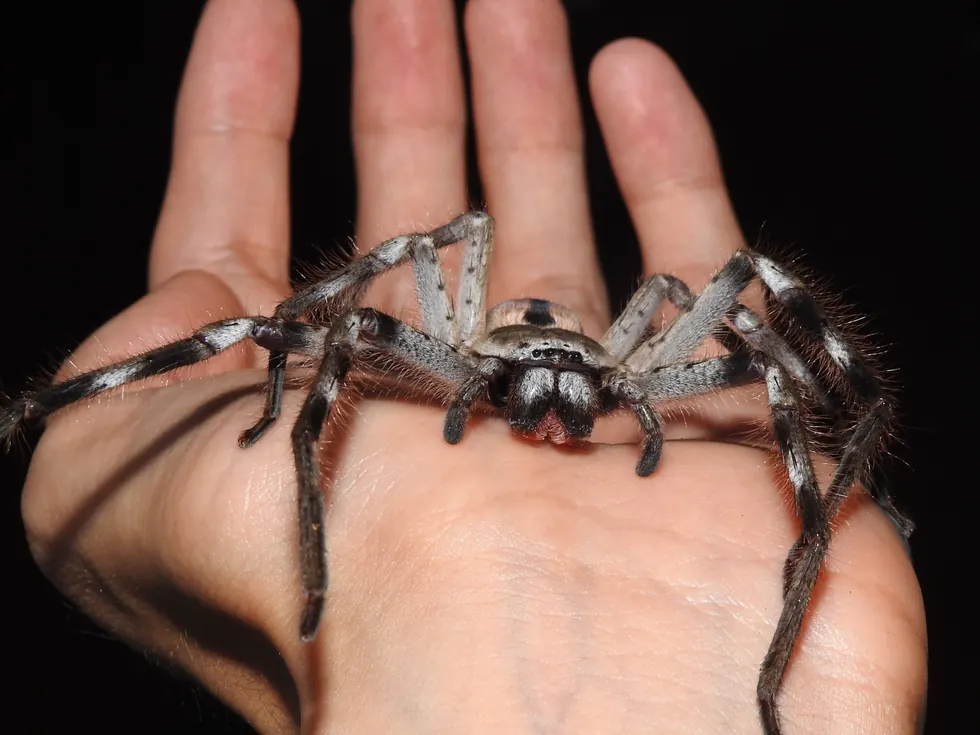
Holconia immanis
Banded Huntsman Spider Identification in Australia
Large grey-brown huntsman from eastern Australia, often recognised by banded legs, a flat body and wall, bark or ceiling habitat.
Painful but usually not life-threateningAbout the Banded huntsman spider
Banded huntsman spiders, also called giant banded huntsmans or grey huntsmans, are large eastern Australian huntsman spiders. They are most useful to compare when a broad, flat, fast spider is seen on walls, ceilings, bark, fences or sheltered outdoor structures, especially in Queensland, New South Wales or Victoria.
How to identify a banded huntsman spider
The accepted name on this page is Holconia immanis (L. Koch, 1867), a large huntsman in the family Sparassidae. The field combination is a broad, flattened body, legs splayed forward and sideways in the huntsman “crab” posture, grey to brown colouring and conspicuous dark banding on hairy legs. A short dark stripe or dagger-like mark on the abdomen can be visible, but it is not a stand-alone test. Holconia was formerly confused with Isopeda in older literature, so an older label or a generic “grey huntsman” name may point to the same species concept without proving it. A clear dorsal view, body length, leg span and eastern-Australian locality are more useful than a ceiling photograph cropped to the legs.
Clues that are not enough on their own
- A large leg span alone, because several huntsmans and other spiders overlap in apparent size
- Grey or brown colour without the body, leg-band and locality combination
- One dark abdominal stripe, which can be hidden by posture, light or moult
- A wall or ceiling encounter, since many huntsman species share indoor and peridomestic habitats
- Sideways running by itself, because other crab-like hunters can move laterally
- An old Isopeda or “grey huntsman” label treated as a current species confirmation
- A Tasmania or non-eastern record assigned to H. immanis solely from the common name
Colour, sex and life-stage variation
Adult size varies with sex, age, feeding and how the legs are spread. Australian Museum summaries give huntsman body lengths around 2 cm in general, while Holconia immanis field accounts report females to about 45–50 mm and males to about 32 mm; a hand-span estimate is therefore a rough visual cue, not a measurement. Grey, brown and muted patterned individuals may look different under warm indoor light, bark shade or flash. Bands can be stronger on the legs than on the body, and the abdominal dagger mark can be faint. Juveniles, moulting spiders and a flattened spider viewed from below may not show the adult pattern. Do not assign the species from size or one stripe alone.
Behaviour, web and retreat
Adult huntsmans do not build a prey-catching web. Holconia immanis is a sit-and-wait or wandering hunter that can return to a favoured ambush site on bark, a wall or a sheltered house edge and then run rapidly when disturbed. Loose bark, rock crevices, ceilings and garden structures provide daytime shelter; the spider may emerge at night to hunt insects and other spiders. A female can guard a silk egg sac under bark or another protected surface, so do not lift bark or poke into a retreat. Running sideways is an escape strategy, not a sign that the spider is pursuing a person. Photograph it in place instead of provoking movement or trying to turn it over.
Australian distribution
The World Spider Catalog accepts Holconia immanis and gives its distribution as Australia; Australian field sources place the familiar grey or giant banded form in eastern Australia from Queensland through New South Wales to Victoria. The project filter is therefore kept to those three states rather than all Australian jurisdictions. Holconia is a multi-species genus, including other banded or grey forms, so a record in Tasmania, South Australia, Western Australia, the Northern Territory or the ACT should not be converted to H. immanis from a common name alone. Preserve the exact locality and seek a museum or expert review when the range or leg pattern is unusual.
What to do if you find one
For an outdoor spider, leave it under bark or on the wall and take a dorsal photograph, a side view, the full leg span and the surface it is using. Put a ruler or familiar object beside it only if this can be done without contact. Indoors, keep children and pets away; use a container and stiff card for relocation only when necessary, and wear gloves when moving loose bark, stored items or garden material. Do not handle a large huntsman to obtain a close-up. If a bite occurs, wash the area and follow healthdirect advice; seek care for severe or persistent pain, allergy symptoms, spreading swelling or worsening illness.
Compare with similar spiders
Use body shape, web or retreat, location and behaviour together before settling on a likely match.
- Huntsman spider — Huntsman spider - the broad group includes many grey-brown species. Keep the result generic when the Holconia body and banding are not clear.
- Badge huntsman spider — Badge huntsman spider - Neosparassus often has a less flattened body and a stronger badge-like dorsal pattern. A single brown flash image can hide both differences.
- Green huntsman spider — Green huntsman spider - foliage camouflage and a green or olive cast can obscure the banded grey Holconia pattern. Habitat is a clue, not a diagnosis.
- Grey huntsman spider — Lichen huntsman spider - bark camouflage can make Pandercetes look flat and mottled. Compare the overall body, leg proportions and exact locality rather than matching texture alone.
Sources for this profile
These accessible authoritative sources support the identification and bite-safety context on this page.
- Australian Faunal Directory: Holconia immanis
- Atlas of Living Australia: Holconia
- World Spider Catalog: Holconia immanis
- World Spider Catalog: Holconia catalogue
- Australian Museum: Huntsman spiders
- OZCAM: Holconia immanis specimen record
- Toohey Forest Environmental Education Centre: Grey huntsman
- healthdirect: Spider bites
Profile review
Published by Spider Identifier Australia. Last factual review: 13 August 2026.
Quick identification
- Large huntsman shape with a very wide leg span
- Grey to brown body with banded or hairy-looking legs
- Flattened body that can tuck under bark, cracks or sheltered edges
- Usually hunts without a capture web on walls, ceilings, bark, fences or garden structures
What to check next
Check for the classic huntsman posture: broad flat body, sideways-splayed legs and banded legs. Compare with generic huntsman spiders, badge huntsmans and lichen huntsmans if the markings are unclear.
When to seek medical help
Bites can be painful but are not usually considered life-threatening. Seek medical advice for severe pain, allergic symptoms, infection signs, spreading symptoms or uncertainty after any bite.
Where it is usually seen
Tree bark, loose bark, walls, ceilings, fences, sheds, verandas, garden structures and sheltered house edges in eastern Australia, especially Queensland, New South Wales and Victoria.