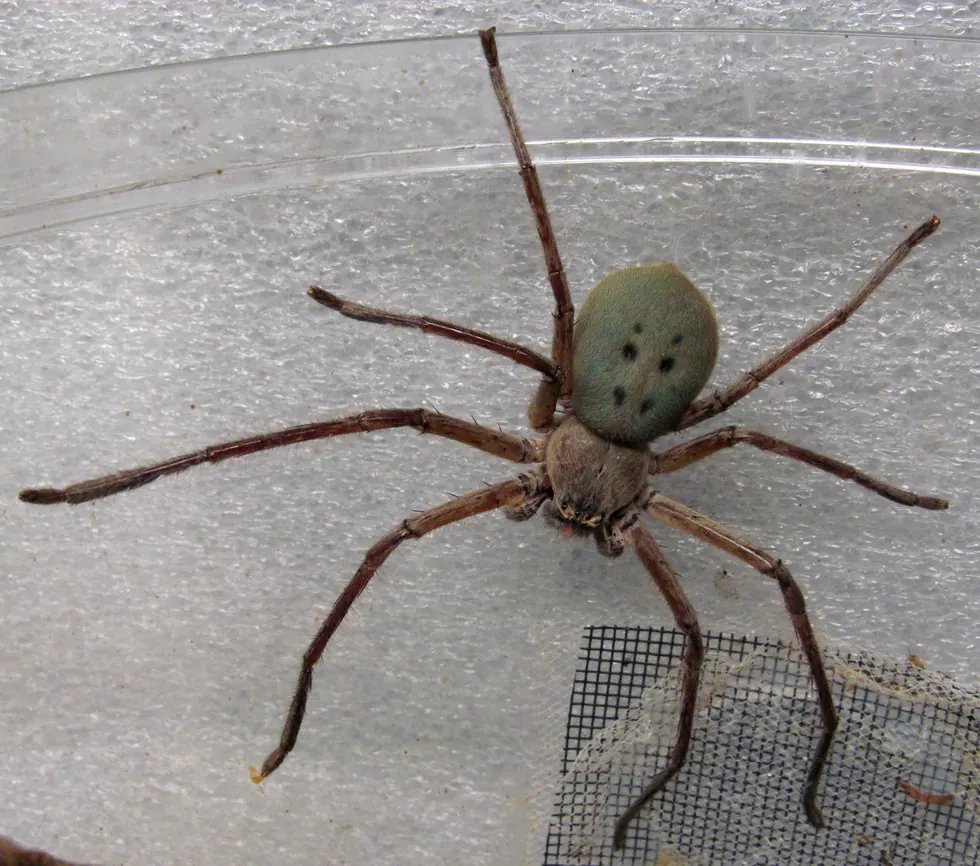
Typostola barbata
Green Huntsman Spider Identification: Typostola barbata
Australian green-bellied huntsman with a fawn body, green at the leg joints, paired black abdominal dots and an orange hair patch above the fangs.
Usually low riskAbout the Green huntsman spider
In Australia, “green huntsman” is an ambiguous common name. This guide covers the native Green-bellied Huntsman, Typostola barbata, also called the Giant Huntsman Spider. Despite the name, adults are usually fawn rather than uniformly green. Green dots at the leg joints, paired black dots on the abdomen and an orange “moustache” above the fangs are more useful clues. A vivid leaf-green huntsman may instead be a juvenile Neosparassus, while the European Micrommata virescens is not the Australian species covered here. Use structure, markings and locality together rather than naming a spider from colour alone.
How to identify a green-bellied huntsman spider
Start with the huntsman body plan: a broad, flattened body and long laterigrade legs whose joints allow them to spread forwards and sideways in a crab-like stance. Typostola barbata reaches about 19 mm in body length according to the Victorian field guide; its full leg span is substantially larger, so compare body length without the legs whenever possible. The species name is easy to misread as a promise of an entirely green spider. Adults are commonly fawn. Look closely for green showing at the leg joints, not just a green cast caused by foliage or camera white balance. Several dark spots can form paired rows on the upper abdomen. The most distinctive close-up clue is a patch of orange hairs above and between the chelicerae, described as an orange moustache. No single mark is guaranteed to be visible in every photograph, but the combined body shape, green joints, abdominal dots, orange facial hairs and south-eastern/eastern Australian range provide a defensible match. Do not turn over or restrain a live spider to check hidden features.
Clues that are not enough on their own
- Green colour by itself, because Typostola barbata adults are often fawn and juvenile Neosparassus can be vivid green
- A spider found on foliage, because many unrelated hunting spiders use leaves and shrubs
- Sideways legs alone, which support the huntsman family but not this species
- A web-free household encounter without clear joint, abdominal or facial markings
- An online image labelled green huntsman without confirming that it depicts an Australian taxon
Colour, sex and life-stage variation
Colour is the main identification trap. The Green-bellied Huntsman can look fawn, grey-brown or softly olive, and green may be limited to small joint areas. The paired black abdominal dots can vary in prominence or disappear in glare, shadow or a low-resolution phone image. Mature males are generally slimmer and longer-legged than females; females may have a fuller abdomen, but sex does not replace the diagnostic pattern. Bright leaf-green huntsmans in Australia also require a separate comparison. The Australian Museum notes that some juvenile Neosparassus badge huntsmans are vivid green and that some undescribed species remain green as adults. Those spiders should not be forced into Typostola from colour alone. The former page photograph showed the European Micrommata virescens from Albania and has been removed. The replacement is an exact-species female photographed in a Cornell University laboratory container; it shows useful morphology but does not document natural habitat or an Australian field locality.
Behaviour, web and retreat
Typostola barbata is a timid active hunter. It does not construct an orb, sheet or tangled capture web. Instead, it uses stealth and speed to catch insects and other invertebrates on foliage, bark and nearby surfaces. Its flattened body and sideways leg posture help it fit into narrow shelters beneath loose bark, in logs and among rock crevices. A daytime spider pressed motionless against a surface may be resting or relying on camouflage; at night it may move more openly while hunting. Sudden movement, torchlight or an attempted touch can make a huntsman sprint rapidly. A silk-lined retreat, dragline or egg sac can be present without being a prey-catching web. Behaviour supports the identification only when the physical markings and documented range also fit.
Australian distribution
Typostola barbata is native to Australia. The Victorian Biodiversity of the Western Volcanic Plains field guide documents it in Victoria, New South Wales and Queensland, and the Australian Faunal Directory recognises the accepted species. Those three states are therefore used as the profile filters. They are an evidence-based route, not proof that the spider occurs throughout each state or that every greenish huntsman elsewhere is excluded. A useful record should include the town or region, date, body length without legs, a dorsal photograph, a front view if safely possible, and a wider habitat image. Records outside the documented range or images without the orange facial hairs and joint colour should remain at Typostola or huntsman-family level until checked by an arachnologist.
What to do if you find one
Leave the spider in place when practical and photograph it without touching the bark, foliage or retreat. A wide dorsal image can capture leg posture and abdominal dots; a zoomed front image may reveal the orange hairs, but do not corner the spider or put fingers near it. If it enters a house or vehicle, give it an escape route or cover it with a wide clear container, slide stiff card underneath and release it in a sheltered outdoor position nearby. Do not pick it up by hand, spray it for identification or keep it confined for a prolonged photo session. If an egg sac or spiderlings are present, avoid separating them. After a suspected bite, follow current health advice based on symptoms rather than waiting for an exact identification.
Compare with similar spiders
Use body shape, web or retreat, location and behaviour together before settling on a likely match.
- Badge huntsman spider — Badge huntsman spider - juvenile Neosparassus can be bright green, and some undescribed adults remain green. The underside badge and genus-level characters are more useful than colour; a vivid green huntsman is not automatically Typostola barbata.
- Huntsman spider — Huntsman spider - use the family page when the flattened sideways stance is visible but the green leg joints, paired black abdominal dots or orange moustache cannot be confirmed. This is often the honest result from one blurry photograph.
- Lichen huntsman spider — Lichen huntsman spider - Pandercetes gracilis is a smaller Queensland rainforest specialist with dense lichen-like mottling and fringed disruptive hairs. It lacks the simpler fawn body, joint dots and orange facial-hair combination used here.
- Grey huntsman spider — Grey huntsman spider - grey and brown huntsmans overlap in overall shape and household behaviour. A smoother grey spider without green at the joints or orange hairs above the fangs should not be called a green-bellied huntsman.
Sources for this profile
These accessible authoritative sources support the identification and bite-safety context on this page.
- Australian Faunal Directory: Typostola barbata
- Victorian Government field guide: Green-bellied Huntsman
- Queensland Museum: Huntsman Spiders fact sheet
- Australian Museum: Badge Huntsman Spiders
- healthdirect: Spider bites
Profile review
Published by Spider Identifier Australia. Last factual review: 10 August 2026.
Quick identification
- Flattened huntsman body with long legs spreading forwards and sideways
- Adult usually fawn, with small green areas or dots visible at the leg joints
- Several black dots may occur in paired rows on the upper abdomen
- Orange hairs form a moustache-like patch above and between the fangs
- Found on foliage, beneath loose bark or in sheltered rock and log crevices without a capture web
What to check next
Photograph the whole spider from above, then take a sharp front view only if it can be done without handling. Look for the combined fawn body, green leg joints, paired black abdominal dots and orange fang hairs. A uniformly bright-green spider or a photo that misses these features should remain at huntsman-family level.
When to seek medical help
Green-bellied huntsman bites can be painful, but the Victorian field guide reports that effects are usually local pain and swelling, with mild nausea or headache occurring occasionally. Avoid handling. For a suspected bite, wash the area and apply a wrapped cold pack for local discomfort. Seek medical advice if pain is severe, symptoms persist or worsen, swelling or itching increases, or you are concerned. Call Triple Zero (000) for breathing difficulty, collapse or other signs of anaphylaxis.
Where it is usually seen
Foliage and tree trunks, beneath loose bark, in rock-wall crevices, inside logs, and under rocks or fallen bark in documented parts of Queensland, New South Wales and Victoria.