Spider Identifier AustraliaBrowse spiders
Badge huntsman spider

Neosparassus species

Badge Huntsman Spider Identification in Australia

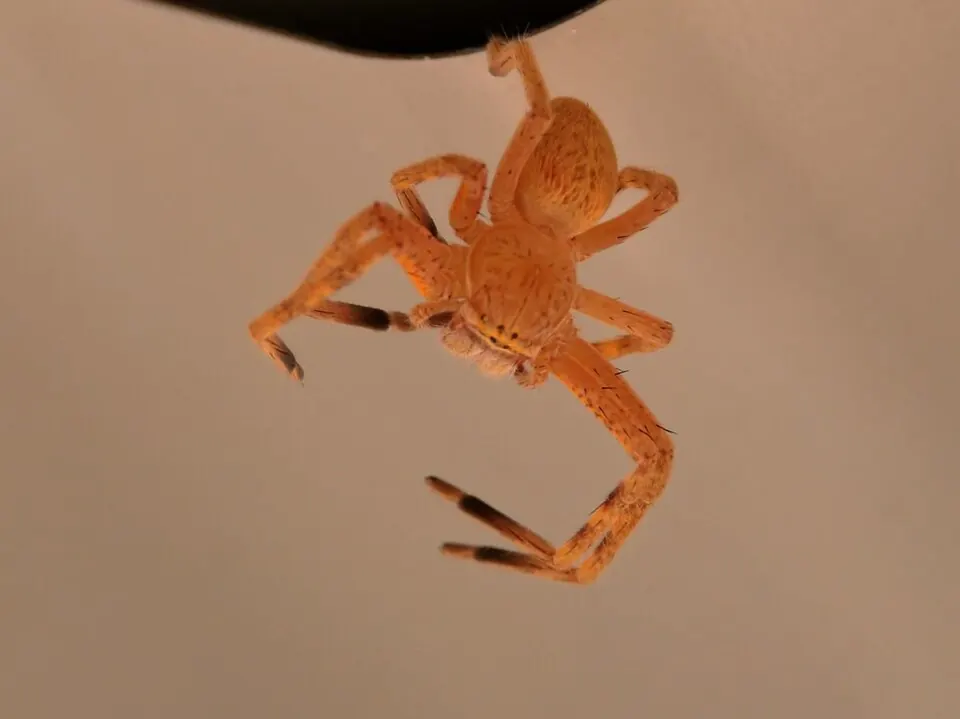
Large Australian huntsman with sideways-spreading legs and a dark, often brightly edged badge on the underside of the abdomen.

Painful but usually not life-threatening

About the Badge huntsman spider

Badge huntsman spiders are Australian huntsman spiders in the genus Neosparassus. The most useful clue is not the brown colour seen from above, but the combination of a broad huntsman stance and a dark shield-like badge on the underside of the abdomen, often accompanied by white, orange or yellow markings. They are active hunters rather than capture-web builders and are usually encountered on bark, foliage, walls or occasionally inside houses and cars. A dorsal photograph may support a huntsman-level identification, but a clear underside view and location are normally needed before narrowing the spider to the badge huntsman group.

How to identify a badge huntsman spider

Start with the huntsman body plan: the legs project forwards and sideways instead of sitting directly beneath the body, giving the spider a crab-like stance. Badge huntsman spiders are generally fawn, grey, orange-brown or pinkish-brown above and are less extremely flattened than many bark-living huntsman groups. The decisive feature is ventral. The underside of the abdomen carries a dark badge or shield, commonly bordered or spotted with white, orange or yellow, and the underside of the front legs may also be banded. Body length is commonly about 15–20 mm; compare body length separately from the much wider leg span.

Clues that are not enough on their own

  • Brown or grey colour by itself
  • A large leg span without measuring the body
  • Being found inside a house or car
  • An online photograph that shows only the upper surface

Colour, sex and life-stage variation

Colour varies between Neosparassus species and life stages. Juveniles are often bright green before becoming browner after later moults, and green can persist into adulthood in some forms. Adult males and females can look broadly similar from above, while the underside pattern may be more informative. Because the genus contains multiple Australian species, a photograph that shows the badge can support a genus-level identification without proving a particular species. The name Neosparassus diana should be reserved for spiders whose features and eastern distribution have been checked more closely.

Behaviour, web and retreat

Badge huntsman spiders are mostly nocturnal hunters of insects and other invertebrates. They do not build an orb, sheet or messy capture web. During the day they may shelter under bark, within a rock or log crevice, inside a silk-bound leaf retreat or, in some species, a shallow burrow. A female may guard a flat silk egg sac and can raise her body or display the coloured underside when threatened. That defensive display is useful for identification but is also a reason not to prod, turn over or handle the spider.

Australian distribution

The genus Neosparassus occurs across Australia, so state alone does not identify the spider. Habitat and the underside marking matter more. The well-documented species Neosparassus diana is associated particularly with eastern mainland Australia and Tasmania, but other badge huntsman species occur elsewhere. Treat online photographs labelled with a single species name cautiously when the underside, locality or diagnostic detail is missing.

What to do if you find one

Leave the spider undisturbed when possible, especially if it is guarding an egg sac or sitting in a silk retreat. If an indoor spider must be moved and no bite has occurred, keep hands away and use a wide container and stiff card rather than touching it. Release it into sheltered vegetation or near loose bark away from busy doorways. Do not chase a huntsman around a moving vehicle; stop safely first. If a bite has occurred, concentrate on the person and current Australian health advice rather than trying to force a species identification.

Compare with similar spiders

Use body shape, web or retreat, location and behaviour together before settling on a likely match.

  • Huntsman spider — The broad huntsman page is the safer match when the sideways legs are clear but no underside badge is visible.
  • Banded huntsman spider — Banded huntsman spiders show conspicuous banding from above; a badge huntsman diagnosis depends more on the ventral shield marking.
  • Green huntsman spider — Green huntsman spiders can overlap with green juvenile Neosparassus, so colour alone cannot separate them.
  • Grey huntsman spider — Grey huntsman spiders share the grey-brown upper surface but are not identified by the contrasting abdominal badge underneath.

Sources for this profile

These accessible authoritative sources support the identification and bite-safety context on this page.

Profile review

Published by Spider Identifier Australia. Last factual review: 10 August 2026.

Quick identification

  • Long legs spread forwards and sideways in the huntsman posture
  • Fawn, grey, orange-brown or pinkish-brown upper surface
  • Dark shield-like badge beneath the abdomen, often with contrasting pale or warm colours
  • Body commonly about 15–20 mm long; leg span makes the spider appear much larger
  • Active hunter on bark or foliage, without a prey-catching web

What to check next

Try to confirm the underside badge, leg posture, body length, daytime retreat and Australian location together. A brown spider seen only from above should remain a huntsman possibility rather than a confident Neosparassus identification.

When to seek medical help

Badge huntsman bites can be painful and may cause swelling or other symptoms. Follow Australian spider-bite guidance and seek medical advice if pain is severe, symptoms persist or worsen, or you are worried. Call 000 for breathing difficulty, collapse or other signs of a severe allergic reaction.

Where it is usually seen

Across Australia on tree trunks, under loose bark, in foliage, logs, rock crevices and sheltered woodland sites. Some species use leaf retreats or shallow burrows, and wandering individuals may enter houses, sheds or vehicles.

Still not sure?

Compare this spider with more clues

Spider lookalikes can be close. Compare size, web, hiding place and state before handling anything.