Spider Identifier AustraliaBrowse spiders
Bird-dropping spider

Celaenia excavata

Bird-Dropping Spider Identification Australia: Celaenia

Native Australian Celaenia excavata with a lumpy bird-dropping disguise, folded legs, moth-luring night hunt and distinctive round egg sacs.

Usually low risk

About the Bird-dropping spider

The common Australian bird-dropping spider, Celaenia excavata, is an orb-weaver relative that has abandoned the familiar circular capture web. The adult female is the conspicuous form: up to about 12 mm long, mottled cream, brown and black, with a broad triangular abdomen, a concave midline, two roughened rear humps and legs folded tightly against the body by day. That shape and posture resemble an unappetising bird dropping. At night she hangs from a short silk line, extends her front legs and chemically mimics a female moth signal to attract male moths within grabbing range. Large marbled-brown spherical egg sacs are a useful supporting clue, but other Australian spiders also mimic droppings, so colour or a lumpy outline cannot prove the species.

How to identify Celaenia excavata

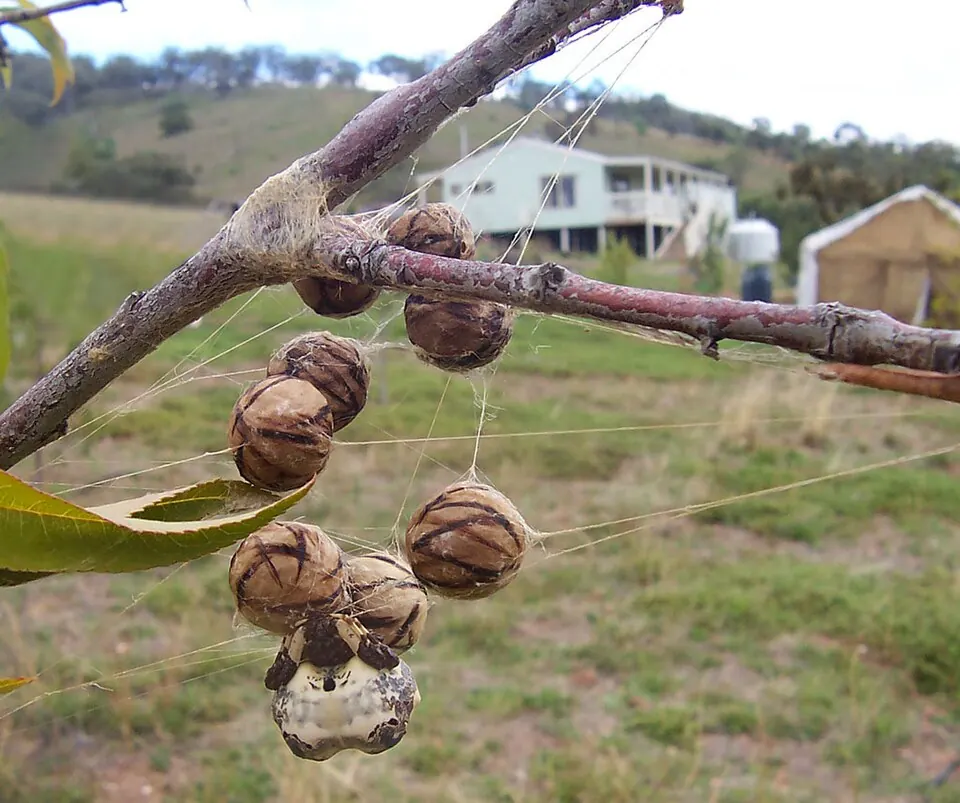
Begin with the adult female’s structure, not the common-name resemblance. From above, the abdomen is broad and roughly triangular rather than smoothly round. Its upper surface rises to two roughened humps near the rear and dips along the centre line. The body is squat and mottled cream, brown and black; by day the legs are pulled in so closely that a stationary female looks like a lump on a leaf or twig. Australian Museum gives a female body length of about 12 mm and a male length of only about 2.5 mm. Exclude egg sacs and outstretched legs from body measurement. A female beside spherical marbled egg sacs is a strong field match, but sacs may remain after she moves and a lone female may have none visible. Confirm several features and locality before using the species name.

Clues that are not enough on their own

  • Looking like a bird dropping: Arkys triangular spiders, bolas spiders and some crab spiders can produce the same first impression.
  • Cream, white, brown or black mottling by itself: many foliage spiders share these colours.
  • A round brown object on a branch: plant galls, cocoons and egg sacs of other animals may look similar from a distance.
  • No visible orb web by itself: many hunting spiders and resting orb-weavers are away from a capture web.
  • A 12 mm “spider” estimate made from a photograph: egg sacs and tightly folded legs can make the body boundary difficult to see.

Colour, sex and life-stage variation

Sex is the largest visible source of variation. The familiar bird-dropping mimic is the adult female, up to about 12 mm long. The adult male is only about 2.5 mm; despite similar brown, black and cream mottling, a tiny male will not present the same bulky silhouette. A female’s abdomen can change fullness after feeding or egg production, while posture, glare and the viewing angle can hide the central depression or rear humps. “Death’s Head Spider” refers to a skull-like interpretation of the markings, and “Orchard Spider” reflects its association with fruit trees, not different species. The main licensed photograph is an exact Celaenia excavata female with egg sacs, as are the two supporting source records retained for this profile. That repeated egg-sac view is useful for structure and behaviour, but it is not proof that every lone bird-dropping mimic is this species.

Behaviour, web and retreat

This species belongs to the orb-weaver family Araneidae but does not maintain a circular prey-catching web. By day the female sits exposed and motionless on a leaf, twig or egg-sac cluster, with her legs folded in; the disguise helps deter day-active predators such as birds and wasps. At night she hangs from the edge of foliage on a short silk line, spreads the front legs and emits an airborne chemical signal that mimics the sex attractant of female moths. Male moths following that false signal can be seized directly with the strong front legs, bitten and wrapped. Australian Museum and Museum Victoria describe the diet as mainly or almost exclusively male moths. Silk is still important for suspension and reproduction: a female may make up to 13 marbled spherical egg sacs, each roughly 12–14 mm across and containing more than 200 eggs, joined together beneath a branch.

Australian distribution

Authoritative records place Celaenia excavata across much of eastern and southern Australia, south-western Western Australia and Tasmania. Australian Museum also notes a record from Uluru in central Australia, so the Northern Territory cannot be excluded simply because most observations cluster farther south and east. Atlas of Living Australia maps more than a thousand occurrence records, but record density reflects observer and collection effort as well as the spider’s true range. The species occurs in woodland, dry sclerophyll forest, orchards, agricultural foliage and suburban gardens. Use state or territory as supporting context only: retain the date, broad locality, host plant and habitat with photographs, and do not assume that every bird-dropping mimic within this broad range is C. excavata.

What to do if you find one

Leave the spider and egg sacs attached to the plant if practical. It is a native moth predator, and cutting or spraying the branch can destroy a whole group of developing eggs. Photograph the stationary spider from above and the side without prodding it to unfold; a wider frame should show whether the round objects are suspended egg sacs and whether any capture web is genuinely present. At night, observe from a respectful distance and avoid repeated flash or touching the silk line to trigger a hunting response. If relocation is unavoidable, move the supporting twig or guide the spider into a container with paper rather than using bare fingers, then place it in sheltered nearby foliage. For any suspected bite, respond to symptoms and current Australian health advice rather than relying on a photo identification.

Compare with similar spiders

Use body shape, web or retreat, location and behaviour together before settling on a likely match.

  • Triangular spider — Some Arkys species also mimic bird droppings, but they show enlarged spined front legs, very short rear legs and a smaller angular body; they do not make the characteristic cluster of large marbled Celaenia egg sacs.
  • Magnificent spider — This moth-hunting bolas relative can be lumpy and pale on foliage, but it has a different humped body pattern and uses a sticky bolas line at night. Compare the exact body form, daytime shelter and egg sacs rather than behaviour alone.
  • Knobbly crab spider — A knobbly crab spider can sit motionless on foliage with a rough outline, but its first two leg pairs extend sideways in a true crab stance and it lacks the Celaenia abdomen depression and hanging marbled egg-sac cluster.
  • Garden orb weaver — A garden orb-weaver may curl its legs by day and have a bulky patterned abdomen, but it normally builds a circular capture web at night. Celaenia hunts from a short line and never presents a normal prey-catching orb.

Sources for this profile

These accessible authoritative sources support the identification and bite-safety context on this page.

Profile review

Published by Spider Identifier Australia. Last factual review: 10 August 2026.

Quick identification

  • Adult female body up to about 12 mm; adult male only about 2.5 mm
  • Broad triangular abdomen with a concave centre and two rough rear humps
  • Cream, brown and black mottling with the legs folded tightly against the body by day
  • Large round marbled-brown egg sacs may hang together from foliage
  • No orb capture web; the female hunts moths from a short silk line at night

What to check next

Take a directly overhead photograph, then a side view showing the abdomen humps and folded legs. Include any suspended egg sacs and a wider habitat frame, and record body length separately from the egg sacs.

When to seek medical help

Australian Museum says this spider’s bite is not considered dangerous. For an unexpected bite, wash the area and use a wrapped cold pack for pain or swelling; seek medical advice if symptoms are severe, persistent or worsening, and call Triple Zero (000) for signs of anaphylaxis.

Where it is usually seen

Foliage in open woodland, dry sclerophyll forest, orchards, agricultural areas and urban gardens, including fruit trees and shrubs where moths occur.

Still not sure?

Compare this spider with more clues

Spider lookalikes can be close. Compare size, web, hiding place and state before handling anything.