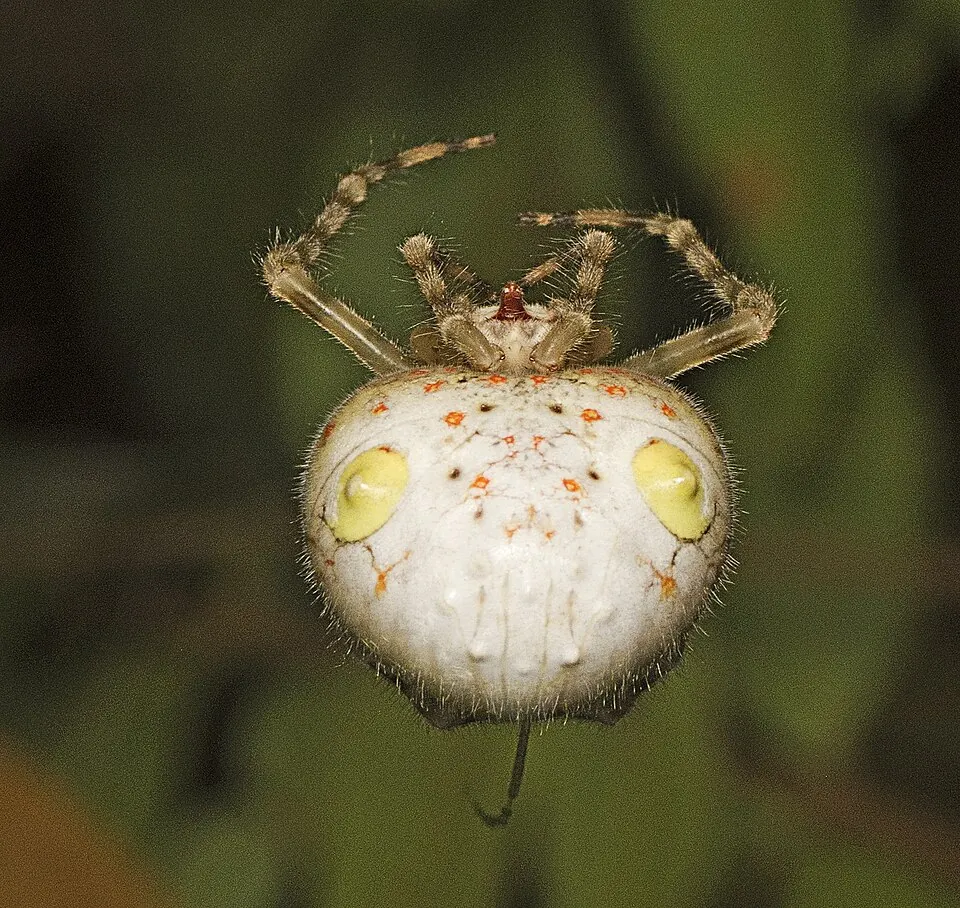
Ordgarius magnificus
Magnificent Spider Identification in Australia
Odd-looking bolas spider with a lumpy colourful body, often camouflaged on foliage during the day.
Usually low riskAbout the Magnificent spider
Magnificent spiders are unusual bolas-spider relatives and are often noticed for their lumpy body shape rather than a classic round web. A foliage setting, camouflage posture and lack of a large orb web help narrow the comparison, but an odd outline alone is not enough to name a species from a photo. Check the page beside other bolas and bird-dropping lookalikes before settling on a likely match.
Exact-species specimen views
These licensed exact-taxon photographs show useful anatomy and variation. Use each caption for record and image context; no single image set represents every colour, posture or habitat.


How to identify a Magnificent spider
The Magnificent spider is the accepted Australian species Ordgarius magnificus (Rainbow, 1897), formerly placed as Dicrostichus magnificus. It is a bolas spider in the orb-weaver family Araneidae, so the most useful identification comes from behaviour and life history as well as appearance. A female is a robust, pale or creamy spider with a lumpy abdomen, two bright yellow knobs and salmon, pink or reddish spots; long fine hairs are especially noticeable on the front legs. She is usually found on foliage or in a retreat made by binding leaves with silk, not sitting in the middle of a large circular orb web. The clearest field sign is often a cluster of spindle-shaped brown or tan egg sacs hanging nearby. At night the female suspends a short line with one or more sticky globules and swings it at approaching male moths. That behaviour is remarkable but rarely captured in a still image. A pale knobbly spider on a leaf can also be a different araneid or a cryptic orb-weaver. Use the complete combination of the body, egg sacs, retreat, broad locality and any safely observed night behaviour. Do not disturb a female, pull a leaf apart or handle an egg sac to obtain a closer view. The species-level page is deliberately narrower than the broader Bolas spider guide, but an image label or common name alone is never confirmation.
Clues that are not enough on their own
- A white or cream abdomen alone, because pale orb-weavers and moulting spiders can look similar in flash
- Two yellow knobs treated as a unique mark without checking body outline, retreat and locality
- A cluster of egg sacs used as proof of O. magnificus when the adult is absent or the sacs are not documented
- A lumpy or bird-dropping-like silhouette on foliage, because camouflage is shared by several araneids
- No classic orb web seen in daylight, because the spider may be in a retreat or a web may be out of frame
- A New South Wales or Queensland label treated as enough without a reliable image and current taxonomy
- A large “50-cent” size estimate that includes legs, perspective or a swollen abdomen
- A moth near the spider assumed to have been chemically lured when no hunting behaviour was observed
- An online label saying bolas, magnificent or Dicrostichus copied without checking the accepted Ordgarius name
Colour, sex and life-stage variation
Sexual size dimorphism is extreme. Australian Museum material gives the female roughly 1.4–2.5 cm in body length and the male about 1.5 mm, while field accounts often measure females around 10–14 mm. A tiny adult male can emerge from the egg sac with functional mating organs and bears little visual resemblance to the large female. The female’s abdomen swells as eggs develop, and colour can appear cream, white, pink, yellow, salmon or brown depending on age, light, substrate and camera flash. Juveniles and newly emerged spiderlings do not carry the full adult pattern. The series of spindle-shaped sacs changes as sacs are added, weathered or parasitised, and the spider may be absent during the day. Use the scale label only as a broad clue. A photograph cropped around the abdomen cannot establish sex, maturity or species, and a dark or dull individual should not be rejected solely because it lacks the bright adult markings described in museum accounts.
Behaviour, web and retreat
During daylight the female hides in a retreat made by binding leaves or nearby foliage with silk, often close to the distinctive egg-sac cluster. At night she spins a short support line and a single vertical hunting line with a sticky globule at its free end—the bolas. The globule may carry chemicals that mimic the scent of a female noctuid moth, drawing a male moth toward the spider. Fine hairs detect the approaching wing vibrations; the spider then twirls the line until the sticky globule strikes the moth. She hauls the line up, bites and immobilises the prey, and may eat it immediately or wrap it for later. This specialised single-line snare is the remnant of an orb-weaving ancestry, not an ordinary orb web. Egg sacs may contain hundreds of eggs, can number several in one season and may be attacked by wasps or flies. The mother usually dies over winter, and spiderlings disperse by ballooning in late winter or early spring. Observe the retreat and line from a distance; never tug the support or collect a sac.
Australian distribution
The World Spider Catalog lists Ordgarius magnificus as accepted in Australia, with Queensland and New South Wales as the documented range. Australian Museum and Arachne accounts place it in eastern Australian forest, sclerophyll and suburban-garden habitats, often in trees or tall shrubs above ground level. The local state filters therefore prioritise NSW and QLD; a Victorian or Western Australian label should prompt careful review rather than automatic range expansion. “Sydney” or “Brisbane” is not a species boundary, and nearby Ordgarius species can share the broader bolas-spider form. Keep the broad locality, host plant, season, retreat and image context with a record. The egg-sac cluster is useful habitat evidence but does not replace adult taxonomy. Check the current Australian Faunal Directory and WSC entry when a record needs a formal name, because older material may use Dicrostichus or a broad Bolas spider label.
What to do if you find one
Leave the female, retreat and egg sacs undisturbed. Keep children and pets away from the branch and do not cut foliage, pull a leaf bundle apart or place a container over a camouflaged spider. From a safe distance, photograph the whole plant, spider and egg-sac cluster with a broad locality and date; a short night video may document the line-swinging behaviour without a risky approach. Magnificent spiders are not considered dangerous to people, but any suspected spider bite should still be monitored and discussed with healthdirect or a poisons service if symptoms are severe, unusual or worsening. Do not climb, lean over water or enter dense foliage for a better angle. If a spider is in a high-traffic area, ask a licensed local wildlife or pest professional for advice rather than improvising a capture. An exact species name is less important than leaving the living retreat intact.
Compare with similar spiders
Use body shape, web or retreat, location and behaviour together before settling on a likely match.
- Bolas spider — Bolas spider - the broader Ordgarius and related-groups page covers the shared single-line hunt. Use this species page only when the adult pattern and Queensland/New South Wales evidence support O. magnificus.
- Bird-lime spider — Bird-lime spider - Celaenia excavata lures moths using a different strategy and has distinctive egg sacs; a moth association alone does not identify either species.
- Bird-dropping spider — Bird-dropping spider - a cryptic Celaenia or another orb-weaver can have a lumpy resting outline and pale patches without a bolas line or spindle-shaped Ordgarius sacs.
- Garden orb weaver — Garden orb-weaver - ordinary circular orb webs and round-bodied araneids share the same vegetation. A classic orb web argues against a daytime Magnificent-spider sighting, but an out-of-frame web is not decisive.
Sources for this profile
These accessible authoritative sources support the identification and bite-safety context on this page.
- Australian Faunal Directory: Ordgarius magnificus
- World Spider Catalog: Ordgarius magnificus
- World Spider Catalog: Ordgarius genus
- Australian Museum: Magnificent Spider
- Australian Museum: prey capture and feeding
- Australian Museum: bolas spider natural-history article
- Australian Natural History: bolas spider hunting article
- Queensland Museum: Spiders of Brisbane
- Wikimedia Commons: exact Ordgarius magnificus photograph
- Wikimedia Commons: exact Ordgarius magnificus egg-sac photograph
- healthdirect: Spider bites
Profile review
Published by Spider Identifier Australia. Last factual review: 14 August 2026.
Quick identification
- Lumpy colourful body
- Camouflaged on foliage
- Does not sit in a classic orb web by day
- Uses specialised silk hunting behaviour
What to check next
Check for a strange lumpy body on leaves rather than a flat huntsman or round orb-weaver.
When to seek medical help
Seek advice for severe or unexpected symptoms.
Where it is usually seen
Shrubs, trees, gardens and moist eastern Australian vegetation.