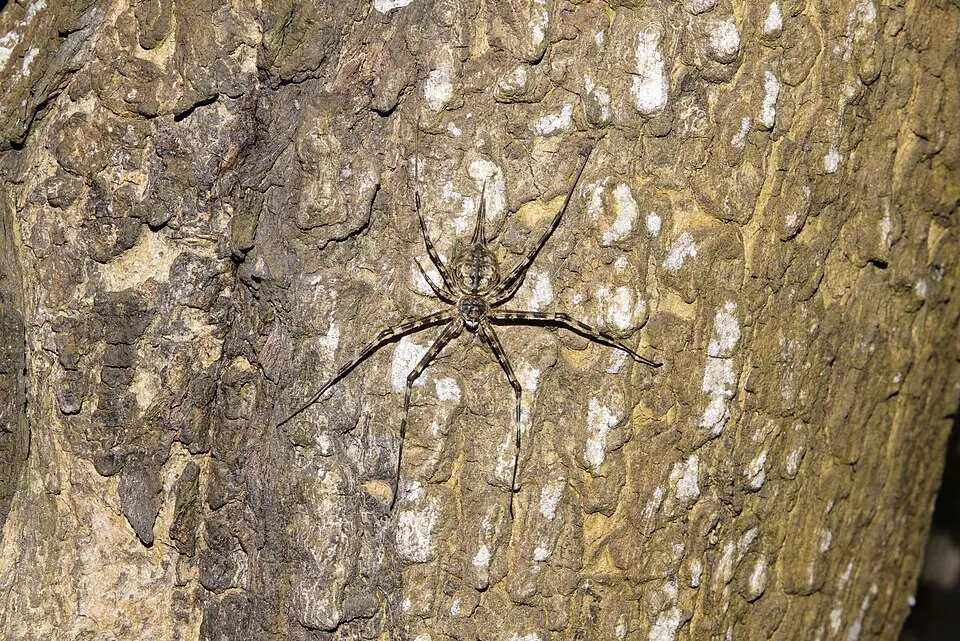
Hersiliidae
Two-Tailed Spider Identification Australia: Hersiliidae
Flat, bark-camouflaged hunter with two extremely long rear spinnerets, sprawling legs and rapid movement across Australian tree trunks.
Usually low riskAbout the Two-tailed spider
Two-tailed spiders are long-spinneret bark spiders in the family Hersiliidae. The apparent tails are not tails or stings: they are the greatly elongated rear spinnerets used to produce silk. A likely Australian identification combines those paired projections with a small, very flat grey-brown body, long sprawling legs and a tree-trunk or branch setting. These spiders do not sit in a large capture web. They camouflage against bark, leave fine silk lines over the surface and rush toward prey that contacts the silk. Photograph the rear of the abdomen and the whole spider on its substrate; a distant image of a flat brown spider is not enough for a family-level conclusion.
How to identify a two-tailed spider
The decisive feature is the pair of extremely elongated posterior lateral spinnerets. They project from the rear of the abdomen like two narrow tails and may approach the length of the abdomen. Confirm that they are paired silk organs rather than a pointed abdomen, shadow or the last pair of legs. The body is flattened and usually grey-brown, with mottling that breaks up its outline against bark. The legs spread widely around the body; Green Adelaide notes that the third leg pair is much shorter than the others. Body length is measured without the legs and spinnerets: its guide gives males up to about 8 mm and females up to about 20 mm.
Clues that are not enough on their own
- A flat grey or brown spider without a clear view of the rear spinnerets
- Fast movement on a wall or tree, which several hunting families share
- Two apparent points caused by legs, shadows or a tapered abdomen
- Matching bark pattern or colour to one named online photograph
Colour, sex and life-stage variation
Australia has two hersiliid genera, Hersilia and Tamopsis, and numerous species, so a family identification is more realistic than choosing a species from an ordinary photograph. Size, mottling, spinneret proportions and body shape vary between species, sexes and life stages. Females may be larger and fuller-bodied, while juveniles can be extremely small and difficult to notice. The hero photograph on this page is an exact-family Hersiliidae specimen photographed in Kozhikode district, Kerala, India. It demonstrates the long spinnerets and flat build, but its pattern and proportions must not be presented as an Australian species template.
Behaviour, web and retreat
Two-tailed spiders are active bark hunters. They do not make an orb, sheet or messy retreat web to trap insects. Instead, they lay fine silk lines across the tree surface and wait in camouflage. When an insect contacts the silk, the spider runs rapidly toward it and circles or moves around the prey while the long spinnerets apply immobilising silk. The spinnerets are therefore functional silk-delivery organs, not defensive tails. Speed is also a survival strategy: a disturbed spider can dart around the far side of a trunk before an observer obtains a clear photograph. Egg sacs may be attached to bark or suspended from vegetation, but an egg sac should never be opened for identification.
Australian distribution
The Australian Museum recognises Hersiliidae as the two-tailed-spider family in the Australian fauna. Australasian Arachnology describes Australian long-spinneret bark spiders from tropical and subtropical areas and across much of the continent where trees occur, while excluding the dry interior from its broad habitat account. The page state filters are therefore only a family-level guide, not proof that any one species occurs throughout each state. Record the exact region, tree type, date and photographs because genus and species ranges differ and Tasmania is not included in the current profile range.
What to do if you find one
Leave the spider on its tree when practical. It is a camouflaged insect hunter and its fine silk lines do not need to be removed. To document it, first photograph the full trunk setting, then take close views from above and behind that show both long spinnerets without touching the spider. Use side lighting carefully; reflected guide threads can reveal where the spider is sitting. If it reaches an exterior wall, guide it toward nearby bark with a container and card rather than handling it. After a suspected bite, follow current Australian health advice and base urgency on symptoms, not on an uncertain photo match.
Compare with similar spiders
Use body shape, web or retreat, location and behaviour together before settling on a likely match.
- Flattened bark spider — Flattened bark spider - also rests flat against trunks, but it lacks the pair of extremely elongated tail-like spinnerets. Confirm the rear of the abdomen before using the two-tailed name.
- Wall spider / baseboard spider — Wall spider / baseboard spider - usually much smaller and associated with walls or crevices. It may look flat, but its spinnerets are not nearly abdomen-length and it does not have the same long-legged bark-running build.
- Huntsman spider — Huntsman spider - has a broad flattened body and sideways-spreading legs, but is usually heavier-bodied and has ordinary short spinnerets. The huntsman stance alone is not enough to identify Hersiliidae.
- Long-spinneret ground spider — Long-spinneret ground spider - may show visible spinnerets, but it is primarily a ground or litter hunter with a different body shape. Two-tailed spiders have a flat bark-adapted body and a uniquely exaggerated paired rear projection.
Sources for this profile
These accessible authoritative sources support the identification and bite-safety context on this page.
- Green Adelaide: Creature Features Volume II
- Australasian Arachnology: Hersiliidae
- Australian Museum: Classifying spiders
- healthdirect: Spider bites
Profile review
Published by Spider Identifier Australia. Last factual review: 10 August 2026.
Quick identification
- Two extremely long posterior spinnerets projecting from the abdomen
- Flat grey or brown body patterned like bark or lichen
- Long sprawling legs, with the third pair noticeably shorter
- Very fast running over a tree trunk or branch when disturbed
- Fine guide threads on bark but no large prey-catching web
What to check next
Use a sharp rear or side photograph to prove that the two projections are spinnerets attached to the abdomen. Then confirm a flat bark-dwelling body and long uneven leg pairs; do not attempt a genus or species identification from colour alone.
When to seek medical help
Two-tailed spiders are not among the Australian spiders highlighted by healthdirect as medically dangerous. For a suspected bite, wash the area and use a wrapped cold pack for local discomfort. Seek medical advice if pain is severe, symptoms persist or worsen, swelling or itching increases, or you are worried. Call 000 for breathing difficulty, collapse or other signs of anaphylaxis.
Where it is usually seen
Tree trunks and branches, especially rough or patterned bark on eucalypts, in gardens, parks, woodland and forest. They may also be noticed on logs, fences or exterior walls close to trees, but Australian species are principally bark dwellers.