Spider Identifier AustraliaBrowse spiders
Swift ground spider

Gnaphosidae (ground spiders)

Swift Ground Spider Identification Australia: Gnaphosidae

A fast ground hunter with no capture web, usually recognised by two separated cylindrical spinnerets and angular rear middle eyes.

Usually low risk

About the Swift ground spider

Swift ground spider is a useful descriptive name for the family Gnaphosidae, but it is not a species name and not every fast spider on a floor belongs to this family. Australian gnaphosids are mostly ground-level hunters found in litter, beneath bark, under rocks and sometimes wandering through buildings. Colour ranges from charcoal grey to reddish or pinkish brown, so colour and speed are weak clues by themselves. The most useful family-level evidence is at the rear of the spider: a pair of large cylindrical anterior spinnerets, separated from each other, combined with angular or oval rear middle eyes. A sharp dorsal photograph may support Gnaphosidae; genus or species identification usually needs finer anatomy.

How to identify a swift ground spider (Gnaphosidae)

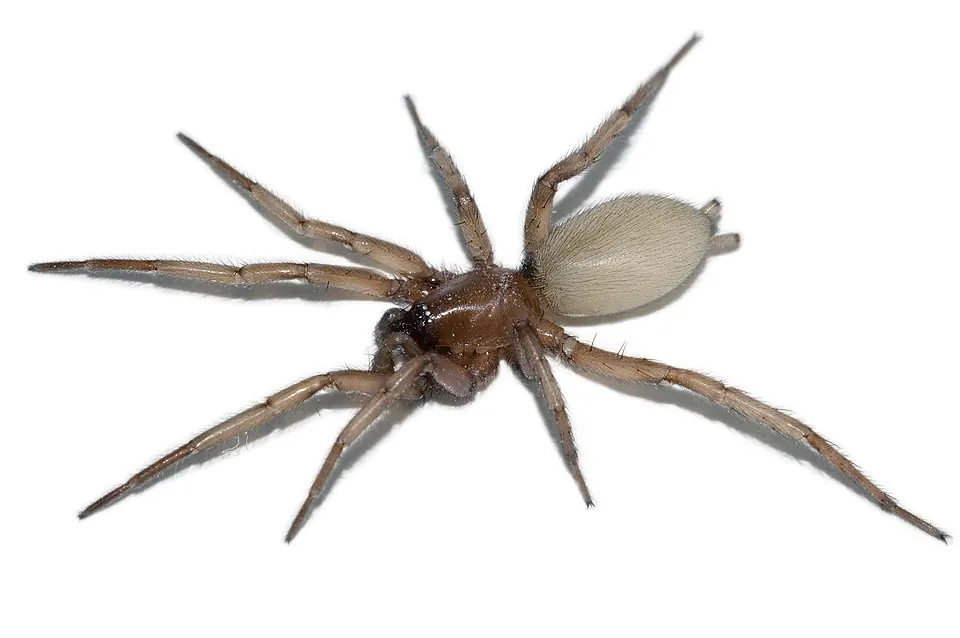
Start at the rear of the abdomen. Gnaphosids typically have a stout pair of cylindrical anterior lateral spinnerets that project enough to be visible from above and are separated rather than touching. The middle eyes in the rear row are commonly oval, angular or irregular instead of round; they may look pale or silvery in a macro image. Most family members have eight small eyes in two rows, a low oval to elongated abdomen and legs suited to running, but body shape is diverse. The Australian genus Hemicloea includes remarkably flattened spiders adapted to narrow spaces beneath bark and rocks, while other genera look more conventionally oval. A global family guide gives a broad adult body-length range of roughly 3–17 mm. These characters identify a family, not a single species. Spinnerets must be distinguished from a pale abdominal tip, and ordinary phone photographs often cannot resolve the rear middle eyes.

Clues that are not enough on their own

  • Fast running by itself, because many unrelated ground and wall hunters sprint when exposed
  • A dark brown, grey or black body without a clear view of spinnerets and eyes
  • Being found on a floor, beneath a rock or in leaf litter, all of which are shared habitats
  • Absence of a capture web alone, because wolf spiders, huntsmans, white-tailed spiders and swift spiders also hunt without one

Colour, sex and life-stage variation

There is no single swift-ground-spider colour pattern. Australian Museum describes the family from charcoal grey through pinkish brown; some Anzacia have shiny iridescent hairs. Individuals may be plain, striped, mottled or glossy, and the abdomen can appear pale after feeding or before moulting. Males may be slimmer and have enlarged pedipalps, while juveniles are smaller and may lack the proportions expected from an adult photograph. The hero image is a licensed exact-family Gnaphosidae specimen photographed in Spain. It clearly shows the general running body and paired spinnerets, but it is not evidence of an Australian locality, genus or universal colour pattern.

Behaviour, web and retreat

Most Australian ground spiders are vagrant arthropod hunters, especially active across litter, soil and bark rather than stationed in a prey-catching web. Speed is useful behavioural context but not a diagnostic feature: wolf spiders, white-tailed spiders, corinnid swift spiders and many juveniles also run rapidly. Gnaphosids use silk without building an orb or tangled capture net. Many shelter by day in a small silken sac beneath an object or inside a crevice, and specialised family members use very different retreats. Australian Museum describes an inland sand-dune slit spider that waits in a horizontal burrow opening, while flattened Hemicloea exploit narrow spaces beneath bark and stone. Finding silk beside a resting spider therefore does not contradict a ground-spider identification; the question is whether it is a retreat or a prey-catching web.

Australian distribution

Gnaphosidae is recorded Australia-wide. Australian Museum describes members from rainforest to desert and notes that they are especially common in forest and woodland litter and beneath bark. The Australian Faunal Directory recognises Gnaphosidae as an Australian family, while Atlas of Living Australia brings together specimen and occurrence records under the same taxon concept. The all-state filter on this guide reflects the documented family range, not an assertion that every genus or species occurs in every state. A locality, habitat photograph and sharp anatomical views are essential if a record is to be narrowed below family level.

What to do if you find one

Leave the spider where it is when practical and photograph before attempting relocation. Use a torch from the side to show the spinnerets without flash glare, then take a dorsal image that includes the eyes and abdomen tip. Measure body length from the front of the carapace to the abdomen tip, excluding legs and projecting spinnerets. If it must be moved indoors, place a clear container over it, slide stiff paper underneath and release it into sheltered litter or beneath loose cover close to the building. Do not pin, squeeze or turn a live spider over for identification. A spider found near a skin mark is not proof that it caused the mark; respond to symptoms and current Australian health guidance.

Compare with similar spiders

Use body shape, web or retreat, location and behaviour together before settling on a likely match.

  • White-tailed spider — White-tailed spider - usually has a more cigar-shaped abdomen and often a pale tip, but colour and the white mark vary. Check the entire rear end and eye arrangement rather than treating any dark indoor runner as Lampona.
  • Wolf spider — Wolf spider - usually shows a distinctive eye pattern with two conspicuously large forward-facing eyes and may produce strong eyeshine. Gnaphosids instead rely more heavily on the separated cylindrical spinnerets and angular rear middle eyes.
  • Orange-legged swift spider — Orange-legged swift spider - Nyssus coloripes is a corinnid, not a gnaphosid. Orange or amber front legs and contrasting black-and-white markings support Nyssus; a plain runner without those colours needs structural checks.
  • Long-spinneret ground spider — Long-spinneret ground spider - this guide covers a different ground-hunting group whose spinnerets are conspicuously elongated. Typical Gnaphosidae have stout separated cylinders, but family boundaries should remain cautious in a blurry rear view.

Sources for this profile

These accessible authoritative sources support the identification and bite-safety context on this page.

Profile review

Published by Spider Identifier Australia. Last factual review: 10 August 2026.

Quick identification

  • Two stout cylindrical spinnerets visible at the rear, usually separated by about their own width
  • Eight eyes in two rows, with the rear middle pair commonly angular, oval or silvery rather than round
  • Usually a low, elongated or oval ground-hunting body, though the family includes strongly flattened forms
  • Runs over litter, soil, bark or floors instead of waiting in an orb, lace or tangled capture web
  • Often charcoal, grey, reddish brown or pinkish brown; some Australian genera have shiny or iridescent hairs

What to check next

Photograph the spider from directly above and include the whole abdomen tip so the paired spinnerets can be assessed. Add a close rear view, a clear eye photograph and a ruler beside the spider without touching it. Record whether it was running or inside a small silk resting retreat. Keep the identification at family level unless diagnostic genital or other fine anatomical characters have been examined.

When to seek medical help

Gnaphosidae are not among the Australian spider groups highlighted by healthdirect as medically dangerous. Avoid handling any unidentified spider. For a suspected bite, wash the area and use a wrapped cold pack for local pain. Seek medical advice if pain, swelling or other symptoms are severe, persist or worsen. Call Triple Zero (000) for breathing difficulty, collapse or other signs of anaphylaxis.

Where it is usually seen

Leaf litter, soil surface, beneath rocks and logs, under loose bark, garden beds, woodland and forest floors, arid ground and sheltered floors or sheds. Australian Museum records the family across Australia from rainforest to desert.

Still not sure?

Compare this spider with more clues

Spider lookalikes can be close. Compare size, web, hiding place and state before handling anything.