Ariadna and related segestriid spiders
Tube-Web Spider Identification Australia: Ariadna Guide
Small Australian tube-web hunter with a circular silk retreat, radiating signal lines, six eyes and the first three leg pairs directed forward.
Usually low riskTube-dwelling spiders on this page are the araneomorph tube-web spiders of the family Segestriidae, especially Australian Ariadna—not every Australian spider that happens to live in a tube. A useful field identification combines a narrow circular silk-lined retreat, radiating signal threads, a long-bodied spider with six eyes, and an unusual resting stance in which the first three leg pairs point forward while only the fourth pair points back. The web is usually easier to document than the spider. Do not probe a silk tube: funnel-web, trapdoor and other unrelated spiders also occupy holes or retreats, and species-level Ariadna identification often needs microscopic characters.
Quick identification
- Circular silk-lined tube, often about 5 cm long with an opening around 5–10 mm across
- Several non-sticky silk signal lines or short spurs radiating from the entrance
- First, second and third leg pairs directed forward at rest; only the fourth pair points back
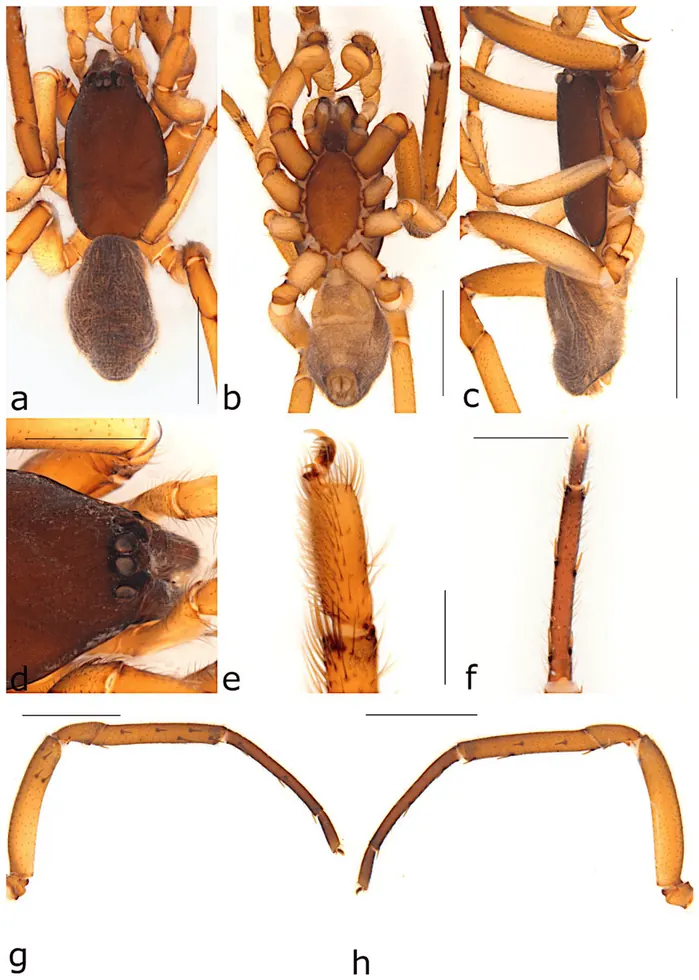
- Six eyes and an elongated body, both best checked in a sharp macro photograph
- Retreat in bark, a borer hole, log, rock crack or small ground crevice rather than an orb web
What to check next
Photograph the tube opening, radiating lines and surrounding substrate before attempting a spider identification. If the occupant appears, take a dorsal and front-oblique macro view that shows the six-eye group and three forward leg pairs. Record body length without the legs and exact locality. Never insert a stick, finger or insect into the tube to force the spider out.
When to seek medical help
Australian segestriid tube-web spiders are not among the spiders highlighted by healthdirect as medically dangerous, but an uncertain dark spider in a silk-lined ground retreat must not be assumed harmless. Avoid handling. For a suspected bite from a possible funnel-web spider, call Triple Zero (000), keep the person still and use pressure immobilisation if trained. For other suspected spider bites, follow current healthdirect guidance and seek urgent help for severe or worsening symptoms, breathing difficulty or collapse.
Where it is usually seen
Silk tubes in bark crevices, logs, old borer holes, cracks in rock and small ground cavities. The retreat may occur from arid South Australian rock habitat to temperate forest and island sites, depending on species. The tube and its radiating lines are part of the spider’s hunting system and should be left intact.