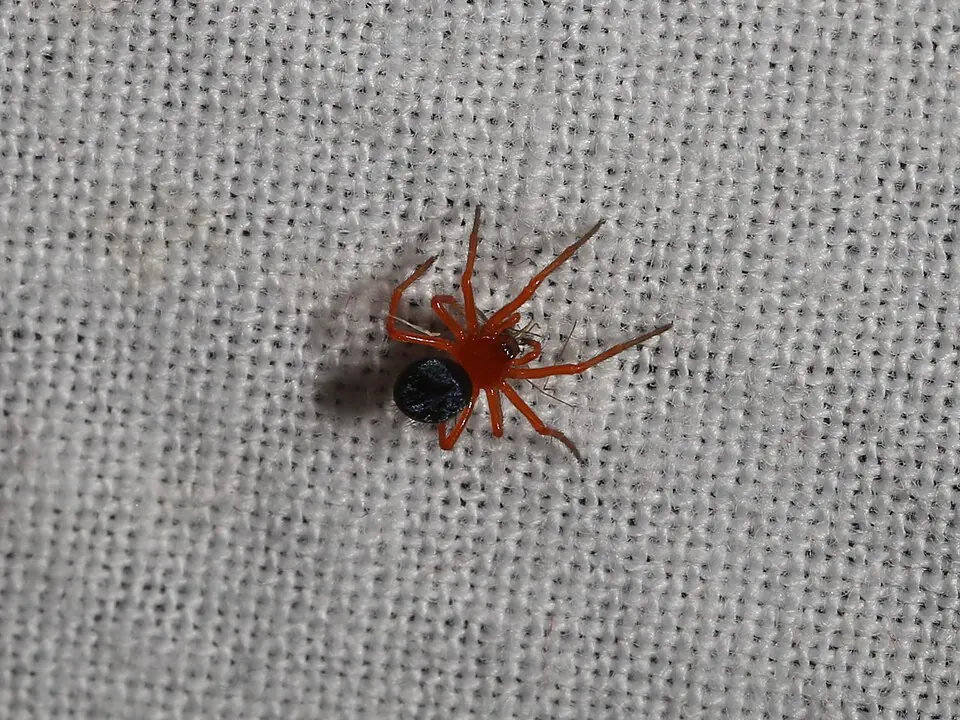
Nicodamus peregrinus and similar species
Red and Black Spider Identification in Australia
Red-bodied and black-abdomen spider often found under bark, logs or in leaf litter.
Usually low riskAbout the Red and black spider
Red and black spiders can trigger concern because of the colour contrast, but many are not redbacks and need shape, web and hiding-place clues checked. A red front body with a darker abdomen under bark, logs or leaf litter points toward a ground-dwelling comparison, whereas a redback is normally assessed with its rounded abdomen and messy web. Do not handle either spider to settle a photo identification.
Exact-species specimen views
These licensed exact-taxon photographs show useful anatomy and variation. Use each caption for record and image context; no single image set represents every colour, posture or habitat.


How to identify a Red and black spider without overcalling a redback
The Red and black spider page is deliberately a cautious visual entry point. The strongest named example is Nicodamus peregrinus, an accepted species in the small Australian family Nicodamidae, but the common colour pattern is shared by several related red-and-black spiders. A likely N. peregrinus has a red to orange-red cephalothorax and legs, a dark black or blue-black abdomen and a compact araneomorph body. The front body is usually more useful than the colour label: look for a small, ground-level spider whose legs and palps carry red and black contrast rather than a glossy black redback body with a conspicuous abdominal stripe. The spider is often found beneath loose bark, fallen wood, stones or leaf litter, where a few sparse, tangled sheet-like threads may cross a sheltered surface. A male may be encountered walking rather than sitting in a web. That combination supports a Nicodamus comparison, not a confirmed species name from a phone photograph. Other Nicodamidae genera can look extremely similar, and older sources may use former combinations such as Centropelma bicolor, Theridion peregrinum or Ozaleus tarandus. Use the current World Spider Catalog name when a formal record is needed, keep the broader red-and-black label when adult structures and locality do not support a species call, and never handle the spider or lift bark simply to expose its underside.
Clues that are not enough on their own
- Red and black colour by itself, because several Nicodamidae and unrelated spiders share the contrast
- Any red mark treated as proof of a redback, even when the body is a small ground hunter under bark
- A dark abdomen assumed to be black in all light, because blue-black, brown-black and flash reflections overlap
- A spider found in a garden called Nicodamus without checking the web, body proportions and broad locality
- No visible web taken as proof of a wandering male, because a sparse sheet may be hidden under cover or out of frame
- A red cephalothorax treated as a unique species mark when related red-and-black genera can show the same impression
- An egg sac or silk patch named from a search result when the adult spider and its supporting structure were not documented
- A coin or match-head size estimate that includes legs, perspective or a gravid abdomen
- A common name, old label or online photograph copied without checking the accepted taxon and licence context
Colour, sex and life-stage variation
Sex, maturity and light change the appearance substantially. Natural-history accounts commonly place adult males in the high single-digit millimetre range and females around the low teens, but the Lucid Central family treatment uses a broader 4–8 mm total-length field guide range for Nicodamidae. These figures are not interchangeable: body length excludes legs, and a close phone image can make a small spider appear much larger. Males are often slimmer and longer-legged, with a narrower abdomen and more mobile behaviour while searching for females. Females can look heavier-bodied and remain under bark or beside a sparse sheet. Freshly moulted spiders may look glossy or pale, while dust, soil, shade and flash can turn red-orange into copper, brown or almost black. The abdomen may read black, charcoal or deep blue-black, and the contrast between red legs and dark joints is not fixed. Juveniles lack the final adult proportions and reproductive structures. Related Nicodamus, Ambicodamus, Durodamus, Litodamus and other genera add genuine taxonomic overlap; a red front body is therefore supporting evidence only. Do not reject a possible Red and black spider because one leg is hidden, the abdomen is dull or a male lacks the fuller female outline.
Behaviour, web and retreat
The usual setting is close to the ground. A female may sit beneath loose bark, a fallen log, stone or garden debris, with sparse irregular threads or a small sheet web attached to the shelter. The web is not a large orb and may be almost invisible until side light catches it. Australian natural-history accounts describe red-and-black nicodamids using sheltered webbing at the base of trunks or in similar positions, with the spider moving along the threads rather than displaying in an open circular web. A mature male is more likely to be noticed wandering across leaf litter or a wall while searching for a mate. Descriptions of Nicodamus behaviour report foreleg waving and palp tapping during walking or courtship; a short video can support the observation, but a still image cannot recover movement that was not seen. Older accounts also describe a pale, fluffy, flattened egg sac hidden under cover. Treat the sac as life-history context, not as a species key: several spiders use white silk sacs in protected places, and a sac without its maker should remain unidentified. Record the underside of the bark, the web attachment, the nearby leaf litter and the date without turning over the refuge or disturbing a sac.
Australian distribution
The World Spider Catalog lists Nicodamus peregrinus as accepted in Australia with Queensland, South Australia, New South Wales, the Australian Capital Territory and Victoria documented on the species entry. Lucid Central shows the wider Nicodamidae family across much of Australia and includes several other red-and-black genera, so a state label is not enough to separate them. The page therefore keeps the state filters broad but treats Tasmania, Western Australia and the Northern Territory as prompts for a careful family-level review rather than automatic N. peregrinus range expansion. Eastern and southern Australian woodland, open eucalyptus forest, temperate or tropical forest edges, semi-arid shelter and suburban gardens can all produce a red-and-black nicodamid record. Locality, host cover, season and web placement help an expert compare candidates, yet the absence of a web or a redback-like mark does not establish a species. Keep the exact locality private when a record could expose a sensitive habitat, and check the current AFD and WSC entries when older images use Centropelma or another historical name. A photograph from Melbourne, Sydney, Brisbane or Adelaide is useful context, not a substitute for adult morphology.
What to do if you find one
Leave the spider and its shelter in place. Do not lift bark, roll a log, prise apart stones or place a ruler under the animal to obtain a cleaner view. From a safe angle, photograph the whole refuge first, then a dorsal image that shows the front body and abdomen, and a wider frame with the plant, log or ground surface. A short video may capture walking or foreleg waving without provoking the spider. Keep children and pets away from loose timber and wear closed shoes and gloves before gardening or moving stored material; gloves do not make handling an unidentified spider safe. Red and black spiders are generally regarded as low risk to people, but a photograph cannot rule out a redback, another medically significant spider or an unrelated lookalike. For a suspected bite, wash the site and use a wrapped cold pack for pain or swelling. Seek medical advice for severe or persistent pain, spreading symptoms, breathing difficulty, collapse, a significant allergic reaction or uncertainty about the spider; call 000 for an emergency and use the Poisons Information Centre on 13 11 26 for advice. If a large black spider or funnel-web-type animal could be involved, use the urgent funnel-web pathway rather than relying on the colour label.
Compare with similar spiders
Use body shape, web or retreat, location and behaviour together before settling on a likely match.
- Redback spider — Redback spider - Latrodectus hasselti is usually a glossy black or dark brown theridiid in a messy tangle web, often with a red or orange dorsal stripe and an underside hourglass. The web, rounded abdomen and safety context matter more than seeing one red mark.
- Slater-eating spider / woodlouse hunter — Slater-eating spider / woodlouse hunter - a ground-running hunter can be red or orange at the front and dark behind, but body proportions, fang structure and behaviour differ. Use the broader comparison when the spider is active on a wall or floor and no Nicodamidae shelter or sparse web is visible.
- Ant-eating spider — Ant-eating spider - Zodarion and other ant hunters can show dark-and-red contrast and a small wandering body. Ant association, a narrower build or a different eye and leg pattern should keep the result at comparison level.
- Spotted ground spider — Spotted ground spider - ground-dwelling gnaphosids and related hunters can be dark, reddish or patterned under bark and in leaf litter. A no-web setting is shared, so do not force Nicodamus without the front-body pattern and locality context.
Sources for this profile
These accessible authoritative sources support the identification and bite-safety context on this page.
- Australian Faunal Directory: Nicodamus peregrinus
- Atlas of Living Australia: Nicodamus peregrinus
- World Spider Catalog: Nicodamus peregrinus
- Lucid Central: Nicodamidae and Nicodamus peregrinus
- Lucid Central: Nicodamidae diagnostic PDF
- Queensland Museum: Spiders of Brisbane
- Royal Society of South Australia: Riverlands and Murraylands natural history
- Australian Museum: Egg sacs, spiderlings and dispersal
- Wikimedia Commons: exact Nicodamus peregrinus photograph
- Wikimedia Commons: exact Nicodamus peregrinus second photograph
- healthdirect: Spider bites
Profile review
Published by Spider Identifier Australia. Last factual review: 14 August 2026.
Quick identification
- Red body with darker abdomen
- Often under bark or logs
- Not the same shape as a redback
- Usually seen wandering or under cover
What to check next
Compare with redback clues: redbacks are usually in a messy web with a rounded dark body and red abdominal mark.
When to seek medical help
Seek advice for severe pain, allergic symptoms or if redback cannot be ruled out after a bite.
Where it is usually seen
Bark, logs, leaf litter, garden beds and sheltered outdoor spaces.