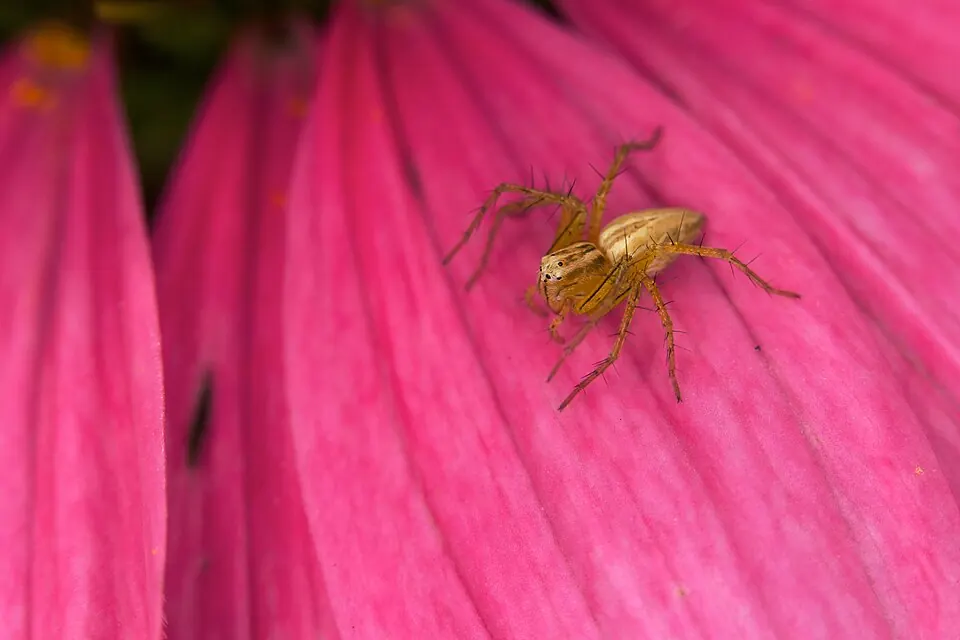
Oxyopes elegans
Elegant Lynx Spider Identification in Australia
Slender, spiny-legged Australian lynx spider with striped body, sharp vision and a foliage-hunting lifestyle in grass and shrubs.
Usually low riskAbout the Elegant lynx spider
Elegant lynx spider is the accepted common-name match for Oxyopes elegans, a small roving hunter recorded especially from Queensland and New South Wales. Look for a slim body, long spiny legs and a spider that moves or waits on grass, leaves, flowers and shrubs rather than building a prey-catching web. A photograph can suggest the lynx-spider group, but the exact species needs the front-leg, head-stripe and adult anatomy clues checked together.
How to identify Oxyopes elegans cautiously
Start with the lynx-spider body plan: an elongated abdomen, long legs armed with obvious spines and a high, forward-facing eye field suited to visual hunting. The most useful field clues for Oxyopes elegans are the slim 5–7 mm body, longitudinal head and abdomen pattern, and black lines along the inner sides of the front legs. Head-side stripe proportions and the adult palp or epigyne are more reliable than colour alone. Oxyopes gracilipes can overlap in appearance and may have broader side head lines; O. variabilis is a further comparison when the front-leg undersides look plain and furry. The 2017 Australian revision also corrected a mixed historical type series and separated O. godeffroyi, so an old label or one online photograph is not proof of species identity.
Clues that are not enough on their own
- Green, brown or yellow colour by itself
- Being found on a flower, in grass or in a garden
- A single side or dorsal photograph with no front legs or eyes
- No visible web treated as unique to this species
- Queensland or New South Wales locality alone
- A labelled online image used as a template for every lynx spider
Colour, sex and life-stage variation
Field notes report females at about 7 mm body length and males about 5 mm; females are fuller while mature males are slimmer and leggier. Juveniles, freshly moulted spiders, wear and lighting can soften or exaggerate the stripe pattern. A female may place a flat oval white egg sac beneath a grass blade or green leaf. These differences are normal variation, not a reason to force a species name from one image.
Behaviour, web and retreat
This is a roving or sit-and-wait foliage hunter. It watches from grass, shrubs and flowers, then pounces on insects and other arthropods, including other spiders. It does not build an orb, sheet or messy prey-catching web; silk may still appear as a dragline, retreat or egg-sac attachment. Leave a female and any pale egg sac undisturbed and photograph the plant setting from a distance.
Australian distribution
Australian Faunal Directory and the Atlas of Living Australia support Oxyopes elegans as the accepted species name. Accessible field notes place many records in coastal to inland Queensland and New South Wales, which is why the public filter remains conservative at QLD and NSW. World Spider Catalog lists additional state-level records that need specialist and specimen-level checking; locality supports a suggestion but does not prove the species. Oxyopes gracilipes and O. godeffroyi are important eastern-Australian comparisons.
What to do if you find one
Photograph the whole spider, front-leg spines and inner surfaces, head and eye field, abdomen pattern, plant and scale object without touching it. If it is indoors, use a container and stiff card only when safe, then release it into sheltered vegetation. For any bite, care for the person first and use current Australian health advice rather than trying to settle the species from a photograph.
Compare with similar spiders
Use body shape, web or retreat, location and behaviour together before settling on a likely match.
- Lynx spider — Lynx spider - use the broader Oxyopes page when the long spiny legs and foliage hunting are clear but the exact front-leg and head-stripe details are not.
- Flower spider / crab spider — Oxyopes gracilipes - can overlap in eastern vegetation; broader side head lines and adult anatomy may separate it, so do not decide from colour alone.
- Garden jumping spider — Oxyopes variabilis - compare the front-leg underside and head pattern; plain furry leg undersides weaken an O. elegans suggestion.
- Green crab spider — Flower or crab spider - a foliage setting overlaps, but crab spiders have a different stance and leg proportions; do not replace a lynx-spider diagnosis with a flower spider from habitat alone.
Sources for this profile
These accessible authoritative sources support the identification and bite-safety context on this page.
- Australian Faunal Directory: Oxyopes elegans
- Atlas of Living Australia: Lynx Spider
- World Spider Catalog: Oxyopes elegans
- Baehr et al. 2017: Australian Oxyopes revision
- Australian Museum: Lynx Spider
- Field of Mars Environmental Education Centre: Lynx spider factsheet
- Wikimedia Commons: Oxyopes elegans photograph and licence
- healthdirect: Spider bites
Profile review
Published by Spider Identifier Australia. Last factual review: 13 August 2026.
Quick identification
- Small, slim 5–7 mm lynx spider with long legs and conspicuous spines
- Black lines on the inner surfaces of the front legs can support Oxyopes elegans; check the whole spider
- Longitudinal head and abdomen striping, with brown, yellow, white or black patterning
- Roving foliage or long-grass hunter with no capture web; a pale oval egg sac may be tucked under a leaf
What to check next
Check the front-leg spines and black inner lines, the proportions of the head stripes, the abdominal pattern and the no-capture-web hunting setting. Compare Oxyopes gracilipes, O. variabilis and the broad lynx-spider page when these details are missing.
When to seek medical help
Oxyopes elegans is not known as a medically significant Australian spider. Do not handle it; after a bite, follow current healthdirect advice and seek care for severe or spreading symptoms, allergic signs, infection or uncertainty that a funnel-web or mouse spider may be involved.
Where it is usually seen
Long grass, shrubs, flowers, forest understorey, heath, suburban gardens and vegetated edges from coastal to inland Queensland and New South Wales records.