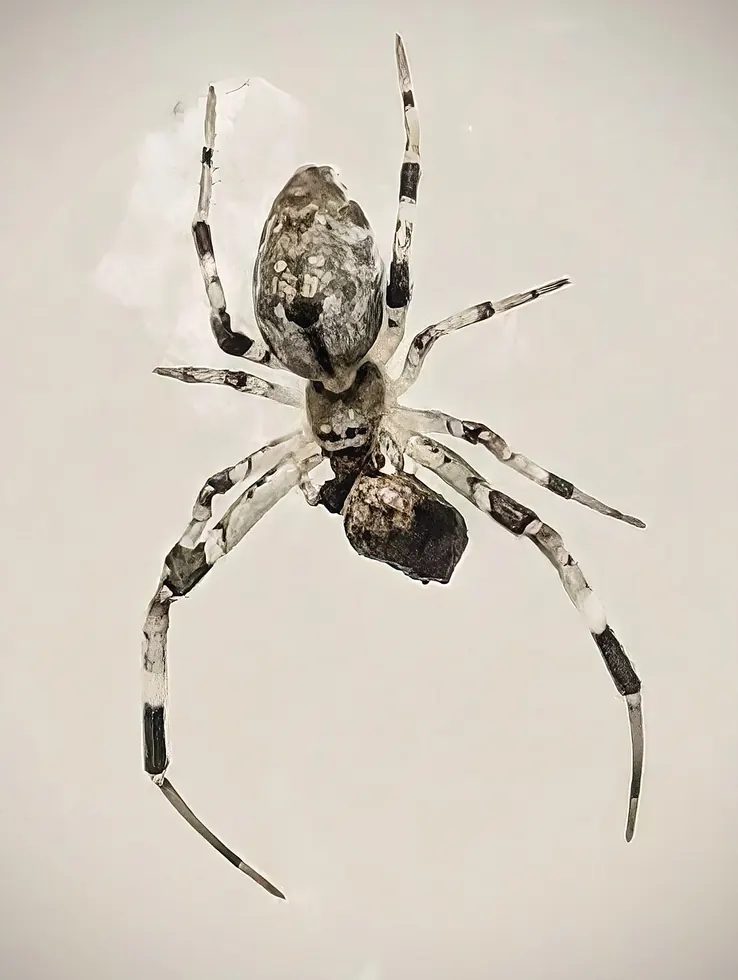
Zosis geniculata
Ninja-Star Ceiling Spider Identification in Australia
Small grey, white and brown hackled orb-weaver with banded legs, a humped female abdomen and distinctive pink star-shaped egg sacs in sheltered webs.
No venom glands; medically low riskThe ninja-star ceiling spider, Zosis geniculata, is a small hackled orb-weaver found in sheltered parts of Australian buildings, especially in subtropical and tropical areas. It is best recognised by a combination of characters: an adult only a few millimetres long, black-grey-white banded legs, a pale mottled abdomen that is humped in females, a damaged-looking cribellate orb web and, when present, a flat pink to light-purple egg sac with five to eight pointed corners. The “ninja star” is the egg sac, not the spider’s body. A ceiling location or messy web alone is not enough for a species identification. The World Spider Catalog uses the accepted feminine spelling Z. geniculata because Zosis is feminine; the Australian Faunal Directory and some Australian Museum captions still display the historical spelling Z. geniculatus. Both spellings refer to this same species in those sources.
Quick identification
- Adult female about 6.3–8.4 mm long; adult male about 4–6.3 mm
- Grey to reddish-brown front body, pale mottled abdomen and strongly black-grey-white banded legs
- Female abdomen elongated and humped near the front; male smaller with a smoother oval abdomen
- Fine blue-grey or whitish hackled orb whose circular centre may be obscured by repairs, debris and old silk
- Pink to light-purple egg sac with five to eight pointed corners suspended in the web
What to check next
Photograph the spider from above, the whole web from the side and any egg sac separately. Measure body length without the legs. The strongest field match combines the banded adult, altered orb and pink pointed egg sac; without those features, keep the identification at Uloboridae or “small house spider”.
When to seek medical help
Zosis geniculata belongs to Uloboridae, the unusual spider family that lacks venom glands, so it cannot cause venom envenomation. That fact should not be used to identify an unknown spider from a bite, and no useful species-specific Australian bite series was found. Avoid handling it to test whether it can break skin. For a witnessed minor spider bite, healthdirect advises washing with soap and water and using a cold pack for pain. Seek medical advice if pain is severe or does not settle within a few hours, if swelling or itching worsens after 24–48 hours, or if you are worried; call the Poisons Information Centre on 13 11 26 for Australian advice. Call 000 for collapse, breathing difficulty or other signs of anaphylaxis. Treat an unidentified big black spider as a separate medical emergency, not as this species.
Where it is usually seen
Sheltered ceilings, wall junctions, verandahs, garages, sheds, under bridges and eaves, cave or rock-overhang entrances, hollow trees and other dry protected sites. Australian Museum specifically notes Brisbane and other subtropical or tropical areas and says the species may have been introduced and moved with human activity.