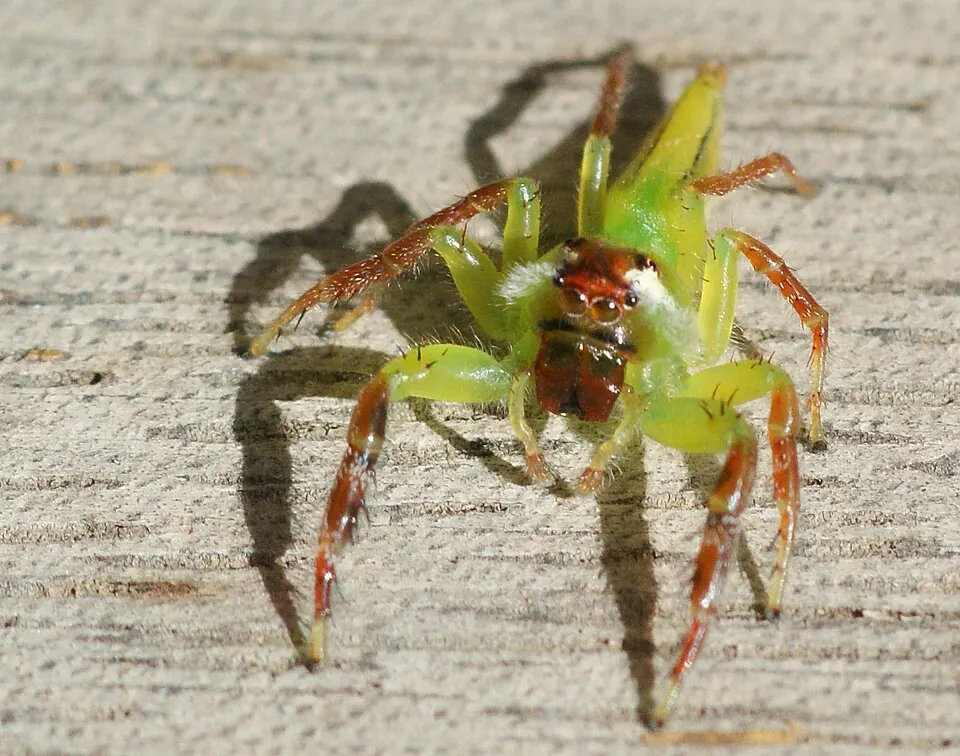
Mopsus mormon
Green Jumping Spider Identification in Australia
Large bright-green Australian jumping spider with dominant forward-facing eyes, an elongated tapering abdomen and strongly different adult male and female face patterns.
Usually low riskAbout the Green jumping spider
Australia’s Green or Northern Green Jumping Spider, Mopsus mormon, is unusually large for a jumping spider and is most convincing when several clues agree: bright green living colour, a long abdomen tapering towards the rear, two dominant front eyes and warm northern locality. Adult males carry conspicuous facial fringes and dark enlarged front-leg sections; females lack that male mask and show red-and-white patterning around the eyes. Colour alone is not enough—several Australian jumpers are green or metallic, and juvenile Mopsus can lack the finished adult pattern.
Exact-species specimen views
These licensed exact-taxon photographs show useful anatomy and variation. Use each caption for record and image context; no single image set represents every colour, posture or habitat.


How to recognise Mopsus mormon rather than any green jumper
Begin with the jumping-spider eye pattern: two huge forward eyes dominate a broad, upright face, with smaller eyes around the sides of the carapace. The Australian Museum describes Mopsus mormon as green and yellow-bodied with white tufts, while the Australian salticid key gives a 12–14 mm body, bright green living colour and an elongated abdomen that narrows rearwards. Northern Territory Government material uses a broader field range—females to 18 mm and males to 12 mm—and separates the sexes. An adult male has strong front legs with black or brown femora, a darker face and conspicuous pale facial fringes; the other legs are lighter, with green femora. A female is more evenly green, lacks the dark front-leg marks and has red-and-white patterning around the eye field. Confirm shape, face, legs, size and northern range together before using the species name.
Clues that are not enough on their own
- Bright green colour alone; Cosmophasis and several other Australian jumpers can be green or metallic
- Any spider that jumps, without checking the dominant front eyes, elongated abdomen and adult pattern
- A “small spider” estimate that includes legs or lacks a scale; Mopsus is large for Salticidae
- White facial hairs assumed to prove either sex; mature male structure and first-leg colour must also agree
- A southern postcode used to override missing anatomy when most verified records are northern
Colour, sex and life-stage variation
Sex and maturity change this spider dramatically. Females can be heavier and greener than males, with a fuller tapering abdomen. Mature males have enlarged palps, longer strong front legs and ornate facial hairs used in display. A 2025 review documented two regional adult male colour forms on the Queensland coast: a darker niger form from Cairns northward and a greener viridis form from Townsville southward. This is a useful reminder that one Brisbane photograph is not a colour template for every population. Juveniles may be paler, less hairy and less strongly sexed; freshly moulted individuals are soft and washed out, while old scales or harsh flash can shift lime green towards yellow, blue-green or grey. A swollen female abdomen may reflect feeding or egg development, not a different species.
Behaviour, web and retreat
Mopsus mormon hunts by sight in daylight. It turns its carapace to inspect movement, stalks insects or other spiders across foliage, judges distance and makes a short hydraulic jump, usually trailing a safety line. It does not build an orb, sheet or sticky capture web. Silk is still important: an individual makes a compact resting or moulting retreat between leaves, and females place and guard eggs within a denser silken chamber. Jackson’s Queensland research found unusually flexible courtship. A male uses visual leg, palp and body displays towards an adult female outside a retreat, but switches to vibration and probing on silk when she is inside. He may build alongside a subadult female, cohabit until her final moult and mate inside the joined retreat. These are reproductive signals, not aggression towards an observer.
Australian distribution
The Australian Faunal Directory accepts Mopsus mormon and records it from Queensland, the Northern Territory, New South Wales and Western Australia; the species also occurs in New Guinea. The warm-climate pattern is much stronger than a generic “Australia-wide” claim. At review time the exact Atlas of Living Australia concept returned 4,436 contributed records: 4,092 Queensland, 222 Northern Territory, 63 NSW, 47 Western Australia, five Victoria, one South Australia and six without a state. The few southern values require specimen or record-level review and are not used here to expand the established state filters. Atlas counts reflect reporting effort and mixed identification confidence, not abundance. Lizard Island Research Station provides an exact-species Great Barrier Reef field record, reinforcing tropical foliage habitat.
What to do if you find one
Let the spider continue hunting if it is outdoors. For photographs, approach slowly from the front or side and use zoom; do not pinch leaves around it or make it jump repeatedly. A face view, dorsal view and body-only scale are more useful than a close green blur. If it is indoors, open a route to nearby vegetation or place a clear container over it, slide rigid card underneath and release it onto a sheltered leafy plant close to the encounter site. Keep children and pets back while moving it and avoid bare-hand capture. Do not tear open an occupied silk retreat to check for eggs or a mate. Submit unusual southern records with precise locality, multiple angles and scale to a museum or biodiversity portal so range evidence can be assessed.
Compare with similar spiders
Use body shape, web or retreat, location and behaviour together before settling on a likely match.
- Garden jumping spider — Garden jumping spider - the site’s Opisthoncus parcedentatus profile is a smaller, mottled garden jumper without the elongated bright-green body or ornate adult male face of Mopsus. Use structure rather than garden location.
- Jumping spider — Jumping spider - choose the family-level page when the large forward eyes and stop-start visual hunting are clear but sex, range or species markings are not. This is the responsible endpoint for many juveniles.
- Peacock spider — Peacock spider - Maratus species are generally much smaller; adult males display colourful abdominal scales or flaps rather than the large green body and facial fringes of Mopsus. Females can still be difficult from poor photographs.
- White-banded house jumping spider — White-banded house jumping spider - Menemerus bivittatus is flatter, grey-brown and wall-associated, with longitudinal bands and no bright-green tapering abdomen. Indoor location alone does not distinguish them.
Sources for this profile
These accessible authoritative sources support the identification and bite-safety context on this page.
- Australian Faunal Directory: Mopsus mormon
- Atlas of Living Australia: Mopsus mormon
- Australian Museum: Jumping spiders
- Australian Museum Lizard Island Field Guide: Mopsus mormon
- Australian salticid key: Mopsus
- Peckhamia: Male colour morphs of Mopsus mormon
- healthdirect: Spider bites
Profile review
Published by Spider Identifier Australia. Last factual review: 12 August 2026.
Quick identification
- Large jumping spider with two very large forward-facing eyes and a square-fronted face
- Bright green living body with an elongated abdomen narrowing towards the rear
- Adult male has conspicuous pale side fringes or “whiskers”, a dark facial area and dark femora on the strong first legs
- Adult female lacks the male mask and dark first-leg pattern and commonly has red-and-white markings around the eye field
- Day-active on broad leaves, shrubs, trunks or garden vegetation in warm northern and eastern Australia
What to check next
Photograph the spider from above and face-on without touching it. Record body length without legs, exact locality, plant or surface and whether a silk retreat is present. A sharp face and first-leg view can establish adult sex; keep a plain green juvenile at Mopsus or jumping-spider level if the elongated body and range do not also agree.
When to seek medical help
Mopsus mormon is not listed among Australia’s medically important spiders, but any large jumping spider may bite defensively if trapped against skin. Avoid handling. For a clearly witnessed minor bite, wash with soap and water and use a wrapped cold pack. Seek medical advice if pain is severe or persists for hours, swelling or itching worsens after 24–48 hours, the wound deteriorates or you feel unwell. Call 000 for breathing difficulty, collapse or anaphylaxis. Do not use pressure immobilisation for a confidently identified jumping-spider bite; healthdirect reserves it for suspected funnel-web or mouse-spider bites.
Where it is usually seen
Broad leaves, shrubs, rainforest foliage, forest edges, garden plants, tree trunks, fences and sunlit walls in warm parts of Queensland, the Northern Territory, northern New South Wales and northern Western Australia. It may enter houses but is principally a foliage hunter.