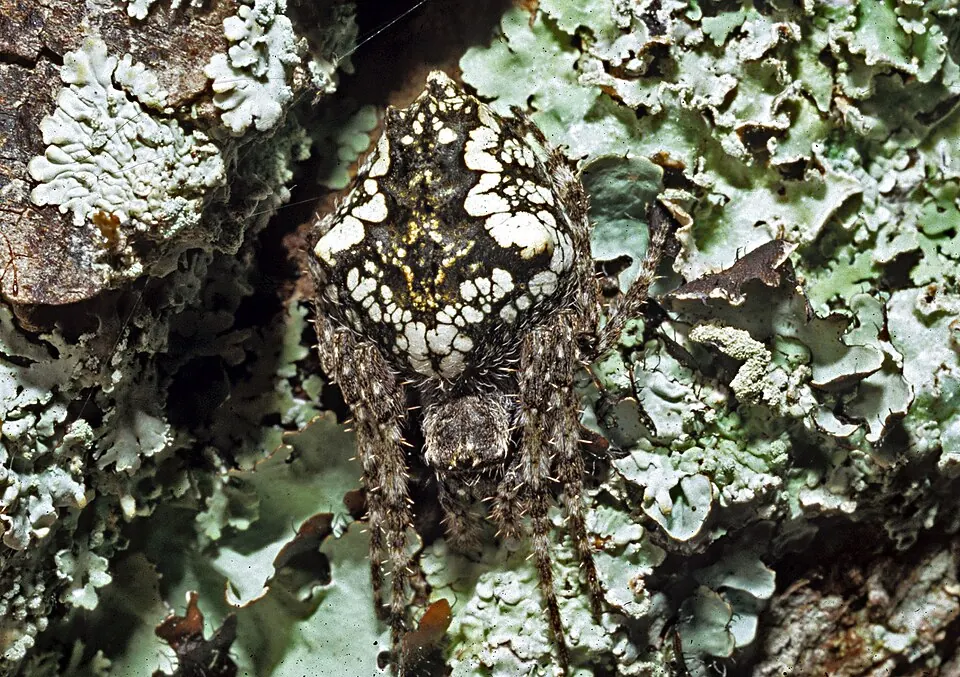
Backobourkia heroine
Heroic Orb-Weaver Spider Identification in Australia
A mottled Australian orb-weaver in the genus Backobourkia, with a robust patterned body, smaller night orb webs and a cautious lichen-spider common-name trail.
Usually low riskPhoto credit
Backobourkia heroine / lichen spider — Don Horne · CC BY 4.0.
About the Heroic orb-weaver / lichen spider
The heroic orb-weaver, also called a lichen spider or outback orb-weaver in some records, is the accepted species Backobourkia heroine in the family Araneidae. A useful field impression is a sturdy, mottled orb-weaver that builds a conventional sticky orb web at night, often lower in shrubs or understorey than the very large garden orb webs. Colour and lichen-like patterning are supporting clues only: Backobourkia overlaps with Hortophora, Salsa, Austracantha and other patterned orb-weavers, and a photograph that lacks the web, body scale or locality should remain an orb-weaver possibility rather than a confident species call.
How to identify a heroic orb-weaver cautiously
Start with the family and web. Backobourkia heroine is an araneid orb-weaver, so a complete photograph should show a rounded or robust abdomen, a compact cephalothorax and the spider’s relationship to a wheel-like web with radial lines and a sticky spiral. The Australian Museum’s Web2Spider guide separates Backobourkia heroine from the very large “garden orb” web pattern by noting smaller webs lower down in understorey or shrubby vegetation; the spider commonly hides away by day and rebuilds the web in the evening. Those web and timing clues are useful, but they are not a substitute for a specimen-level examination. A mottled brown-grey body or lichen-like camouflage can support the heroic-orb-weaver label only when the body plan, web, locality and scale agree. Keep the result at Backobourkia or Araneidae when a dorsal image is blurred, the abdomen is hidden, the spider is juvenile or the web is missing.
Clues that are not enough on their own
- Brown, grey, white or lichen-like pattern alone, because many Australian orb-weavers and bark spiders overlap
- Any round web without checking its size, slope, hub, radial density and the spider’s position
- A spider on a wall or fence, since an orb-weaver may be resting there and unrelated hunters share the surface
- An apparent body size guessed from leg span, a coin at another distance or a cropped flash photograph
- The common name “lichen spider” or “outback orb-weaver” without accepted taxonomy and locality
- A web observed in daylight, because damage, a juvenile web or a hidden spider can change the pattern
- One online photograph that omits the web, adult sex, body scale or original locality
Colour, sex and life-stage variation
Sex and life stage change the impression. The original Backobourkia revision records a documented female around 17 mm total length and smaller males in the roughly 6–15 mm range; these are specimen anchors, not a hard field limit. Females tend to look fuller-bodied, while adult males can be slimmer and proportionally leggier, with enlarged palps beside the mouth. Brown, grey, cream, white and mottled surfaces can all occur, and flash, bark, dust, moulting and background colour alter the apparent pattern. “Lichen spider” is a useful search phrase but not a diagnostic colour test. Do not transfer the appearance of one exact photograph to every Backobourkia heroine, and do not turn a familiar common name into a species identification when the locality or adult characters are missing.
Behaviour, web and retreat
This is a web-building night hunter rather than a wandering wall spider. Backobourkia heroine makes a conventional vertical or slightly sloping orb web with sticky capture silk, often in lower vegetation or an understorey gap. The spider may remain away from the web during daylight and return or rebuild after dusk. A web can be damaged by wind, rain, garden work or prey, and a spider may be hiding nearby when a photograph is taken, so “no web” means only that no web was observed. Silk retreats, a resting line and an incomplete or juvenile web should not be confused with the large wheel of an adult orb. Do not shake a shrub, pull down the web or handle the spider to obtain an underside view.
Australian distribution
World Spider Catalog lists Backobourkia heroine from mainland Australia and Norfolk Island, with records from New Caledonia and a possible New Zealand occurrence. The original genus revision places the species more strongly toward western Australia than the eastern Backobourkia brouni, but the genus is broad and state filters are not species proof. Atlas, Faunal Directory and regional records can support a locality lead, not abundance or a complete range map. Keep the exact observation locality with the photograph, and remember that a Backobourkia labelled “outback orb-weaver” online may be a different species or an unresolved genus record. A family- or genus-level answer is safer when the web, sex and adult pattern do not agree.
What to do if you find one
Leave an orb web in place where possible, especially in a garden path or shrub that can be avoided. If a spider must be moved without a bite, keep hands, children and pets away, use a wide container and stiff card and release it into sheltered vegetation; do not grab legs or wipe the web across skin. Photograph from a distance with one natural upper view, a side view, the web, substrate, a nearby scale object and broad locality. Do not publish a precise private address. If a bite occurs, focus on first aid and symptoms rather than capturing the spider for proof.
Compare with similar spiders
Use body shape, web or retreat, location and behaviour together before settling on a likely match.
- Garden orb weaver — Garden orb-weaver - Hortophora species can be larger and heavier and make conspicuous night orb webs. Web scale, abdomen outline and locality help, but a single brown or pale pattern does not separate Hortophora from Backobourkia.
- Sooty orb weaver — Sooty orb-weaver - Salsa species can be darker and patterned in orb webs. Use the body shape, web placement and current taxonomy rather than treating a dark abdomen as a diagnosis.
- Spiny spider — Spiny spider - Austracantha minax has a hard abdomen with obvious projections and often a colonial or individual orb-web setting. A smooth mottled abdomen should not be called spiny, but a partial image can hide the projections.
- Bird-dropping spider — Bird-dropping spider - Celaenia and related species use camouflage and may sit near webs or foliage. Their compact shape and egg-sac context can overlap with a mottled orb-weaver, so retain uncertainty without a clear adult view.
Sources for this profile
These accessible authoritative sources support the identification and bite-safety context on this page.
- Australian Faunal Directory: Backobourkia heroine
- World Spider Catalog: Backobourkia heroine
- World Spider Catalog: Backobourkia genus
- Framenau et al. 2010: Backobourkia systematics
- Framenau et al. 2010: Backobourkia systematics DOI
- Australian Museum Web2Spider: Backobourkia heroine web
- Fauna Portal: Backobourkia genus
- Canberra Nature Map: Backobourkia heroine
- Queensland Museum: Spiders of Brisbane
- healthdirect: Spider bites
Profile review
Published by Spider Identifier Australia. Last factual review: 14 August 2026.
Quick identification
- Robust, mottled Araneidae body with brown, grey, cream or pale patches
- A conventional vertical or slightly sloping orb web built after dusk
- Web often lower in shrubs or understorey rather than a giant exposed garden web
- Backobourkia heroine range and a full-body view support the lead, but colour alone does not prove the species
What to check next
Record the whole spider, body length separately from leg span, web position, substrate, date and broad locality. Check whether the orb web is rebuilt at night and whether the spider is a compact Backobourkia rather than a large Hortophora or a spiny Austracantha.
When to seek medical help
Backobourkia heroine is not generally treated as a medically important Australian spider. Avoid handling it or its web; for a witnessed bite, wash the area, use a wrapped cold pack and seek medical advice if pain is severe or persistent, swelling worsens or the person feels unwell. Call 000 for breathing difficulty, collapse or other signs of anaphylaxis.
Where it is usually seen
Shrubs, understorey vegetation, woodland edges, gardens, fences and other sheltered Australian sites where a smaller night orb web can be stretched between leaves or low branches. A wall or shed record is a setting clue, not a species diagnosis.