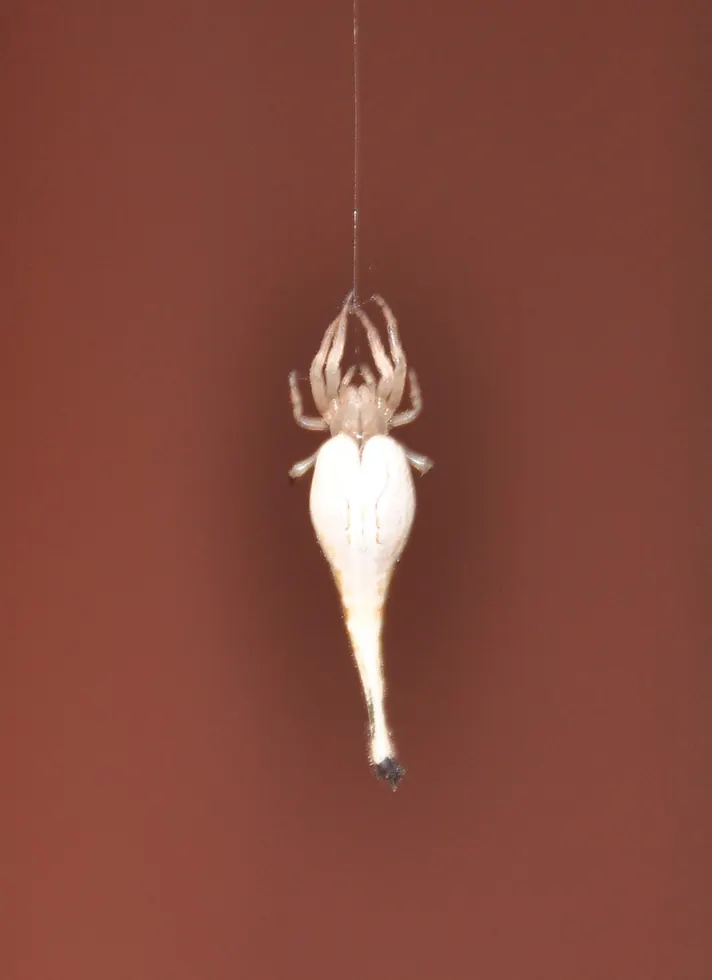
Arachnura higginsi
Scorpion-Tailed Spider Identification: A. higginsi
Distinctive endemic Australian orb-weaver whose female has a soft, flexible tail-like abdomen and sits in a sloping incomplete orb web.
Usually low risk; the tail cannot stingThe scorpion-tailed spider, Arachnura higginsi, is an Australian orb-weaver, not a scorpion or a spider–scorpion hybrid. A mature female is one of the country’s most distinctive spiders: her small front body leads into a broad abdomen with two raised “shoulders”, then narrows into a long flexible tail ending in dark soft lobes. The spinnerets lie well before the tip, proving that the tail is abdomen rather than a stinger. Females reach about 15–16 mm in body length, but the tiny 2–3 mm male has no tail and can look like an unrelated spider. Confirm a likely female using the sloping, incomplete orb web, missing upper sector, egg-sac line and documented Australian range as well as the body shape.
Quick identification
- Female abdomen has two high front shoulders and a long narrowing flexible tail
- Tail ends in dark soft lobes and has no sting; spinnerets sit nearer the abdomen’s middle
- Female commonly fawn, cream or brown; juveniles may be yellow, pink or red
- Sloping or vertical incomplete orb web with a V-shaped upper sector missing
- Woolly egg sacs may form a line through the missing sector to the female at the hub
What to check next
Photograph the female directly from above and from the side, then take a wide image of the entire web. Record body length without the legs, web diameter, locality, date, web angle and whether a line of woolly egg sacs fills the missing upper sector. Do not flick the web or touch the tail.
When to seek medical help
The soft abdominal tail has no sting, and this species is not considered medically dangerous. Avoid handling any spider. For a suspected bite, wash the area with soap and water and use a wrapped cold pack for local discomfort. Seek medical advice if pain, swelling or other symptoms are severe, persist or worsen, or if the identification is uncertain. Call Triple Zero (000) for breathing difficulty, collapse or other signs of anaphylaxis. Do not use funnel-web pressure-immobilisation first aid merely because the spider has a raised “tail”; follow current healthdirect guidance for the symptoms and spider involved.
Where it is usually seen
Bushland, woodland, waterside vegetation, shrubs, vines and occasionally urban gardens, where low foliage provides anchor points for a permanent sloping or vertical orb web. Australian records are concentrated south of about 24°S.