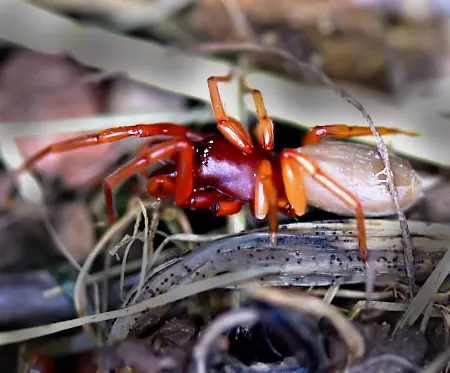
Dysdera crocata
Slater-Eating Spider Identification in Australia
Reddish spider with long forward-pointing jaws and a pale grey to yellow-brown abdomen, often found in damp sheltered places.
Usually low riskAbout the Slater-eating spider / woodlouse hunter
The slater-eating spider, or woodlouse hunter, is Dysdera crocata, an introduced European species now recorded in south-eastern Australia and Tasmania. The useful field combination is a dark red to orange cephalothorax and legs, a pale grey to yellow-brown cylindrical abdomen and disproportionately large jaws projecting forward. It hides in a silk retreat by day, emerges after dark and hunts slaters and other ground arthropods without building a prey-catching web. Those clues can support a cautious species lead, but a phone photograph still needs a whole-body view, locality and adult characters before the name is treated as certain.
How to identify Dysdera crocata cautiously
Start with the front half and the jaws. Dysdera crocata has a dark red, reddish-orange or red-brown cephalothorax and legs, a contrasting pale grey to yellow-brown abdomen and very large chelicerae held at the front of the head. Australian Museum and Museums Victoria describe the abdomen as pale and cylindrical, while Arachne records the shiny yellow-brown colour and disproportionately large chelicerae. Adult females are commonly reported around 11–15 mm in body length and males around 9–10 mm; an Australian Museum account gives roughly 14 mm for a female and 11 mm for a male. Measure the body only, not the leg span. A clear dorsal and side view, the substrate and a broad locality make a useful record, but exact identification may still require mature anatomy and expert comparison. The common name is a clue to diet, not a visual character: a spider found near one slater has not thereby been proven to be D. crocata.
Clues that are not enough on their own
- Red or orange colour alone, because lighting, moulting and substrate alter the front body
- Large jaws seen in a cropped close-up without the abdomen, legs and locality
- The word “slater” in the common name treated as proof that a spider found near a slater is D. crocata
- A body-size estimate based on leg span, a coin at a different distance or a vague “large” impression
- A damp garden, cellar or log habitat without a clear whole-body view
- No capture web treated as a species character rather than a broad hunting clue
- A night-time wandering spider assumed to be a woodlouse hunter without the red-front and pale-abdomen combination
Colour, sex and life-stage variation
Sex, maturity, feeding state and light change the appearance. Females are usually larger and fuller-bodied; males are smaller, narrower and more long-legged, with the jaws still prominent. Juveniles can be paler, less strongly contrasted and harder to separate from other ground hunters. The front body may look cherry red, orange-red, mahogany or nearly dark brown in a shaded retreat, while the abdomen can appear white-grey, cream, tan or warm yellow-brown. Flash can flatten the contrast or make the chelicerae look larger than they are. The exact-species hero photograph shown here documents D. crocata anatomy and variation; do not treat it as a template for every red-fronted ground spider. Keep the taxon at a cautious likely identification when the abdomen, jaws or adult sex cannot be seen clearly.
Behaviour, web and retreat
This is a nocturnal wandering hunter. During daylight it rests in a silk-lined sac or retreat under a log, stone, brick, paving edge, litter or other damp cover. The retreat is used for rest and moulting and, for a female, may be sealed while eggs are present. At night the spider leaves the shelter and searches on foot for slaters and other small arthropods; it does not spin an orb, funnel or messy prey-catching web. A short silk line or retreat therefore does not contradict the identification. The absence of a web is only a broad negative clue because the spider may have moved away and other wandering spiders also hunt without capture silk. Do not lift bark, turn rocks, open a retreat or provoke the large jaws for a photograph.
Australian distribution
Dysdera crocata is native to Europe and has been transported widely. Australian Museum, Museums Victoria and Australian records place the introduced species in south-eastern mainland Australia and Tasmania; the sources used here do not justify treating every state filter as a confirmed range for this one species. A locality in New South Wales, Victoria or Tasmania is a sensible search context, not proof of identity, and a garden record does not establish abundance. Preserve the date, broad locality, substrate and uncropped views with any observation. If a record falls well outside the documented south-eastern context, submit it to a museum or biodiversity-record service rather than silently extending the range from a photo resemblance.
What to do if you find one
Leave a woodlouse hunter under its shelter whenever practical: it is a small predator and normally avoids people. Wear gloves before moving timber, bricks, compost or stored garden material, and check crevices before reaching in. If an indoor spider must be relocated, keep hands, children and pets clear, place a broad container over it and slide stiff card underneath before releasing it into sheltered vegetation. Do not pinch, hold, turn over or chase it, and do not dismantle a retreat containing eggs. For a suspected bite, focus on first aid and symptoms rather than catching the spider. A useful record has an upper view, side view, nearby scale, substrate and broad location; avoid publishing a precise private address.
Compare with similar spiders
Use body shape, web or retreat, location and behaviour together before settling on a likely match.
- White-tailed spider — White-tailed spider - Lampona species are often grey or dark with a pale tail tip and a more elongated cigar-like body. They also wander without a capture web, so do not use nocturnal movement alone; compare the tail marking, body proportions and clear dorsal view.
- Yellow sac spider — Yellow sac spider - Cheiracanthium species can be pale and active on foliage or buildings and may make a silk sac. Their front body, abdomen and web retreat differ from the red-fronted, large-jawed Dysdera form; retain uncertainty when the jaws are not visible.
- Spotted ground spider — Spotted ground spider - Storena and related zodariids are ground hunters with patterned abdomens and no obvious prey web. A dark or reddish mark is not enough to separate them from Dysdera; use the cylindrical pale abdomen, jaw shape and locality together.
- Long-spinneret ground spider — Long-spinneret ground spider - ground spiders in Gnaphosidae can share the wandering, litter-dwelling habit. Visible spinnerets, body proportions and adult anatomy may be needed, so a flat or blurred photograph should remain a broad ground-hunter record.
Sources for this profile
These accessible authoritative sources support the identification and bite-safety context on this page.
- Australian Museum: Slater-eating spider
- World Spider Catalog: Dysdera crocata
- araneae.nmbe.ch: Dysdera crocata
- Australian Museum: Classifying spiders
- Australian Museum: Prey capture and feeding
- Tasmanian Spiders: Dysderidae
- NSW Environment: Spiders in Sydney
- Queensland Museum: Spiders of Brisbane
- healthdirect: Spider bites
Profile review
Published by Spider Identifier Australia. Last factual review: 28 September 2026.
Quick identification
- Reddish upper body and legs
- Pale grey or yellow-brown cylindrical abdomen
- Large forward-pointing jaws
- Often under logs, rocks, bricks, paving or damp shelter
What to check next
Check for the reddish front half, pale abdomen and damp hiding place. It hunts slaters and does not make a prey-catching web.
When to seek medical help
A bite is not usually considered dangerous, but the large jaws can be painful. Seek advice for severe pain, swelling, infection signs, allergic symptoms or uncertainty.
Where it is usually seen
Damp sheltered ground habitats, urban gardens, old bricks, paving, rocks, logs and rubbish, especially in south-eastern Australia.